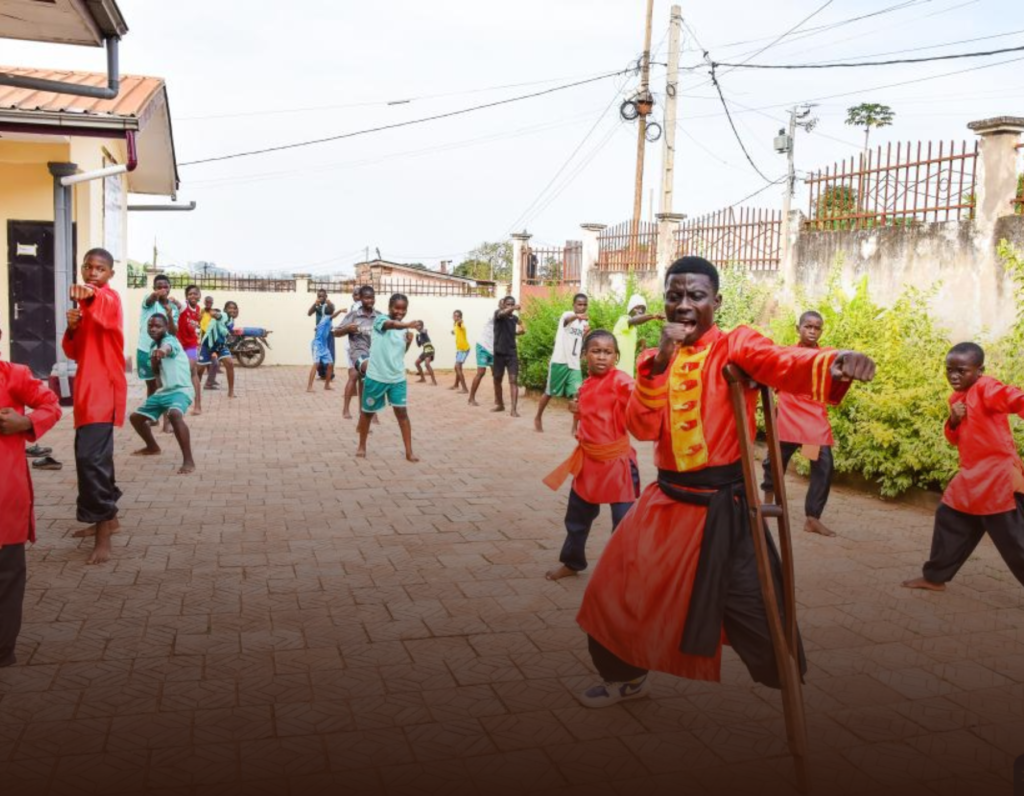
In the bustling neighbourhood of Mimboman, Yaoundé, the clatter of wooden floorboards and the sharp rhythm of disciplined movement mark a different kind of power – one rooted not just in strength, but in resilience, spirit, and shared culture. Here, 29-year-old Cameroonian martial-arts instructor Martin Mangwandjo leads a class of young learners through fluid, forceful moves, his body supported by crutches due to a congenital disability.
Mangwandjo’s journey into Chinese martial arts began with kung-fu films featuring legends like Bruce Lee and Jackie Chan and though he initially wondered whether a person with a disability could ever master the discipline, his persistence and passion transformed self-doubt into mastery. His breakthrough came when a visiting Chinese instructor, impressed by Mangwandjo’s determination, offered him personal training. That mentorship opened the way for study of both martial arts and traditional Chinese healing practices.
Today, Mangwandjo runs the Temple of the Golden Knights, a kung-fu school in Yaoundé where he trains students not just in technique, but in discipline, respect, and the philosophy behind Chinese martial arts. Through his work, he doubles as a cultural ambassador, bridging Cameroonian and Chinese traditions and challenging societal perceptions about disability and ability.
This story reflects a broader pattern of Chinese cultural influence across Africa. In Cameroon, pioneers like Fabrice Mba have long promoted Chinese martial arts and traditional medicine, offering free training and physiotherapy to young people from disadvantaged backgrounds. Their “Lotus and Water Lily” program is a symbol of hope, designed to build self-reliance, discipline, and community cohesion through Kung Fu and cultural education.
Across Africa, from Rwanda to Benin, Zambia to Tanzania, Chinese martial arts are gaining traction among youth seeking physical fitness, mental balance, and cross-cultural exchange. In 2025 alone, the first continental Shaolin-Kung Fu games were held, connecting practitioners from across the continent under shared values of respect, harmony, and resilience.
Mangwandjo’s story is about more than kicks and punches, it’s about reclaiming dignity, reshaping identity, and building bridges across cultures. For many Africans, Chinese martial arts offers an alternative path to personal growth, wellness, and cross-cultural understanding.
At a time when Africa and China are expanding ties not just through infrastructure or trade, but through education, health, and cultural diplomacy, individuals like Mangwandjo remind us that real transformation begins with courage, community, and the belief that limitations can be redefined.