

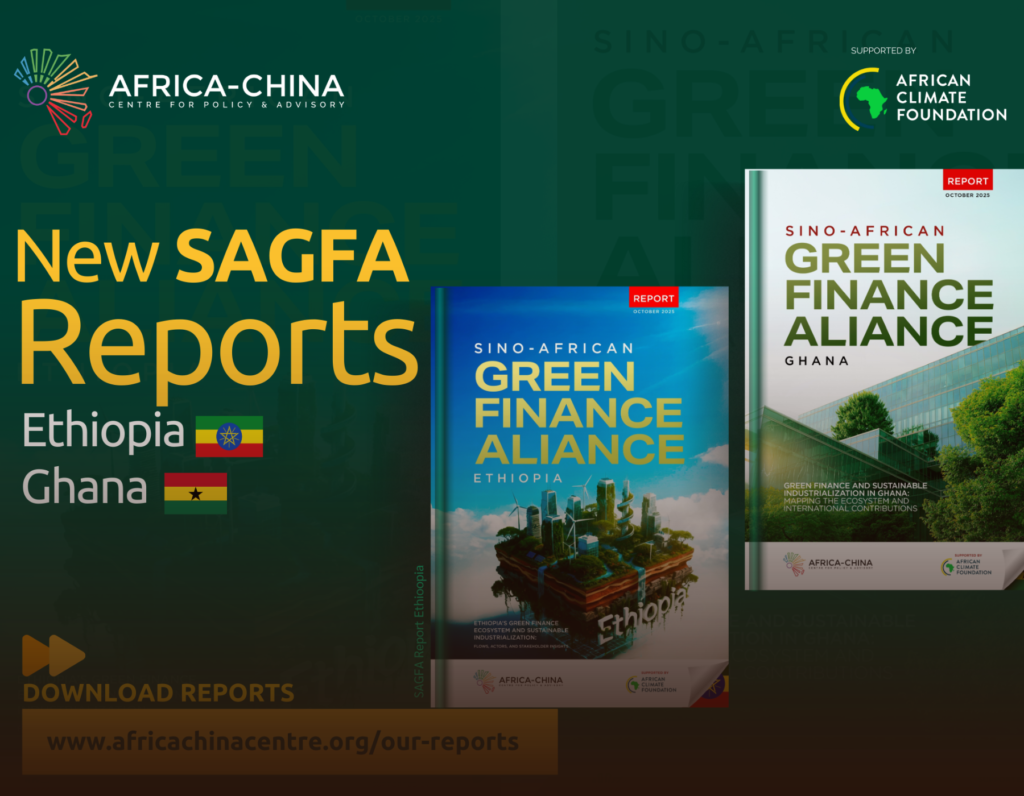
The Africa-China Centre for Policy and Advisory (ACCPA), with support from the African Climate Foundation (ACF), has unveiled a landmark report that offers the most detailed mapping to date of Ghana’s green finance ecosystem. Produced under the Sino-Africa Green Finance Alliance (SAGFA), the report provides a comprehensive analysis of the country’s green finance structure, flows, institutional landscape, and emerging opportunities, while outlining the strategic steps required to accelerate Ghana’s transition toward sustainable and climate-resilient industrialization.
The study finds that Ghana has made notable progress in integrating green finance principles into national planning, demonstrated by instruments such as the Ghana Green Finance Taxonomy (2024) and strengthened climate commitments under the NDCs. However, implementation remains uneven across institutions, and gaps in coordination and policy continuity continue to limit the overall impact of these reforms.
According to the report, green finance flows into Ghana are expanding but remain fragmented and dominated by external concessional funding. International climate finance, including contributions through the Forum on China-Africa Cooperation (FOCAC) – has driven progress in renewable energy, agro-processing, and forestry initiatives. Yet, weak data transparency, limited tracking mechanisms, and insufficient domestic participation hinder Ghana’s ability to fully leverage these opportunities. Local financial institutions are increasingly adopting ESG practices, but challenges related to risk perceptions, limited long-term capital, and the lack of incentives restrict broader engagement.
Despite these constraints, the report highlights promising sectoral advancements. Progress in decentralized renewable energy, REDD+ emission reduction programmes, and women-led agro-processing demonstrates how targeted interventions can deliver economic, social, and environmental benefits. Adaptation finance is also emerging as a critical area, particularly for water security, food systems, and climate resilience.
The report further analyzes China’s evolving contribution under FOCAC, noting its influence on renewable energy infrastructure, industrial development, and technology transfer. Strengthening alignment with Ghana’s policy priorities, improving transparency on financial flows, and enhancing domestic capacity for green industrial projects are identified as essential next steps in the Ghana-China partnership.
Overall, the assessment calls for more deliberate and coordinated action across government, financial institutions, industry, and international partners. Key priorities include fully operationalizing the Green Finance Taxonomy, improving MRV systems, establishing a Green Innovation Fund, and enhancing land governance and institutional stability to reduce investment risks.
The Sino-Africa Green Finance Alliance (SAGFA) continues to serve as a platform for collaborative research, dialogue, and capacity strengthening to advance climate-aligned development across the continent. The Ghana assessment contributes to this growing body of knowledge and offers actionable insights for policymakers and partners committed to a sustainable economic future.