

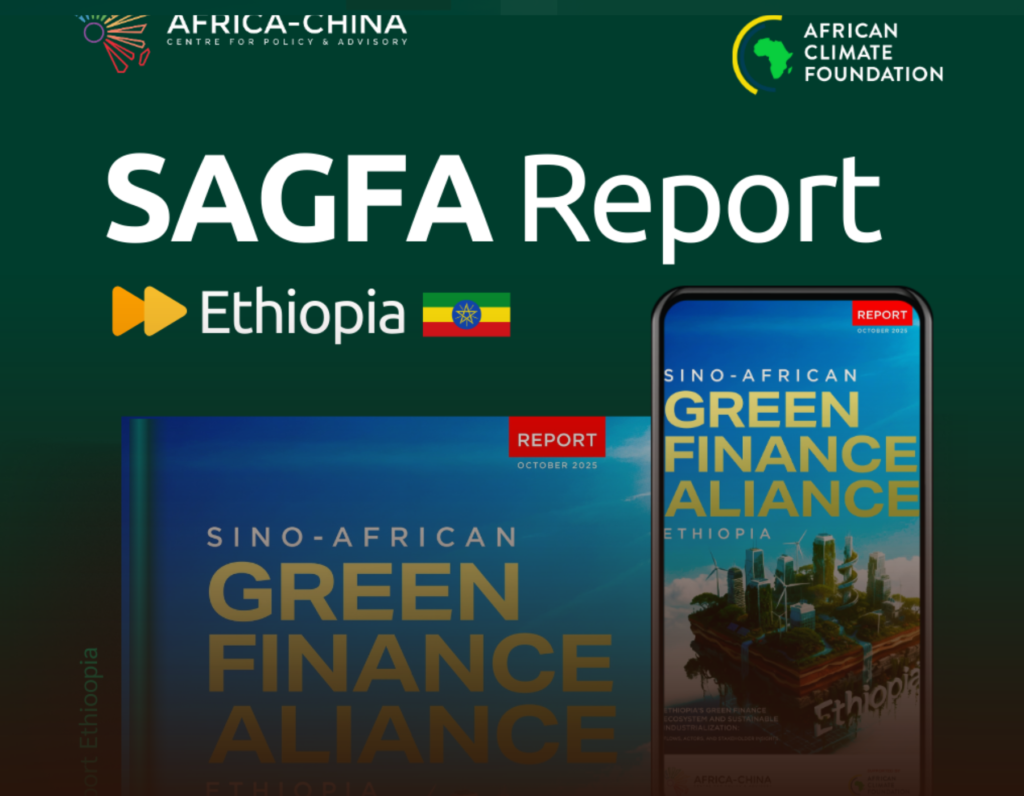
A newly released report by the Africa-China Centre for Policy and Advisory (ACCPA), supported by the African Climate Foundation (ACF), provides an in-depth analysis of Ethiopia’s evolving green finance landscape and outlines a pathway for realizing the country’s long-term vision of a Climate-Resilient Green Economy (CRGE). Published under the Sino-Africa Green Finance Alliance (SAGFA), the report maps the state of green finance in Ethiopia, identifies key sectoral opportunities, and highlights the institutional reforms needed to accelerate the country’s green transition.
The report finds that Ethiopia has made ambitious policy commitments through the CRGE Strategy, successive Nationally Determined Contributions (NDCs), and its 10-Year Development Plan. These frameworks underscore the country’s intention to pursue low-carbon industrialization while strengthening climate resilience across agriculture, water, forestry, energy, and urban systems. However, the study notes that implementation is constrained by fragmented climate finance flows, weak monitoring and reporting systems, institutional capacity gaps, and limited alignment between national and subnational structures.
Green finance flows into Ethiopia have increased in recent years, driven largely by multilateral climate funds, bilateral partners, and concessional financing arrangements. Yet the report finds that Ethiopia’s financing landscape remains heavily donor-dependent, with limited domestic mobilization and underdeveloped private-sector participation. Barriers such as foreign exchange shortages, high-risk perceptions, limited green financial instruments, and challenges in project preparation continue to hinder investment readiness. These constraints, the report argues, must be addressed to unlock larger volumes of climate-aligned capital and reduce reliance on external sources.
Despite these challenges, Ethiopia possesses several strategic opportunities that position it favourably for a green transformation. Its vast renewable energy potential – particularly hydropower, geothermal, and solar – combined with ongoing investments in industrial parks, climate-smart agriculture, and reforestation programmes, demonstrate the country’s potential to anchor green growth in key economic sectors. However, realizing these opportunities requires stronger coordination between ministries, development partners, private investors, and regional institutions.
The report also highlights the role of international cooperation, including Sino-Africa engagement, in supporting Ethiopia’s green ambitions. Strengthening transparency, technology transfer, and institutional alignment will be essential for maximizing the impact of climate-related partnerships.
Overall, the SAGFA report calls for a more coordinated, well-governed, and strategically aligned green finance architecture to enable Ethiopia to fully achieve its CRGE vision and advance a resilient, inclusive, and sustainable development pathway.
The full SAGFA Reports for Ghana and Ethiopia are available at:
🌐 https://africachinacentre.org/our-reports/