

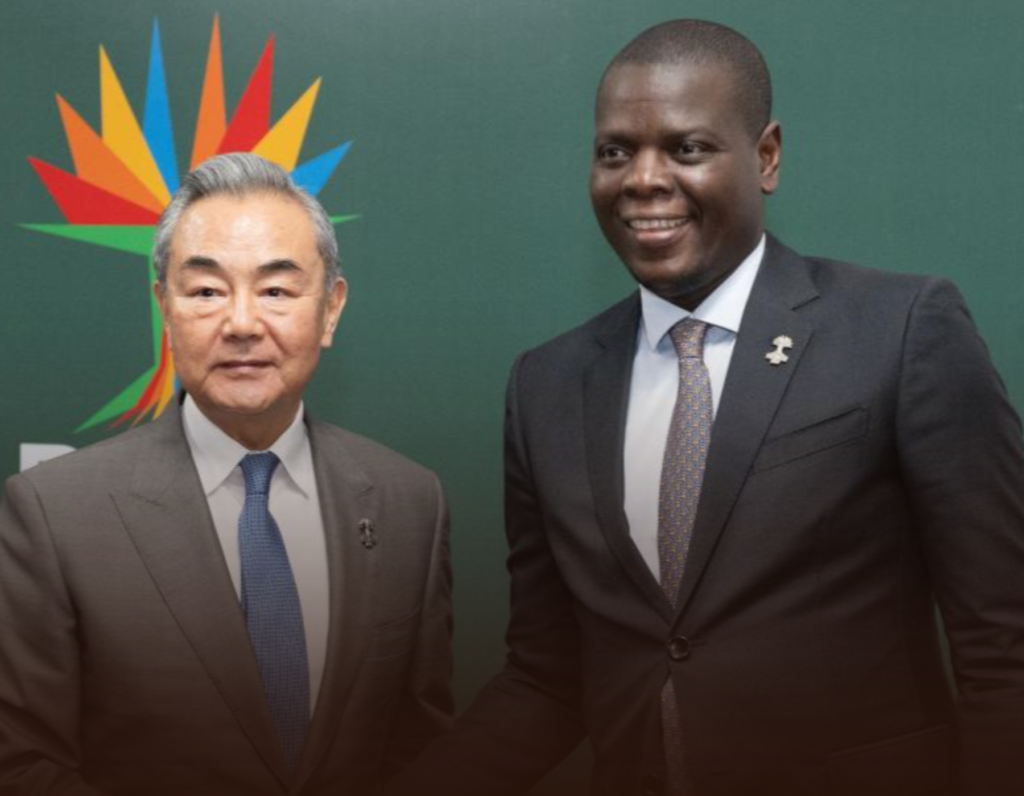
China and South Africa have reaffirmed their commitment to enhancing South-South cooperation, signalling a renewed focus on multilateralism and closer bilateral collaboration in political, economic, and social spheres. The call came during a January 11, 2026 phone conversation between Chinese Foreign Minister Wang Yi and his South African counterpart, Ronald Lamola, reflecting deepening ties between the two strategic partners.
During the exchange, Wang congratulated South Africa’s African National Congress (ANC) on its 114th anniversary, highlighting confidence that the ruling party’s efforts will help the country navigate external challenges and pursue national development goals. He underscored China’s readiness to maintain high-level exchanges, expand inter-party interactions, enhance strategic mutual trust, and broaden practical cooperation that benefits people in both countries.
Central to the discussion was the goal of strengthening South-South cooperation – a collaborative approach that prioritises mutual support, shared development strategies, and collective action among developing countries. Wang also reiterated China’s support for the implementation of its zero-tariff measures for African exports, which aims to improve market access for South African goods and bolster local industries.
Lamola affirmed South Africa’s commitment to working with China to uphold multilateralism and defend international fairness and justice – priorities shared by both nations in global diplomacy. The two sides also exchanged views on regional and international issues of common concern, reaffirming their coordinated stance on key global governance agendas.
The call for closer cooperation builds on a longstanding and comprehensive framework of bilateral relations. China and South Africa elevated ties to a comprehensive strategic partnership following the 20th anniversary of diplomatic relations, with cooperation spanning infrastructure, trade, finance, people-to-people exchanges, and multilateral coordination.
Among the structured mechanisms guiding the relationship are the Bi-National Commission (BNC), Strategic Dialogue, Regular Exchange Mechanism (REM) between legislative bodies, and the High-Level People-to-People Exchange Mechanism – all designed to deepen cooperation across governance, economic integration, cultural exchange, and social development.
Both sides have highlighted the role of the Belt and Road Initiative (BRI) and related frameworks as vehicles for mutually beneficial investments in infrastructure, logistics, trade and investment, manufacturing, digital economy, science and technology, and green development – areas where joint ventures and strategic alignment have delivered tangible results.
The broader China-South Africa partnership has produced meaningful outcomes in recent years:
- Economic and Trade Linkages: South Africa is a major African trade partner for China, exporting minerals, agricultural products, and manufactured goods – while importing Chinese goods, technology and machinery that support industrialisation and local development.
- Public Health Support: China pledged US$3.49 million to South Africa’s HIV prevention response in 2025, enhancing health services and capacity building amid cuts in other aid sources.
- Multilateral Engagement: Both countries coordinate positions on global governance, including shared support for the United Nations, multilateral trade systems, and equitable global policy frameworks.
The renewed emphasis on South-South cooperation between China and South Africa aligns with wider efforts by developing countries to shape global economic and political agendas through shared development initiatives and collective action. Such cooperation is anchored in respect for sovereignty, mutual benefit, and a commitment to equitable development -principles championed by both countries in forums such as the BRICS, the United Nations, and the Forum on China-Africa Cooperation (FOCAC).