

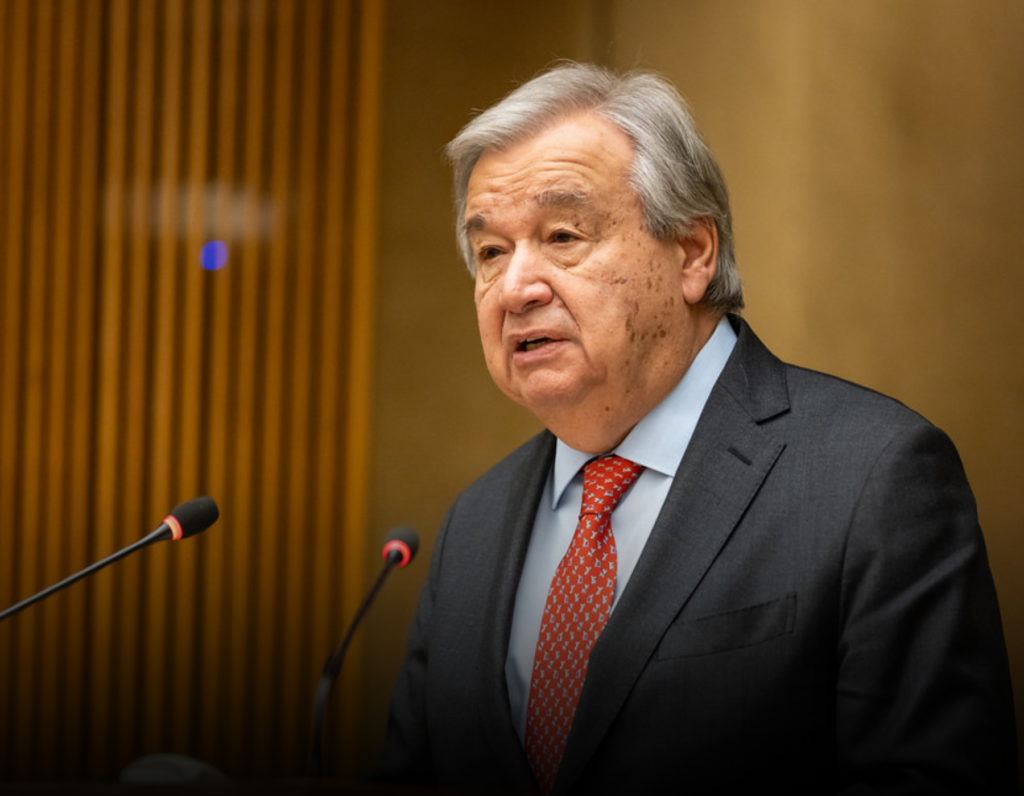
United Nations Secretary-General Antonio Guterres on Sunday voiced strong support for China’s newly announced zero-tariff trade policy for Africa, describing it as a significant step toward promoting free trade and sustainable economic development across the continent. Speaking on the sidelines of the 39th African Union Summit, Guterres urged other major economies to consider similar trade-opening measures that could help accelerate Africa’s industrialisation and integration into global value chains.
China has pledged to fully implement zero-tariff treatment on imports from 53 African countries with which it maintains diplomatic relations, starting from May 1, 2026 – a move that expands preferential access to the world’s second-largest market and signals Beijing’s deepening economic partnership with the continent.
“Africa cannot be penalised by restrictive trade barriers that constrain the competitiveness of its goods,” Guterres said, underscoring his long-standing advocacy for freer global trade rules, particularly for developing economies.
Under the new policy, zero tariffs will apply broadly across a wide range of products exported from eligible African countries to China, including agricultural goods, manufactured products and value-added items, helping to lower costs and improve market access for African producers.
China’s expansion of duty-free access builds on earlier preferential schemes and reinforces its position as Africa’s largest trading partner for more than a decade, with bilateral trade between China and the continent approaching hundreds of billions of dollars annually.
In addition to tariff removal, Beijing plans to enhance the “green channel” trade facilitation mechanism, designed to streamline customs clearance, reduce logistical bottlenecks and expedite the flow of African goods into Chinese markets.
“This initiative creates new opportunities for African producers to scale up exports and strengthen their participation in global value chains,” said Henry Okello Oryem, Uganda’s Minister of State for Foreign Affairs, highlighting the policy’s potential to boost export revenues and economic growth.
China’s broad zero-tariff policy complements bilateral trade frameworks already being signed with individual African countries. Most recently, China and South Africa concluded a Framework Agreement on Economic Partnership for Shared Prosperity, under which South African exports are slated to receive zero-tariff access on 100% of tariff lines once early harvest provisions are finalised.
Such agreements deepen economic integration and provide institutional assurances to exporters. Parks Tau, South Africa’s Minister of Trade, Industry and Competition, has emphasised how this arrangement is expected to boost South African exports and stimulate industrial capacity, particularly in strategic sectors.
Across the continent, similar cooperation patterns are emerging: in Lesotho, China has pledged to accelerate implementation of zero tariffs and expand facilitation for specialty products to enter the Chinese market, reinforcing ties between the two governments.
Observers note that China’s zero-tariff policy aligns with long-term strategic cooperation initiatives such as the Forum on China-Africa Cooperation (FOCAC), which sets out frameworks for trade, investment, infrastructure and technology collaboration, and seeks to support African-led economic transformation.
In addition to trade liberalisation, China has pursued large-scale infrastructure development, industrial partnerships, technology exchange and joint projects on digital trade and standards cooperation, affirming its commitment to a comprehensive economic partnership with Africa.
Analysts argue, however, that for zero tariffs to translate into meaningful export growth and job creation, African countries must also invest in industrial capacity, quality standards and supply chain competitiveness – challenges that governments and regional bodies like the African Continental Free Trade Area (AfCFTA) are actively addressing.
As China’s zero-tariff policy takes effect later this year, many African stakeholders see it as a pivotal development in the continent’s engagement with global markets. Coupled with ongoing bilateral agreements, infrastructure cooperation and strategic dialogues, the policy could reshape trade dynamics between China and Africa, deepen South-South cooperation, and contribute to broader economic resilience and shared prosperity.