

Ghanaian policymakers and development experts have called for stronger policy continuity, long-term national planning and more accountable implementation of development programmes, arguing that frequent changes in political administration should not derail the country’s development priorities.
Ghana’s development challenge may not simply be a shortage of policies, but the difficulty of sustaining them long enough to deliver results.
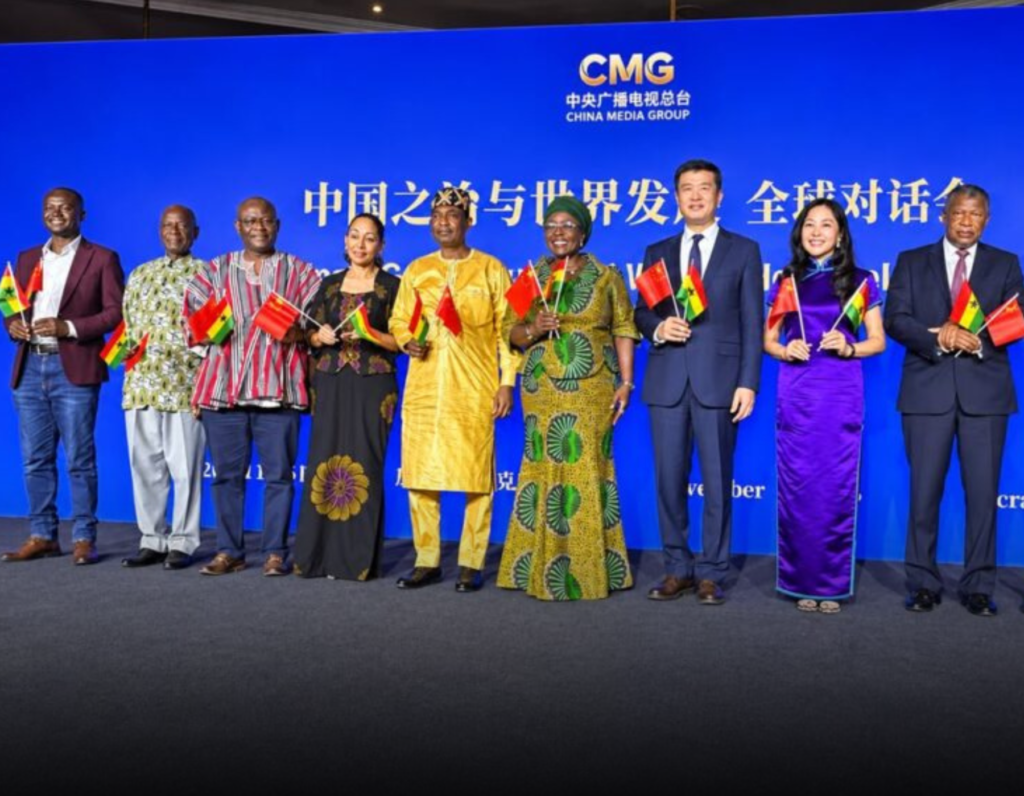
That was a central message emerging from the China’s Governance and Worldwide Development Global Dialogue held in Accra on November 6, where Ghanaian academics, political figures and policy experts examined lessons the country and other African states could draw from China’s development experience.
The discussion moved beyond an assessment of China’s economic transformation to confront a question familiar to many African countries: how can governments maintain national development priorities beyond electoral cycles and translate long-term ambitions into measurable improvements in people’s lives?
At the centre of the discussion was the need for African countries to build consensus around national priorities, strengthen institutions and connect development plans to budgets, implementation responsibilities and accountability mechanisms.
Paul Yaw Frimpong, Executive Director of the Africa-China Centre for Policy and Advisory (ACCPA), said African countries could adapt relevant elements of China’s development planning and implementation approach without necessarily adopting its political system.
He called for national development plans to be directly linked to government budgets, with clearly identified institutions responsible for implementation.
He also emphasised the need for measurable targets and accountability systems to ensure that development commitments translate into tangible outcomes.
For Ghana, he argued, political parties should agree on a manageable number of national priorities that successive administrations can sustain rather than abandon whenever political power changes hands.
Mr Frimpong further stressed the importance of citizen participation and regular monitoring of government promises, budget allocations and actual results.
His contribution placed the focus on a critical distinction in development governance: having an ambitious national plan is not the same as having the institutional capacity and political commitment to implement it.
The problem of development beyond political cycles
The panel, which also featured Professor Richard Asante of the University of Ghana, politician Samia Nkrumah and Ambassador Anani Demuyakor, President of the Ghana-China Friendship Association, examined the institutional and political conditions that have supported China’s development trajectory.
Professor Asante attributed China’s progress partly to strong political institutions, pragmatic leadership and governance focused on citizens.
He said the consistent implementation of national policies had enabled China to pursue long-term objectives without being constrained by short-term political interests.
Using Shanghai’s emergence as an international financial centre as an example, he highlighted the importance of sustained national planning in achieving major development outcomes.
Samia Nkrumah, meanwhile, drew attention to the historical relationship between Ghana and China, noting that the two countries established diplomatic relations in 1960.
She recalled that early areas of cooperation included agricultural mechanisation, industrialisation, education and skills development.
She argued that African governments needed to establish consensus around national development priorities so that critical programmes could continue regardless of changes in political administration.
“If it is manufacturing, so be it; if it is control of our resources, so be it, but we need that consensus,” she said.
Her remarks highlighted a recurring challenge in African development: the tendency for national programmes to become closely associated with particular political administrations, making continuity difficult when governments change.
Ambassador Demuyakor encouraged African countries to study China’s experience with an open mind, describing it as a source of useful perspectives, technology and development opportunities.
The panel’s broader message was that Africa could learn from China’s experience while adapting relevant lessons to its own political, institutional and economic circumstances.
Ghana-China relations must deliver industrialisation and jobs
Beyond governance and planning, the dialogue also examined how Ghana’s relationship with China could contribute more directly to economic transformation.
Delivering the keynote address, Minister of Tourism, Culture and Creative Arts, Abla Dzifa Gomashie, called for a more strategic and transformative partnership anchored on industrialisation, technology transfer, human capital development and job creation.
She said Ghana’s engagement with China should move beyond traditional diplomatic relations towards cooperation that builds productive capacity and delivers tangible benefits for citizens in both countries.
“As we look to the future, there is the need to prioritise technology transfer, industrial capacity, human capital development, job creation, and sustainable growth,” she said.
The Minister noted that China’s development experience offered useful lessons for Ghana, particularly in long-term planning and sustainable economic growth.
She also stressed that bilateral cooperation should be guided by mutual respect, shared interests and partnerships that produce reciprocal benefits.
Her remarks reinforce a growing policy conversation around the quality of Ghana’s economic partnerships with China: beyond the value of infrastructure projects and financial commitments, how much technology, skills, industrial capacity and employment do these relationships generate locally?
On the cultural front, Ms Gomashie commended the Chinese Government for its support towards the rehabilitation and modernisation of the National Theatre of Ghana.
She said the project would improve the facility’s infrastructure and technical capacity, strengthen its role as a centre for performing arts and create opportunities for artists and creative entrepreneurs.
The modernisation, she added, could contribute to cultural exchange, tourism development and the expansion of Ghana’s creative economy.
China presents its development experience as a global contribution
Chinese Ambassador to Ghana, Cong Song, said the world was experiencing profound changes unseen in a century, but China remained committed to working with development partners to advance the development agenda of the Global South.
“China can only do well when the world is doing well,” he said.
The Ambassador reaffirmed China’s commitment to working with Ghana on development projects intended to improve the lives of citizens.
His remarks reflected China’s broader position that its development experience and international cooperation could contribute to the development aspirations of other countries, particularly across the Global South.
In a separate video address, President of China Media Group (CMG), Shen Haixiong, emphasised the role of the Communist Party of China in understanding the country’s governance and development trajectory.
“To understand China today, one must understand the Communist Party of China,” he said.
Mr Shen said the Fifth Plenary Session of the 20th Central Committee of the Communist Party of China had reaffirmed the party’s commitment to strengthening its governance through higher standards and more concrete measures.
He added that CMG would continue explaining the factors behind China’s governance experience and sharing them with international audiences.
Veteran journalist and socialist Kwesi Pratt Jnr also commended China for what he described as its solidarity with Africa’s development efforts.
Learning from China without copying its system
One of the important questions raised by the Accra dialogue is how African countries can learn from China’s development experience without assuming that its governance arrangements can simply be replicated elsewhere.
China’s development trajectory has been shaped by its own political institutions, historical circumstances, economic structure and long-term planning system.
Ghana, by contrast, operates under a multiparty constitutional democracy, where political competition, elections, institutional checks and public accountability are central to governance.
The challenge, therefore, is not necessarily to reproduce China’s political model, but to identify practical development principles that can be adapted to Ghana’s institutional environment.
These include policy consistency, long-term infrastructure planning, effective coordination among government institutions, investment in human capital and a stronger relationship between national development priorities and public expenditure.
For Ghana, such an approach could help address the persistent gap between policy announcements and implementation, particularly in sectors requiring sustained investment and coordination.
It also raises the importance of building cross-party consensus around critical national priorities, so that changes in government do not automatically translate into changes in development direction.
The discussion at the Accra dialogue suggests that the real value of international exchanges on governance lies not simply in celebrating another country’s achievements, but in examining the institutions, planning processes and implementation mechanisms behind them.
Ultimately, Ghana’s development progress will depend on its ability to turn policy commitments into sustained action, ensure that public resources are aligned with national priorities and hold institutions accountable for results.
The central lesson emerging from the dialogue was clear: development requires more than good policies and ambitious promises. It requires continuity, institutional discipline, political consensus and the determination to deliver beyond electoral cycles.
[/ihc-hide-content]