
For as long as most Gambians can remember, women have been the backbone of the country’s politics, but rarely its face.
They mobilized voters in dusty village squares, cooked for campaign teams, organized rallies, canvassed communities, and turned out in large numbers at polling stations. They helped build political parties, sustained civil society movements, and in many cases carried families through difficult economic times. Yet when presidential ballots were printed, the names at the top were always men.
That is why Thursday’s announcement by the Independent Electoral Commission carries significance beyond electoral procedure. Among the candidates whose nomination papers have been accepted is Dr. Isatou Touray, placing her on the threshold of becoming the first woman to contest a Gambian presidential election after successfully fulfilling the commission’s requirements.
Alongside her stand incumbent President Adama Barrow, United Democratic Party leader ANM Ousainu Darboe, and Talib Ahmed Bensouda, whose nomination papers have also been found to be in order.
But while the race itself will be fiercely contested, the candidacy of Touray has already opened a different conversation, one that reaches beyond politics into the lives of ordinary Gambian women.
For many, the moment is deeply personal.
“I never imagined that in my lifetime I would see a Gambian woman seriously contesting for the presidency,” said women’s rights activist Tabou Njie-Sarr in previous public discussions on women’s political participation. “Representation matters because it tells girls what is possible.”
That sentiment echoes across generations of Gambian women who have watched politics from the sidelines of power despite being central to national development.
From the late Satang Jow’s pioneering role in public service, to Isatou Njie-Saidy’s historic tenure as Vice President, to Fatoumatta Tambajang’s leadership during the democratic transition, Gambian women have repeatedly demonstrated that they can govern, negotiate, and lead. Yet none reached the presidential ballot as a candidate.
The obstacles have never been merely political.
Women entering politics often face questions rarely asked of men. They are scrutinized for their marital status, appearance, tone of voice, age, and family responsibilities. Campaign financing remains a significant challenge, and party structures across much of Africa continue to be dominated by men.
According to women’s rights advocate Fatou Baldeh, genuine political inclusion requires more than symbolic participation.
“We cannot continue speaking about democracy while women remain underrepresented in the spaces where decisions are made,” Baldeh has repeatedly argued in her advocacy work for gender equality and women’s empowerment.
For Touray, however, the road ahead may prove particularly difficult because she does not enter the race as a political outsider.
Her years as Vice President are likely to become both an asset and a liability.
Supporters will point to her experience in government, her long record in civil society, and her understanding of state institutions. Critics, meanwhile, are almost certain to revisit decisions made during the administration she served.
Questions surrounding governance, economic challenges, public sector performance, and unmet expectations from the post-2016 democratic transition may all find their way into campaign debates. Opponents are likely to ask whether Touray represents change or continuity.
It is a familiar dilemma faced by politicians who move from government service into electoral contests. Yet for a woman candidate, that scrutiny is often amplified.
Political analyst Modou Lamin Bah has previously noted that women leaders frequently face a “double standard” in politics, where performance is judged not only on outcomes but also on gendered expectations of leadership.
For many observers, Touray’s challenge will therefore be twofold: convincing voters that she is qualified to lead while simultaneously overcoming deeply rooted assumptions about who looks presidential.
Her candidacy also emerges in an election shaped by contrasting political journeys.
If Touray represents a historic first, ANM Ousainu Darboe embodies political endurance.
For more than three decades, Darboe has occupied an extraordinary place in Gambian politics. He has survived arrests, imprisonment, electoral defeats, political realignments and changing political tides, all while maintaining his position as one of the country’s most recognizable opposition figures.
Few politicians on the continent have pursued the presidency with such persistence.
To younger Gambians, Darboe is a living bridge between different political eras. To his supporters, he remains the embodiment of resilience and democratic struggle. Whether admired or criticized, his career has become inseparable from the story of modern Gambian opposition politics.
In contrast, Talib Ahmed Bensouda’s rise symbolizes a different chapter altogether.
Young, energetic and increasingly influential, Bensouda has emerged as one of the most significant political figures of his generation. His profile expanded considerably during his tenure at the Kanifing Municipal Council, where supporters frequently cite development projects and municipal reforms as evidence of effective leadership.
Yet his ascent has been accompanied by persistent controversy.
Debates over political succession, privilege, elite influence, and his relationship with established political structures have followed him throughout his rise. Critics question whether his rapid prominence reflects inherited political advantage. Supporters argue that reducing his achievements to family connections ignores his record in public office.
What is undeniable is that Bensouda has become a powerful symbol for younger Gambians seeking a new political direction.
Together, Darboe, Bensouda and Touray represent three distinct narratives competing for the country’s future: experience, generational change, and a historic breakthrough for women.
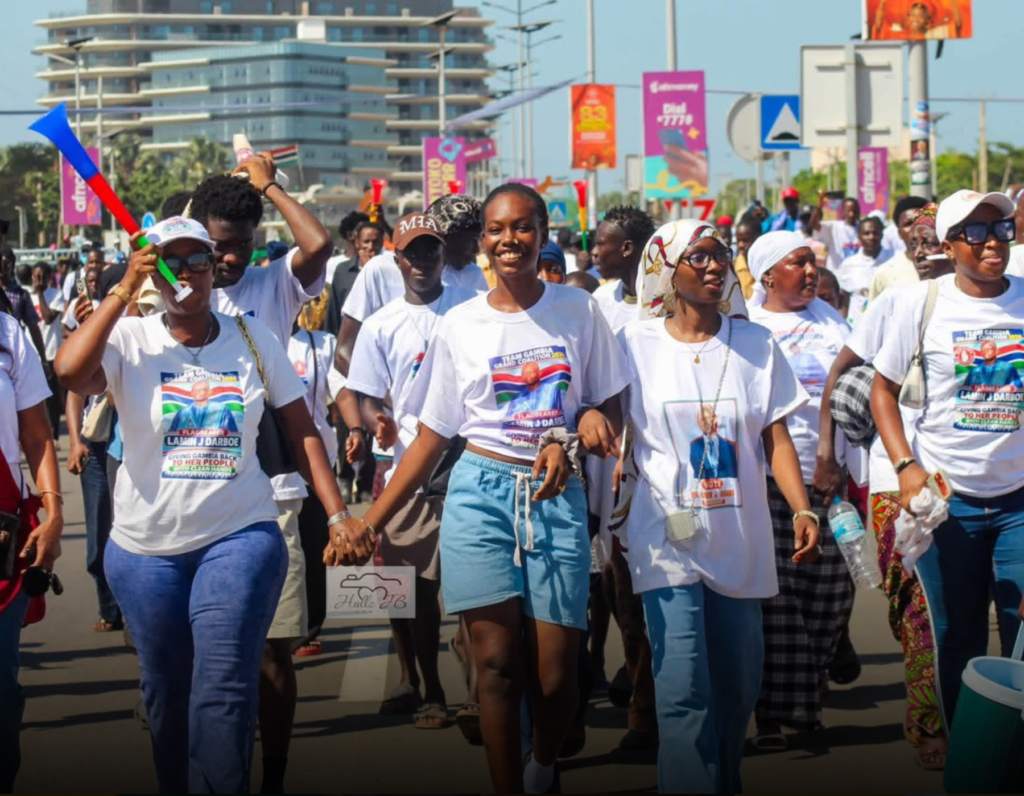
Yet perhaps the most compelling story belongs not to politicians but to ordinary women.
Women like the market vendor in Serekunda who has never seen someone who looks like her seek the presidency.
Women like the teacher in Basse who encourages girls to dream beyond traditional expectations.
Women like the young university student who now sees leadership differently because another woman dared to step forward.
Across Africa, countries including Liberia, Tanzania and Namibia have demonstrated that female leadership at the highest level is possible. Those victories did not happen overnight. They came after decades of advocacy, resistance and persistence.
The aspirations of the African Union’s Agenda 2063 envision a continent where women participate fully in leadership and governance. In many ways, the significance of Touray’s candidacy lies in its contribution to that wider story.
Whatever the outcome in December, her name appearing on the ballot would mark a moment that future historians are likely to revisit.
For generations, Gambian women helped others get elected.
In 2026, one of them is asking Gambians to elect her.
[/ihc-hide-content]