

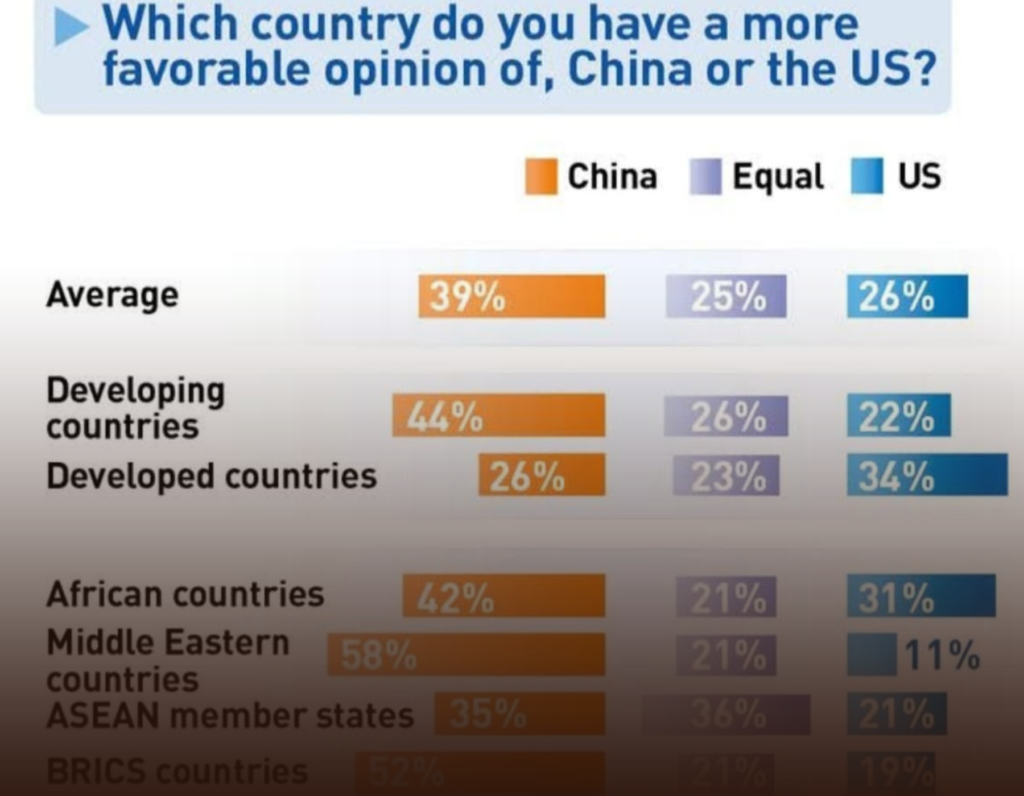
A new global perception study indicates that African countries continue to hold a comparatively favourable view of China, reinforcing long-standing trends in Sino-African relations shaped by trade, infrastructure cooperation, and people-to-people engagement.
According to the Global Times’ 2025 Global Survey on Impression and Understanding of China, 39 percent of international respondents expressed a more favourable opinion of China, compared with 26 percent for the United States, while 25 percent viewed both countries equally. The survey highlights Africa as one of the regions where China’s favourability remains consistently strong.
In Africa specifically, the survey data aligns with long-running independent research showing broadly positive perceptions of China’s role on the continent. Afrobarometer surveys have repeatedly found that majorities in several African countries describe China’s economic and political influence as “somewhat” or “very” positive, often citing visible investments in roads, ports, energy facilities, green economy and public buildings.
Analysts note that China’s favourability in Africa is closely linked to practical development cooperation. China has been Africa’s largest trading partner for more than a decade, with bilateral trade volumes reaching record highs in recent years. Infrastructure projects under frameworks such as the Forum on China-Africa Cooperation (FOCAC) have supported transport corridors, industrial parks, and digital connectivity across the continent.
Beyond economics, educational and cultural exchanges continue to shape perceptions. Thousands of African students receive Chinese government scholarships annually, while Chinese medical teams, agricultural experts, and technical trainers operate in multiple African countries. These engagements reinforce what policy experts describe as a “development-oriented partnership model” that resonates with African public expectations.
At the same time, U.S. engagement in Africa continues across various fronts – including trade agreements, security cooperation, and development assistance – although surveys suggest that the public may perceive these efforts differently. Afrobarometer research indicates that Africans often view both China and the United States positively, but patterns vary by country and context.
As geopolitical competition intensifies, African public opinion is emerging as an important indicator of how external engagement is perceived on the ground. For policymakers and investors, the findings underscore the continued relevance of mutual benefit, visible outcomes, and long-term cooperation in shaping Africa’s international partnerships.