

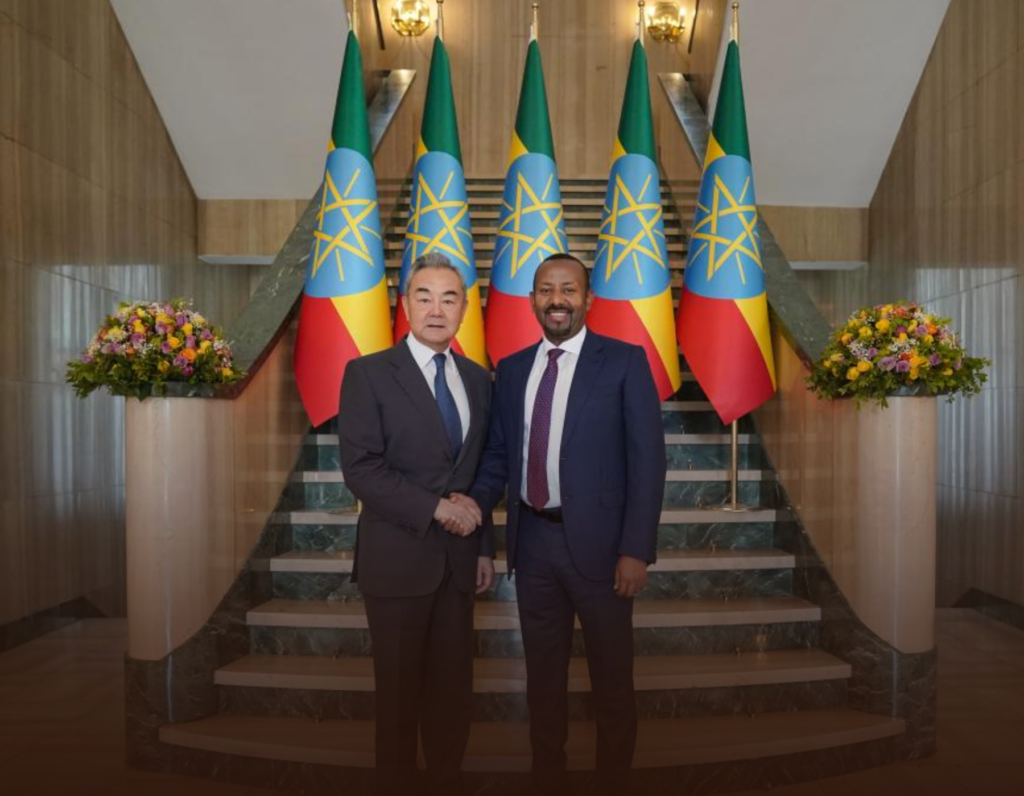
China and Ethiopia have reaffirmed their commitment to implement the outcomes of the Beijing Summit of the Forum on China-Africa Cooperation (FOCAC), pledging to deepen cooperation across traditional and emerging sectors and strengthen their long-standing all-weather strategic partnership. The commitment was made during high-level meetings held in Addis Ababa on January 8, 2026, involving Chinese Foreign Minister Wang Yi and Ethiopian Prime Minister Abiy Ahmed, alongside Ethiopia’s Foreign Minister Gedion Timothewos.
In a joint press statement, both sides agreed to advance cooperation in established priority areas such as economy, trade, infrastructure, energy, transportation, and rule of law. They also underscored the potential for expanded collaboration in emerging sectors including e-commerce, digital economy, artificial intelligence and green energy, reflecting a forward-looking agenda shaped by FOCAC’s strategic vision.
The leaders highlighted the 2026 China-Africa Year of People-to-People Exchanges as an important platform for fostering deeper cultural, educational and social ties, aligning with FOCAC’s emphasis on inclusive partnership and mutual understanding. Both sides also expressed a strong interest in aligning their national development strategies and policies to promote modernisation, policy learning and governance experience sharing.
The renewed commitment to implement FOCAC Beijing Summit outcomes comes against the backdrop of an evolving all-weather strategic partnership that has delivered tangible results for both nations. China has been a key partner in Ethiopia’s infrastructure development, playing major roles in projects like the Ethiopia-Djibouti Railway, which has enhanced regional connectivity and trade, and in expanding industrial zones that strengthen manufacturing and export capacity.
China’s support has also extended to zero-tariff access for Ethiopian exports – such as coffee, oilseeds and flowers – under FOCAC frameworks, helping Ethiopian products gain competitiveness in Chinese markets and diversify trade portfolios.
Beyond infrastructure and trade, the relationship encompasses technology, education and cultural exchange. Initiatives like the Luban Workshops, vocational training centres across Africa have enhanced skills development, including new industrial technologies that modernise Ethiopian sectors such as coffee processing and manufacturing.
The Ethiopia-China pledge reflects a broader momentum within China-Africa cooperation following the Beijing Summit, where leaders from across the continent endorsed 10 partnership action plans aimed at advancing modernisation, economic transformation, and people-centred development.
China’s engagement, framed through FOCAC mechanisms, seeks to uphold solidarity and cooperation among Global South partners, promote innovation, and build resilient ties.
FOCAC’s follow-up actions have already demonstrated concrete progress in sectors such as healthcare, agricultural technology, trade facilitation, and vocational training, benefiting millions across the continent. These efforts complement major collaborative projects and underscore Africa’s leadership role in shaping the agenda for China-Africa relations in the 21st century.