

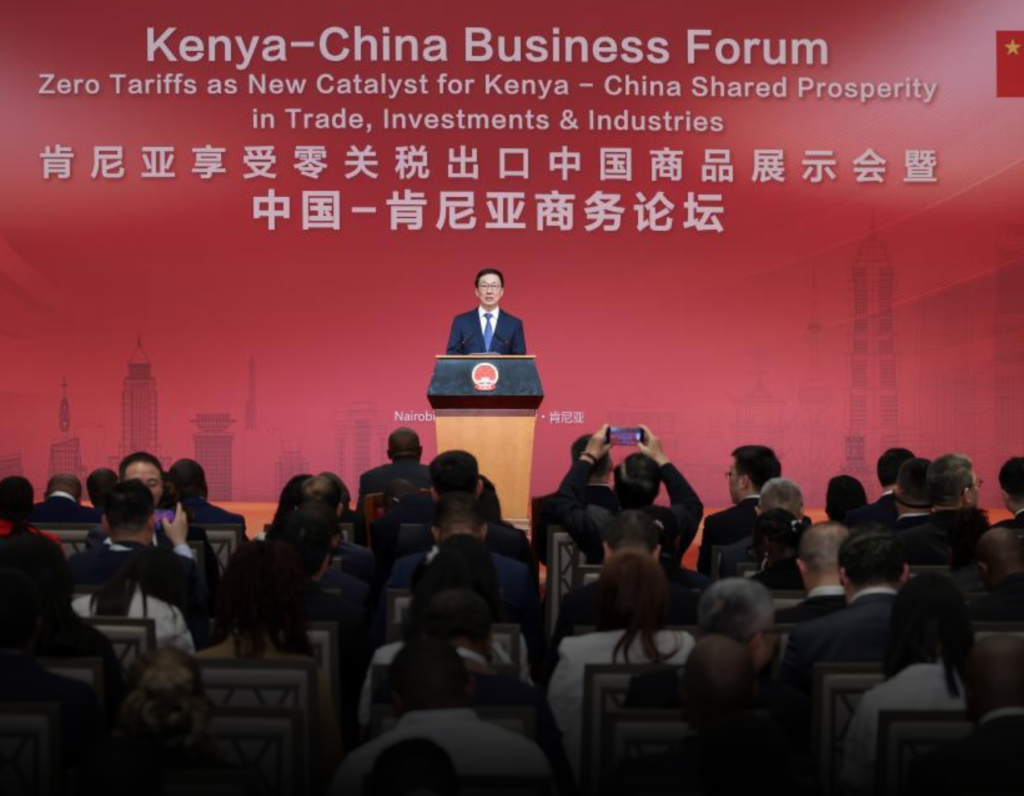
China and Kenya are entering a renewed phase of economic engagement, one defined not just by ambition but by recalibration. At the heart of this shift is a clear objective: transform a historically imbalanced trade relationship into a more mutually beneficial partnership.
During recent high-level engagements, Chinese officials reaffirmed Beijing’s commitment to expanding trade with Kenya, emphasising openness, multilateralism, and shared growth. China signalled readiness to deepen cooperation across sectors including agriculture, green energy, and the digital economy, while encouraging Kenyan exporters to tap into its vast consumer market.
This pledge aligns with a broader policy direction. Beginning May 1, China is set to implement a zero-tariff regime covering exports from over 50 African countries, including Kenya – an initiative designed to unlock market access and stimulate African exports.
The announcement comes at a critical moment. Kenya has just finalised negotiations on a bilateral trade agreement with China, a deal expected to grant duty-free access to up to 98% of Kenyan exports.
For Nairobi, the stakes are clear. Trade between the two countries has long been tilted in China’s favor, with Kenya importing machinery, electronics, and manufactured goods while exporting comparatively fewer agricultural products such as tea, coffee, and horticulture.
The new agreement, combined with China’s tariff reforms, is expected to change that equation. Kenyan officials have described the moment as a “game changer,” opening access to a market of more than 1.4 billion consumers and offering a pathway to boost export volumes, create jobs, and drive value addition in agriculture and manufacturing.
Trade is only one dimension of a much broader relationship. Since establishing diplomatic ties in 1963, China and Kenya have steadily expanded cooperation across infrastructure, education, finance, and technology.
China is currently Kenya’s largest trading partner and a key development financier. Flagship projects such as the Standard Gauge Railway and major highway networks – developed under the Belt and Road Initiative – have reshaped Kenya’s logistics and connectivity landscape.
Recent developments show this cooperation evolving rather than slowing. Kenya has revived stalled railway expansion projects with Chinese firms under new financing models, signalling a shift from heavy loan dependence toward more diversified investment structures.
Meanwhile, collaboration is expanding into emerging sectors. Both countries are exploring partnerships in digital innovation, agricultural technology, and green energy – areas seen as critical for Kenya’s long-term economic transformation.
Kenya’s deepening engagement with China also reflects a broader diplomatic strategy. Even as it strengthens ties with Beijing, Nairobi continues to pursue parallel trade negotiations with other global partners, including the United States.
This dual-track approach underscores Kenya’s ambition to position itself as a gateway between Africa and major global markets – leveraging Chinese investment and market access while maintaining diversified economic alliances.
For China, Kenya remains a strategic anchor in East Africa: a logistics hub, a regional economic powerhouse, and a key partner in advancing South-South cooperation.
What emerges is not a simple expansion of trade, but a recalibration of a long-standing relationship. The emphasis is shifting – from infrastructure-led engagement to trade-driven growth, from imbalance to gradual correction.
If effectively implemented, the new trade frameworks could mark a turning point. Kenyan producers gain unprecedented access to one of the world’s largest markets, while China strengthens its economic ties with a key African partner.
In a world of shifting alliances and economic uncertainty, the China-Kenya partnership is being rewritten, not as a one-sided equation, but as a shared pursuit of opportunity.