

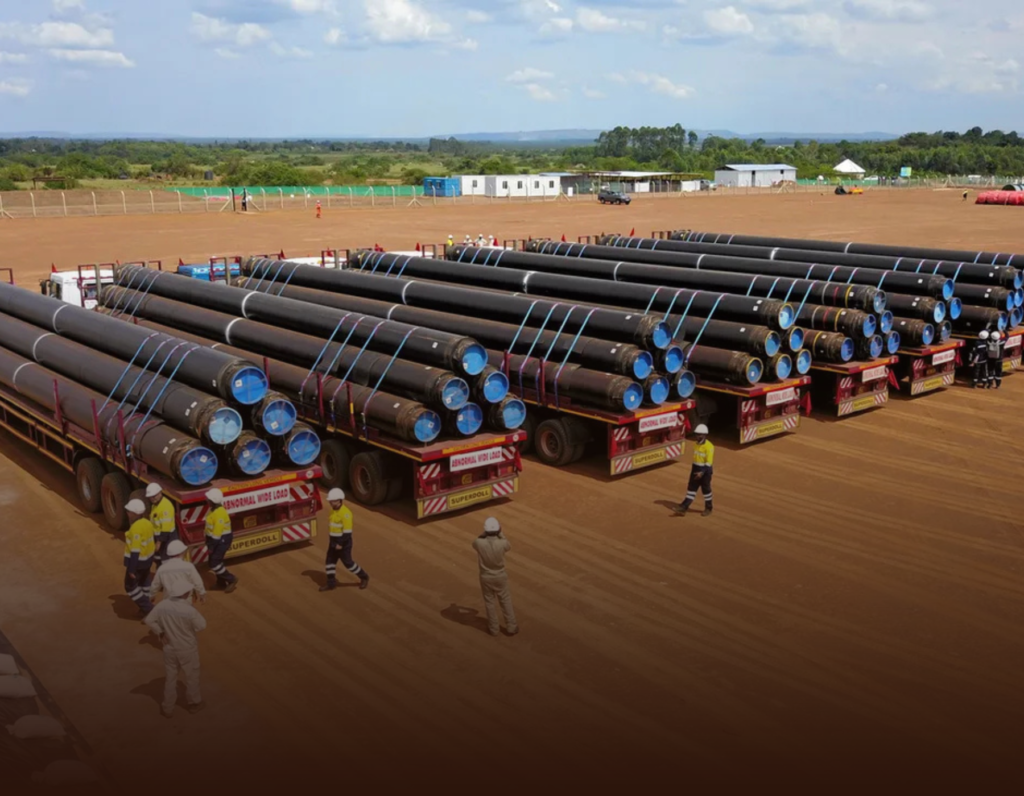
A key phase in the development of the East African Crude Oil Pipeline (EACOP) was marked with the completion of mainline welding, a critical engineering step in one of East Africa’s most ambitious cross-border energy infrastructure projects. The accomplishment brings the warming-heated pipeline closer to reality and reflects the expanding role of Chinese engineering in regional energy initiatives.
Constructed by China Petroleum Pipeline Engineering Co., Ltd. (CPP), the pipeline stretches 1,539 km from the Tilenga Central Processing Facility in Uganda to the Port of Tanga in northeastern Tanzania – spanning wetlands, rivers, mountainous areas and sensitive ecological zones. Over 1,426 km of the mainline has now been welded, signalling strong progress as the project moves toward further phases including joint coating, cable installation and pre-commissioning.
The EACOP project is set to become a significant artery for Ugandan crude exports, providing a direct link from landlocked oilfields to the Indian Ocean and boosting revenue streams that can support broader economic development. Supported by partners including TotalEnergies, China National Offshore Oil Corporation (CNOOC), and national companies from Uganda and Tanzania, the pipeline is expected to transport hundreds of thousands of barrels per day once in operation.
Advanced welding technologies and digitalised construction management have helped CPP maintain steady progress, even as the terrain presented logistical challenges. At peak construction times, the pipeline’s implementation employed thousands of workers, with local labour accounting for a majority of the workforce, contributing to job creation and skills transfer in both countries.
Beyond welding, joint training efforts in welding, safety and pipeline maintenance have been organised in Uganda to strengthen local capacity and ensure that East Africans are equipped with technical skills that endure beyond construction. A focus on local content development and technology transfer has been a consistent theme for the project’s developers, aligning with national content requirements in both Uganda and Tanzania.
The EACOP completes a major link in East Africa’s energy infrastructure network, connecting oil discoveries in the Tilenga and Kingfisher fields to global markets through Tanzania’s Tanga port. The project has been a central element of both countries’ economic visions for boosting exports, generating revenue, and promoting industrial growth.
China’s involvement in African energy infrastructure extends beyond EACOP. Chinese firms and financial institutions have supported and financed other large-scale energy and export pipeline projects across the continent, such as the Niger-Benin Oil Pipeline, which connects extractive regions to the Gulf of Guinea, enhancing West Africa’s integration into global energy markets.
The EACOP milestone also aligns with broader cooperation frameworks like the Forum on China-Africa Cooperation (FOCAC), under which China and African partners prioritise infrastructure, industrialisation and energy security as cornerstones of shared development. Chinese participation in energy projects underscores a long-term approach that combines physical infrastructure with skills training, operational capacity building and policy dialogue.
With mainline welding complete, project stakeholders are now focusing on downstream activities that will bring EACOP closer to commissioning, currently targeted for 2026. While debates continue globally over fossil fuel development and climate change implications, East African governments have framed the pipeline as a critical catalyst for economic transformation, employment creation and regional integration.