

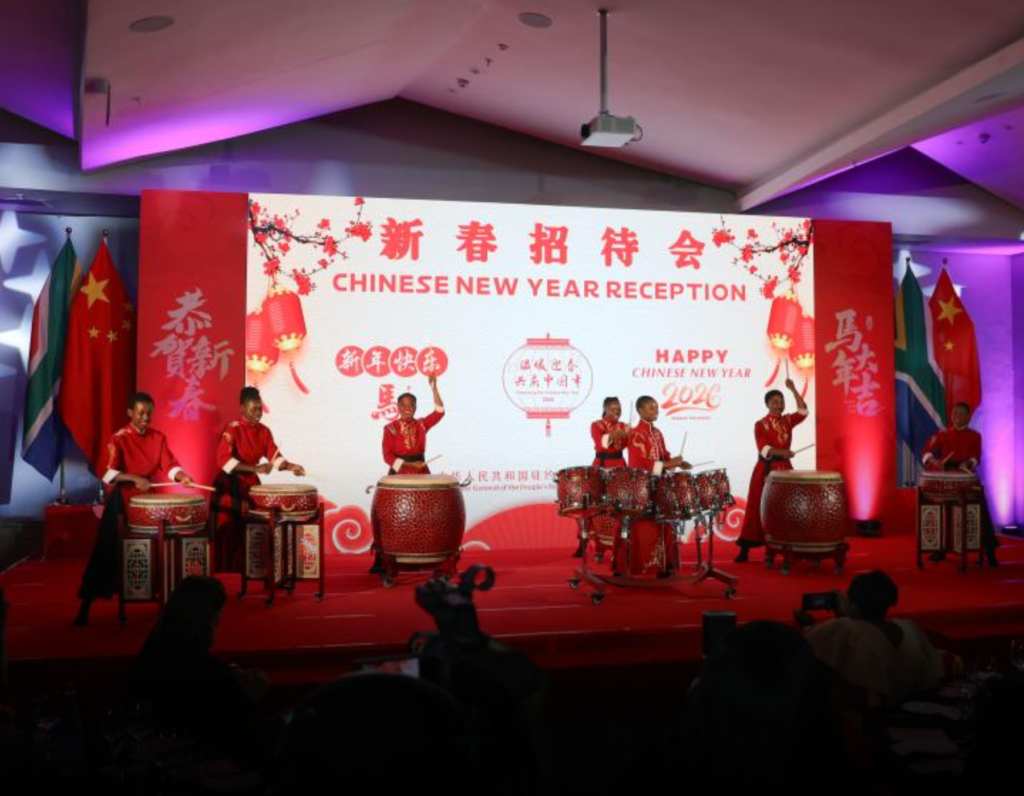
In a vibrant demonstration of cultural diplomacy and bilateral friendship, the Chinese Consulate General in Johannesburg hosted an elegant reception on Feb. 9, 2026, to mark the upcoming Chinese New Year of the Horse. The event brought together more than 300 guests – including government officials, business leaders, academic figures, media representatives, non-governmental organizations, consular corps, and members of the local Chinese community — reflecting the depth and diversity of China-South Africa relations.
Chinese Consul General Pan Qingjiang extended warm festive greetings to both Chinese nationals and South African friends, underscoring the Lunar New Year’s themes of peace, harmony and renewal – values he noted resonate closely with South African cultural ideals. Attendees enjoyed immersive cultural experiences such as tea ceremonies and woodblock printing, offering a heartfelt showcase of Chinese traditions and fostering mutual appreciation.
Speakers at the reception, including Ntombizanele Sifuba of the Free State Executive Council and Morakane Mosupyoe, Speaker of the Gauteng Provincial Legislature, emphasised that such celebrations provide an opportunity to further strengthen cultural and socioeconomic ties. Sifuba highlighted the festival as a cultural phenomenon capable of deepening people-to-people bonds, while Mosupyoe pointed to longstanding cooperation across business, culture, academia, and governance.
The Lunar New Year festivities come amid a broader framework of enhanced China-South Africa cooperation. Earlier this year, the Chinese Embassy in South Africa launched the “2026 China-Africa Year of People-to-People Exchanges”, marking an initiative to expand cultural, academic, and societal engagement between China and African countries, including South Africa. Ambassador Wu Peng highlighted the importance of these exchanges as a foundation for strengthening solidarity and mutual understanding against a backdrop of global uncertainties.
Last December, at the 4th meeting of the China-South Africa high-level people-to-people exchange mechanism in Beijing, representatives from both nations agreed to deepen cooperation in culture, education, science and technology, and sports – a strategic effort to build public support for enduring bilateral friendship.
Beyond cultural engagement, economic ties are also expanding. South Africa’s Trade Minister Parks Tau recently signed the China–Africa Economic Partnership Agreement framework with Chinese counterparts, designed to secure duty-free access for South African products into the Chinese market – a landmark move expected to enhance trade and investment opportunities.
China and South Africa’s relationship extends well past ceremonial occasions. Over 70 years of diplomatic engagement between China and African nations have seen cooperation mature into a comprehensive strategic partnership, covering trade, infrastructure, education, and health sectors. China has emerged as South Africa’s largest trading partner for over a decade, with substantial Chinese investment contributing to job creation and economic development.
Such collaboration also includes cultural outreach through Confucius Institutes, exchange programs involving students and researchers, and bilateral efforts in science and innovation – efforts underscored by Chinese diplomatic posts across South Africa, including in Cape Town and Durban, which similarly host cultural and academic activities to strengthen ties.
For both nations, the Lunar New Year celebration in Johannesburg is more than a festive gathering – it is emblematic of the broader trajectory of China-South Africa relations. Every year, cultural events like these act as bridges that bring people together, nurture mutual respect, and lay the groundwork for deeper cooperation. With significant economic agreements underway and ambitious cultural exchange initiatives in motion, the bonds between China and South Africa continue to evolve into a partnership of shared future and mutual benefit.