

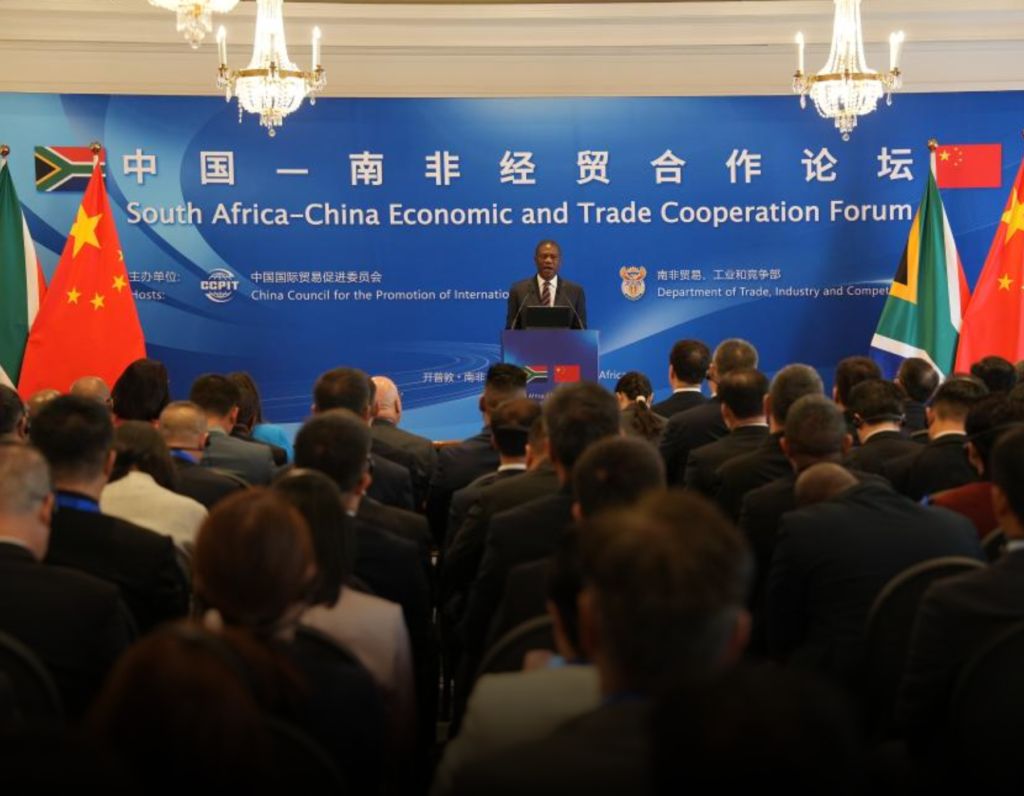
In Cape Town, a familiar partnership is being reshaped for a new era – one where trade is no longer just about volume, but value, diversification, and shared resilience.
The China-South Africa Economic and Trade Cooperation Forum, held on March 27, brought together more than 350 government officials, investors, and business leaders from both countries to deepen collaboration across key sectors, including agriculture, manufacturing, energy, mining, finance, automobiles, and logistics.
Jointly organised by the China Council for the Promotion of International Trade (CCPIT) and South Africa’s Department of Trade, Industry and Competition, the forum served as a platform to align policy with private-sector ambition – turning diplomatic commitments into practical outcomes.
At the forum, South African Deputy President Paul Mashatile emphasised that the recently signed Framework Agreement on Economic Partnership for Shared Development would play a pivotal role in reshaping trade dynamics.
The agreement, he noted, is expected to “lower costs for Chinese companies importing South African goods” while opening new pathways for local industries to expand competitiveness and reach.
Behind this lies a broader ambition: moving South Africa beyond raw commodity exports toward value-added production. As Mashatile highlighted in his remarks, the country is actively seeking to strengthen sectors such as mineral beneficiation, renewable energy, automotive manufacturing, and agro-processing – areas where Chinese investment and technology can accelerate industrial growth.
The significance of the forum is underscored by the scale of China-South Africa economic ties. China has remained South Africa’s largest trading partner for years, while South Africa is China’s biggest trade partner in Africa.
In 2025 alone, bilateral trade reached approximately $53.58 billion, with Chinese direct investment in South Africa exceeding $11.7 billion – figures that reflect both depth and continuity in the relationship.
Chinese Vice President Han Zheng described economic cooperation as the “driving engine” of bilateral relations, pointing to expanding collaboration not only in traditional industries like automobiles and manufacturing, but also in emerging sectors such as digital technology and green development.
The forum also highlighted a strategic shift: from resource-based trade to diversified industrial ecosystems.
Experts note that agriculture, green energy, and advanced manufacturing are becoming central pillars of cooperation. These sectors are not only aligned with South Africa’s development priorities but also with China’s evolving global economic strategy. While trade remains the backbone, China–South Africa relations extend far beyond economics.
Through the Bi-National Commission, established in 2000, the two countries have expanded cooperation across tourism, science and technology, education, culture, and environmental development.
South Africa has also emerged as a key destination for Chinese investment projects, with over 100 initiatives contributing to job creation and industrial capacity. At the same time, South African companies have invested in China across sectors including ICT, healthcare, and manufacturing – highlighting a two-way flow of capital and expertise.
On the global stage, both countries collaborate within platforms such as BRICS and the G20, advocating for multilateralism and the interests of developing economies – an alignment that strengthens both political and economic ties.
Amid global trade tensions, rising protectionism, and shifting supply chains, both China and South Africa are seeking stability through partnership. As analysts note, trade has become “strategically important for both sides” in navigating an uncertain global environment.
The introduction of zero-tariff policies for African exports to China and new bilateral agreements further reinforce this direction – creating opportunities for South African goods to access one of the world’s largest consumer markets.
The message from Cape Town is clear: the next phase of China-South Africa relations will be defined by depth, not just scale.
From industrialisation to green energy, from market access to innovation, the partnership is evolving into a model of modern South-South cooperation – grounded in mutual benefit and long-term vision.