

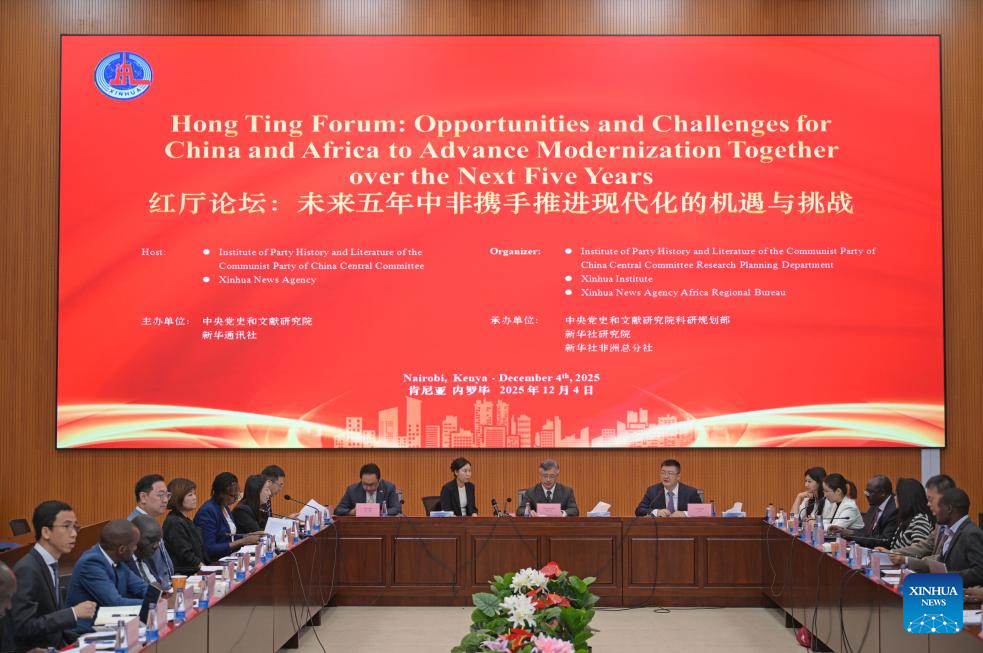
Nairobi hosted the Hong Ting Forum on December 4, 2025, drawing policymakers, scholars, media practitioners and thought leaders from across Africa and China to explore how the two partners can advance modernisation over the next five years. The event, organized by China’s Institute of Party History and Literature and Xinhua News Agency, centered on “Opportunities and Challenges for China and Africa to Advance Modernisation Together”.
Speakers underscored that modernisation in Africa must build on local history, culture and economic context while drawing on shared development experience, including China’s rapid structural transformation in recent decades. Qing Xuemin, director of the Sixth Research Department of as Africa’s largest trading partner and a major investor in infrastructure, healthcare, education and digital technologies.
Peter Kagwanja, CEO of the Nairobi-based Africa Policy Institute, highlighted that China’s success in poverty alleviation and grassroots governance offers practical inspiration for homegrown modernisation – a process that moves societies from traditional agrarian economies to more industrialised, urbanised ones, tailored to each country’s unique circumstances.
Hassan Khannenje of the HORN International Institute for Strategic Studies pointed out that the China-Africa relationship is evolving beyond hardware such as roads and railways to emphasise software – skills and technology transfer, cultural exchange, and green development.
Those themes echo broader China-Africa collaboration frameworks. The Forum on China-Africa Cooperation (FOCAC), for instance, has long advanced infrastructure, trade, and human-capital the host institute, described China-Africa cooperation as grounded in “mutual trust, respect and win-win outcomes,” noting Beijing’s role cooperation between China and African states – including projects such as the Mombasa-Nairobi Standard Gauge Railway that reduced travel time and stimulated commerce across Kenya’s interior.
Participants at the Hong Ting Forum argued that deepening modernisation cooperation will also require building local industrial capacity, improving regulatory environments, and strengthening policy coordination. Such efforts align with both China’s Belt and Road Initiative – which aims to support high-quality infrastructure and economic connectivity across Africa – and African Union strategies like Agenda 2063, which emphasise inclusive and sustainable development.
By blending experience, innovation, and local leadership, the forum’s discussions reiterated a shared vision: modernisation is not a one-size-fits-all process, but a collaborative journey that draws on historical strengths, communal values, and mutual learning. As China and Africa look ahead, this renewed focus on partnership – through dialogue, research and practical cooperation, may help shape an era of development that benefits both continents and reinforces their role in the global economy.