

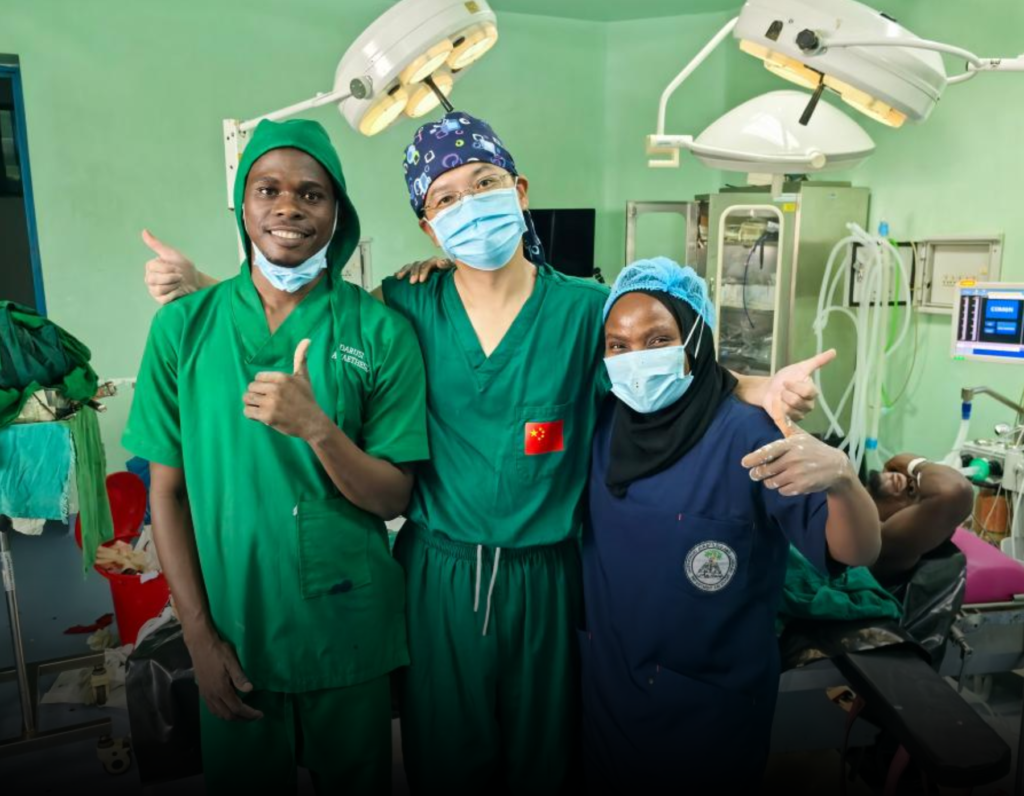
In a remarkable display of international health cooperation, Chinese medical professionals stationed in Tanzania’s Zanzibar region are delivering life-changing care – from reconstructive surgery on a bus conductor’s shattered arm to advanced clinical training and community health outreach that together underscore the deepening Sino-Tanzanian partnership in healthcare and beyond.
For 31-year-old commuter bus conductor Ali Hamad Kombo, a devastating traffic accident on Pemba Island threatened not just his livelihood, but his family’s wellbeing. The serious fracture of his right arm left him unable to work – a situation that could have spelled long-term hardship.
At Abdulla Mzee Hospital, a surgical team from the 35th Chinese medical mission in Zanzibar collaborated with local orthopaedic surgeons to perform a challenging operation that repaired the complex injury. Lacking some advanced diagnostic equipment, the surgeons relied on deep anatomical expertise and teamwork to reconstruct the shattered bone and joint – a success that has set Kombo on the path to recovery and a return to work.
“I thought everything was over,” Kombo said of his ordeal, reflecting on how the surgery brought renewed hope. “They not only saved my hand after a very difficult surgery, but they also saved my family.”
Kombo’s story is part of a broader trend of sustained medical engagement by Chinese health workers in Zanzibar. Across recent years, multiple initiatives have reached thousands of residents:
- Free healthcare days and community clinics have provided services in areas such as ophthalmology, surgery, dentistry and traditional Chinese medicine – benefiting more than 5,000 people in one free clinic event alone.
- Outreach to vulnerable populations, including programs serving over 200 orphans with comprehensive health checks, counselling, and gifts to encourage wellbeing.
- Advanced clinical training, such as a recent MRI diagnostics program jointly launched with Abdulla Mzee Hospital, equipping local physicians and technicians with skills to operate and interpret scans that previously required referral out of Zanzibar.
- Public health education and cultural exchange, including malaria awareness and traditional medicine workshops at Zanzibar University, blending clinical expertise with cultural and preventive knowledge.
These efforts form part of China’s long-established “100 Medical Teams in 1,000 Villages” pro-health initiative and broader cooperation under frameworks such as the Forum on China-Africa Cooperation (FOCAC) that emphasise people-to-people ties and high-impact development assistance.
The health sector cooperation is one dimension of rapidly expanding ties between Tanzania and China. Bilateral relations have deep roots dating back to Tanzania’s independence, when China first sent medical teams and supported infrastructure development. In recent years:
- China has funded medical equipment and surgery supplies to Tanzanian hospitals, including a donation valued at US$50,000 to Muhimbili National Hospital to expand surgical capacity.
- Investment and aid agreements worth hundreds of billions of Tanzanian shillings have been signed to improve healthcare infrastructure such as the Jakaya Kikwete Cardiac Institute, widening access to specialist cardiac treatment in East and Central Africa.
- A Comprehensive Strategic Cooperative Partnership underscores collaboration in health, education, culture, and people-to-people exchanges, while pledging continued support for sending Chinese medical teams and expanding training opportunities for Tanzanian professionals.
Tanzanian health officials and community members broadly praise the Chinese medical teams’ professionalism and empathy, seeing them as more than temporary guests but as friends who share knowledge and strengthen local capacity. Meanwhile, Chinese practitioners emphasise mentorship and joint responsibility in delivering care, aiming for sustainable improvements that outlast their missions.
As Tanzania continues to develop its health system and expand access to essential care, the ongoing Sino-Tanzanian cooperation at the community level illustrates how international partnerships can tangibly improve lives – one operation, one clinic, and one training program at a time.