

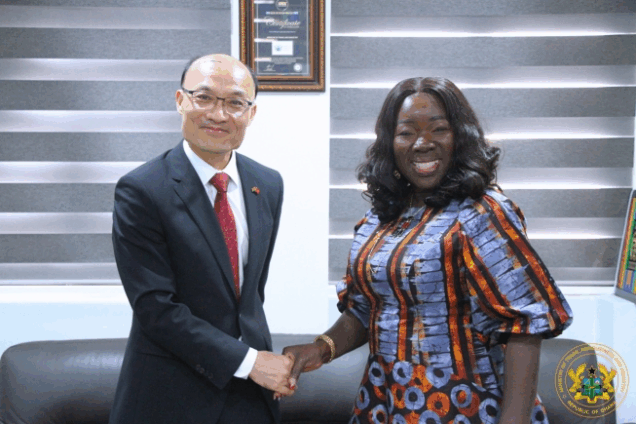
Ghana is poised to expand its commercial footprint in Asia with the planned launch of a Ghana Trade Office in Nanjing, China, next year as part of a broader strategy to boost bilateral trade and investment flows between the two countries. The announcement, made by Ghana’s Minister for Trade, Agribusiness and Industry Elizabeth Ofosu-Adjare, underscores a new chapter in one of Africa’s most dynamic economic partnerships.
The planned office, slated to open in 2026, will serve as a dedicated platform to promote Ghanaian products, facilitate investment opportunities, and strengthen business linkages with Chinese partners. Speaking during a courtesy call from the outgoing Chinese Ambassador to Ghana, H.E. Tong Defa, the minister described the initiative as pivotal to diversifying and deepening the scope of commercial ties with China.
“This Trade Office will play a central role in promoting Ghana’s export potential and supporting investment facilitation in one of China’s key trade hubs,” Ofosu-Adjare said, noting that the move aligns with Ghana’s broader economic diplomacy objectives. The minister also confirmed Ghana’s preparedness to finalise a Zero-Tariff Agreement with China, a measure expected to enhance trade flows and open new opportunities for Ghanaian exporters.
A key ambition underpinning the initiative is strengthening local currency trade, which has already begun between Ghana and China. “If we are able to trade in our own currencies, Ghana’s currency will be strengthened, because the bulk of our trading goes to China,” Ofosu-Adjare explained, pointing to the macroeconomic benefits of such arrangements.
Ambassador Tong Defa, in turn, praised the minister for her efforts to deepen bilateral economic engagement. He affirmed the growing interest among Chinese enterprises seeking to invest in Ghana, expressing confidence that Ghana’s exports to China would rise in the coming years. “I am happy that Chinese businesses are doing very well under President Mahama,” the ambassador noted, highlighting the attractiveness of Ghana’s market.
The development comes against the backdrop of strong and expanding trade between Accra and Beijing. Bilateral trade reached historic levels of US$11.8 billion in 2024, with China maintaining its position as Ghana’s largest trading partner. Chinese companies have invested widely in Ghana, spanning sectors such as infrastructure, manufacturing, mining, energy, and ICT – all contributing to employment generation and industrialisation efforts.
Participation in major trade and investment platforms – such as the China-Africa Economic Trade Expo (CAETE) – has also provided Ghanaian firms with increased access to Chinese markets, helping to elevate “Made-in-Ghana” goods such as cocoa, textiles and agribusiness products on the global stage.
The establishment of a Ghana Trade Office in China signals both countries’ commitments to mutually beneficial trade and investment integration under frameworks such as the Forum on China-Africa Cooperation (FOCAC) and broader bilateral agreements on economic cooperation. With strengthened platforms for dialogue, market access and policy coordination, Ghana aims to leverage its strategic commercial relationships with China to foster sustainable economic growth and export competitiveness in the years ahead.