

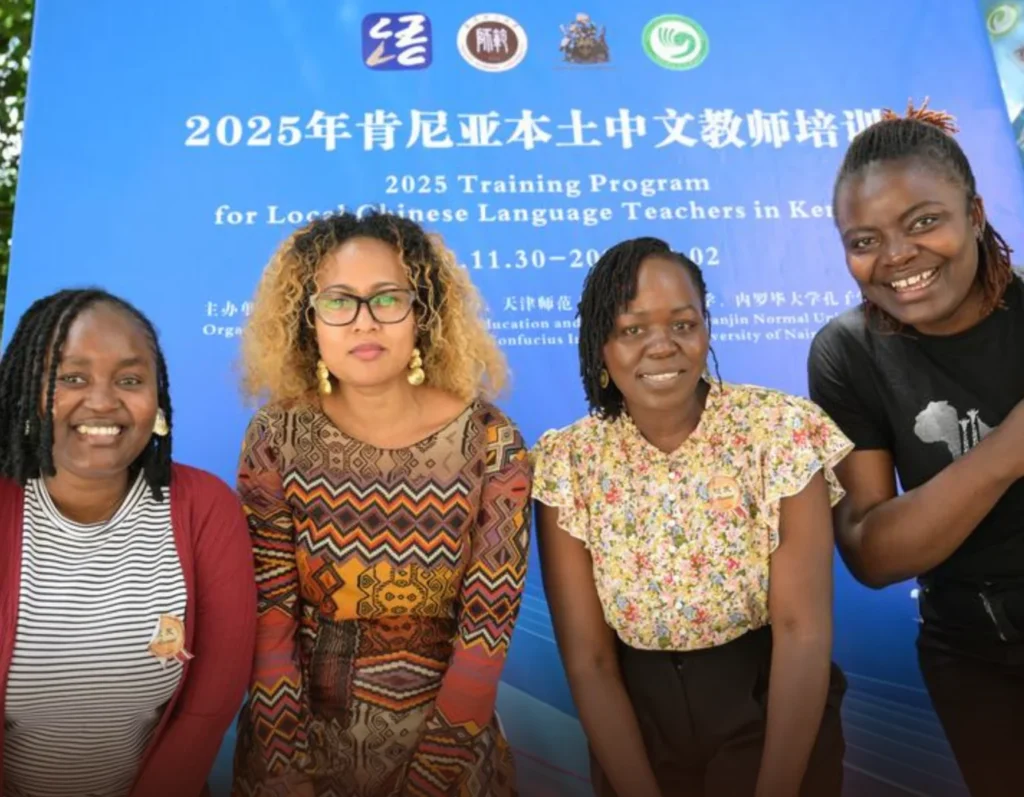
In classrooms across Kenya, a quiet transformation is underway – one shaped not by infrastructure or trade alone, but by language, culture, and human connection.
Kenya’s recent capacity-building seminar for local Chinese language teachers marks a significant step in deepening educational and cultural ties with China. The initiative reflects a growing recognition: language is no longer just a subject – it is a strategic bridge between nations.
The seminar brought together educators, linguists, and policymakers to strengthen teaching capacity, improve curriculum delivery, and expand Mandarin instruction across Kenyan schools. It forms part of a broader push to integrate Chinese language learning into the country’s evolving education system, driven by rising demand among students and institutions.
This latest training effort builds on momentum already visible across Kenya’s education sector. In recent years, Mandarin has been incorporated into the country’s competency-based curriculum, signalling its growing importance in global engagement.
Earlier programs have already laid the groundwork. In late 2025, nearly 30 Kenyan teachers completed an intensive Mandarin training course at the Confucius Institute of Kenyatta University, aimed at boosting both linguistic proficiency and cultural understanding.
Officials emphasised that such initiatives are not merely academic – they are strategic investments in Kenya’s future workforce. As one education leader noted during previous training sessions, teachers are “part of a growing community” shaping the future of Chinese language education in the country.
Language training has become a cornerstone of China-Kenya cultural diplomacy. Institutions such as Confucius Institutes – established through partnerships between Kenyan universities and Chinese counterparts – have played a central role in expanding Mandarin education and fostering cross-cultural exchange.
A training program launched in Nairobi in 2025, involving collaboration between Chinese education authorities and Kenyan institutions, highlighted the scale of this effort. The initiative brought together educators and students to strengthen linguistic skills while deepening mutual cultural understanding.
Today, more than 30 institutions across Kenya offer Chinese language programs, reflecting a steady rise in demand driven by trade, tourism, and academic exchange.
The expansion of Mandarin education is closely tied to the wider China-Kenya relationship – one of the most dynamic partnerships in Africa.
China is Kenya’s largest trading partner and a major investor in infrastructure, including flagship projects such as the Standard Gauge Railway and major road networks. These developments have not only transformed logistics but also increased the need for cross-cultural communication and skilled bilingual professionals.
At the same time, people-to-people exchanges continue to grow. Thousands of Kenyan students have studied in China on scholarships, while Chinese enterprises operating in Kenya have created demand for local talent with Mandarin proficiency.
The presence of an estimated 50,000 Chinese nationals in Kenya further underscores the depth of interaction, spanning business, education, and community life.
What emerges is a clear pattern: education is no longer a peripheral aspect of bilateral relations, it is central to it.
By investing in teacher training, Kenya is not only expanding its linguistic capacity but also positioning its youth to engage more effectively in a globalised economy where China plays a pivotal role.
As the seminar concludes, its significance extends far beyond the classroom. It represents a shift toward deeper intellectual and cultural integration – where communication becomes the foundation for cooperation.