

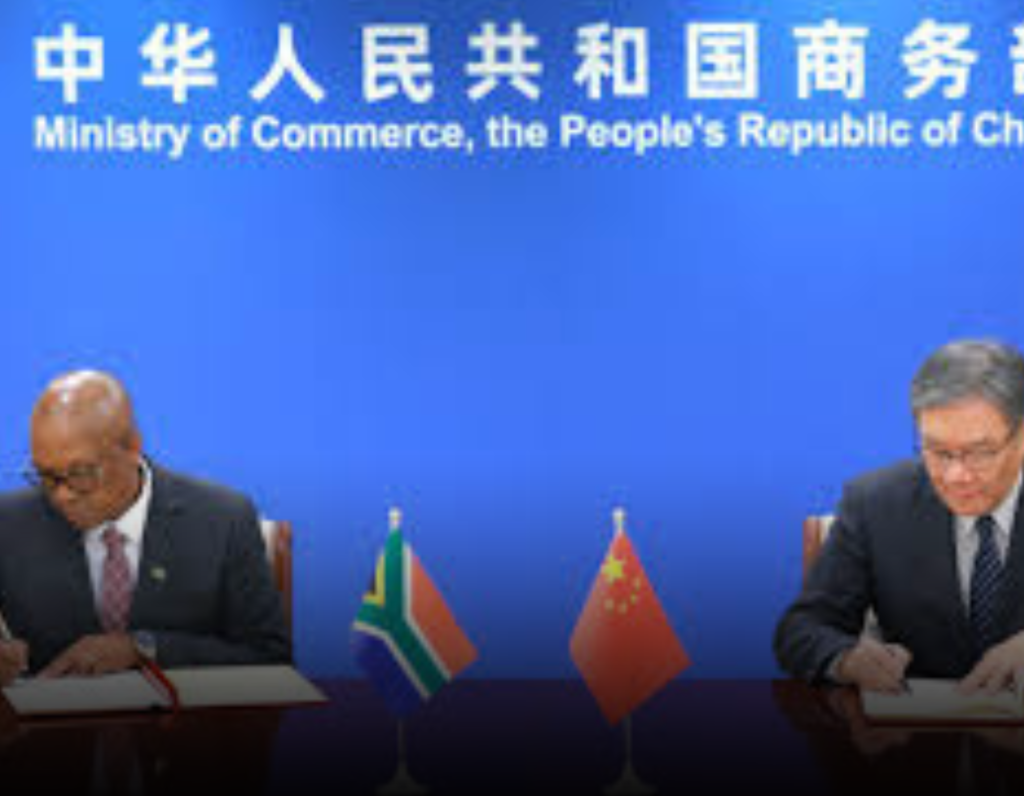
South African leaders and economic experts have welcomed a landmark trade milestone with China, saying a newly signed Framework Agreement on Economic Partnership will expand market access for South African goods and attract fresh investment at a time when Johannesburg is intensifying its economic outreach to global partners.
Signed during Trade Minister Parks Tau’s visit to Beijing, the accord sets the stage for an Early Harvest Agreement expected by the end of March 2026, which will grant duty-free access for South African exports to the Chinese market – a move hailed as a strategic victory for Africa’s most industrialised economy.
Speaking at a Chinese New Year reception in Johannesburg, Ntombizanele Sifuba, Free State’s Executive Council Member for Sports, Arts, Culture and Recreation, underscored how the agreement could help cushion the South African economy against rising protectionist pressures abroad. With the country’s unemployment rate hovering near 32 percent in late 2025, she said increased access to China’s vast marketplace may spur job creation and broaden economic opportunities.
Local government leaders also pointed to potential collaboration with Chinese firms in manufacturing, infrastructure, and energy – areas that could underpin long-term growth. Mangaung Municipality’s executive mayor discussed ambitions to work with Chinese partners on key projects, including railway upgrades and skills transfer initiatives.
Academic voices have framed the pact as particularly beneficial for South Africa’s agricultural sector, helping it overcome barriers such as steep U.S. tariffs on certain exports and tap into new consumer demand in Asia’s largest economy.
The timing of the agreement is significant. South Africa, which has relied heavily on exports to the United States and Europe, faced notable challenges following the imposition of 30 percent tariffs on some exports by U.S. authorities in 2025, prompting officials to develop alternative avenues for market diversification.
China has been South Africa’s largest trading partner for over a decade, with two-way commerce amounting to tens of billions of dollars annually and Chinese firms playing a major role in domestic infrastructure, renewable energy and digital investment projects. The new trade deal builds on this foundation, signalling deepening economic interdependence between the two countries.
This development also occurs amid Beijing’s broader efforts to encourage trade with Africa. China has moved toward zero-tariff treatment for imports from many African states and has actively negotiated framework economic partnerships that bolster shared development goals under initiatives such as the Forum on China-Africa Cooperation (FOCAC).
The strengthened economic relationship complements a wide range of cooperation between South Africa and China. In recent years, both nations have collaborated on infrastructure and industrial projects, including investments in renewable energy, green hydrogen and logistics that enhance export competitiveness.
China also supports broader regional development through initiatives such as agricultural technology cooperation with the African Union, which benefits many African partners including South Africa by fostering modern farming practices and local capacity-building.
As South Africa prepares to implement the Early Harvest Agreement by March and negotiates the full economic partnership, observers say the deal underscores a pragmatic shift toward South–South cooperation and regional economic resilience. Analysts believe that gaining preferential access to China’s vast marketplace could spur growth in key sectors, particularly agriculture and manufacturing, while bolstering bilateral investment flows and people-to-people exchanges.