

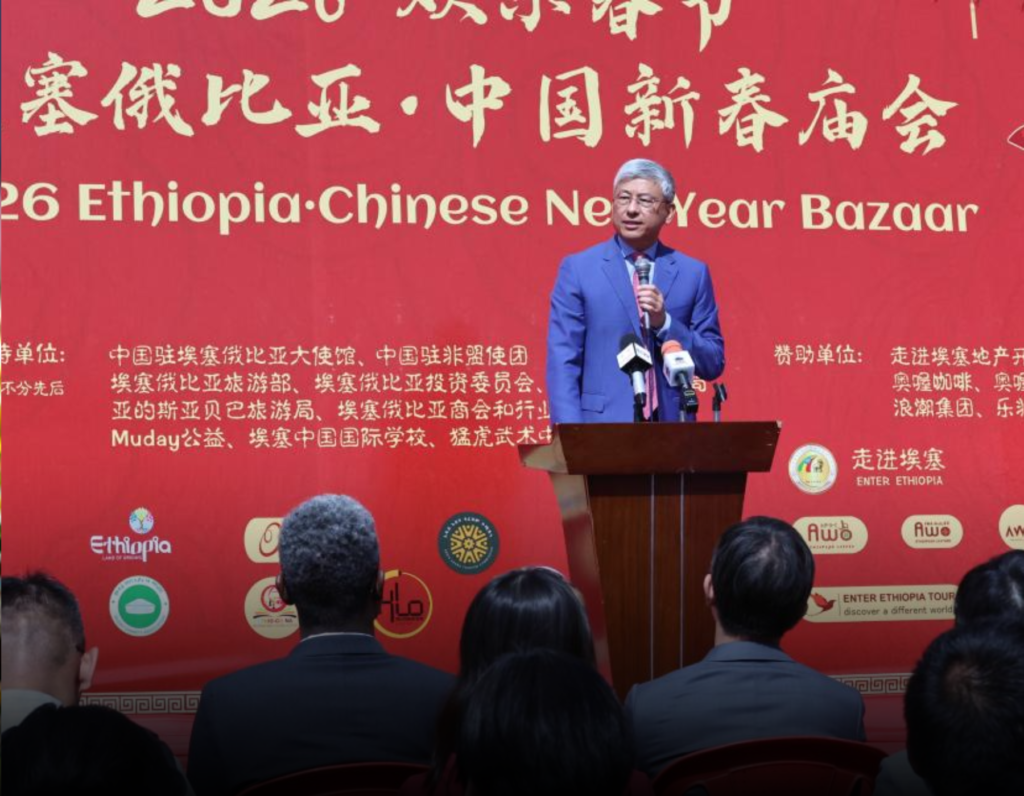
In a spirited celebration of cultural unity and diplomatic friendship, the United Nations Economic Commission for Africa (UNECA), the African Union (AU), the Chinese Mission to the AU, and a wide array of diplomatic, business, and civil society representatives gathered in Addis Ababa on Feb. 10 to commemorate the upcoming Chinese New Year of the Horse. The event highlighted the enduring people-to-people bonds and expanding cooperation between China, Ethiopia, and the broader Africa region.
The Chinese Spring Festival – traditionally a time for reunion and hope – was celebrated with a blend of Chinese and African cultural performances, including Wu Opera and a cappella music, symbolising a fusion of traditions and a shared optimism for collaborative future endeavors. Jiang Feng, head of the Chinese Mission to the AU and China’s representative to UNECA, underscored the festival’s significance as an opportunity to renew friendships, deepen cultural exchange, and foster mutual understanding.
Aboubakri Diaw, Chief of Staff at the Office of the UNECA Executive Secretary, noted that the festivities also reflected the broader South-South cooperation spirit and partnership values upheld by the United Nations, African Union, and participating nations. “The Chinese New Year is a celebration of renewal, continuity, and hope,” Diaw said, emphasising that these values “resonate deeply with the principle of multilateralism … echoing mutual respect and shared responsibility for the future.”
This year’s celebration dovetails with the China-Africa Year of People-to-People Exchanges, aimed at bolstering cultural, educational, and social linkages between China and African countries. Cultural events such as this bazaar and artistic showcases have become key platforms to bring local communities, diplomats, and business leaders together in shared cultural appreciation.
The Chinese New Year celebration in Ethiopia occurs against the backdrop of deepening bilateral relations between China and Ethiopia. Over the past half-century, the two countries have cultivated a partnership that spans diplomatic, economic, cultural, and strategic spheres. In 2025, China and Ethiopia marked the 55th anniversary of formal diplomatic relations with festivities in Addis Ababa that showcased Chinese culture, trade cooperation, and community initiatives. During that event, officials highlighted China’s role as one of Ethiopia’s major trading partners and a key source of foreign direct investment, while pointing to shared ambitions for economic modernisation and infrastructure development.
Ethiopia and China have also elevated their relationship to an “all-weather strategic partnership,” reflecting long-standing cooperation under initiatives such as the Belt and Road Initiative (BRI) and the Forum on China-Africa Cooperation (FOCAC). Beijing and Addis Ababa continue to pursue collaboration in infrastructure, industry development, commerce, and people-to-people exchange, including educational scholarships and cultural programs.
In January 2026, Ethiopia’s Prime Minister Abiy Ahmed Ali met with Chinese Foreign Minister Wang Yi in Addis Ababa, reaffirming a mutual commitment to deepen strategic coordination across bilateral and multilateral platforms, strengthen economic cooperation, and support each other in regional and international affairs.
While cultural diplomacy provides a rich context for celebrations like the Spring Festival, China-Ethiopia relations extend into robust economic and development cooperation. Trade between the two nations has expanded significantly in recent years, with China emerging as Ethiopia’s largest trading partner, major investor, and engineering contractor. Projects such as the Addis Ababa-Djibouti Railway and various industrial and infrastructure initiatives have been cited as tangible symbols of this cooperation.
Additionally, collaborative efforts in agriculture, mining, and technology sectors have been formalised through fairs, forums, and business exchanges aimed at unlocking mutual economic potential. Ethiopian officials have emphasised the role of Chinese partnerships in supporting local industrial growth, while Chinese counterparts have highlighted the complementary strengths each country brings to joint development.
As the Year of the Horse approaches, celebrations in Addis Ababa and beyond serve not only as cultural observances but also as affirmations of a dynamic bilateral relationship that continues to evolve. With a focus on shared prosperity, cultural exchange, and strategic cooperation, leaders and communities from China and Ethiopia appear poised to advance a multifaceted partnership that resonates well beyond ceremonial gatherings – into sustainable development, people-centric diplomacy, and collective advancement.