

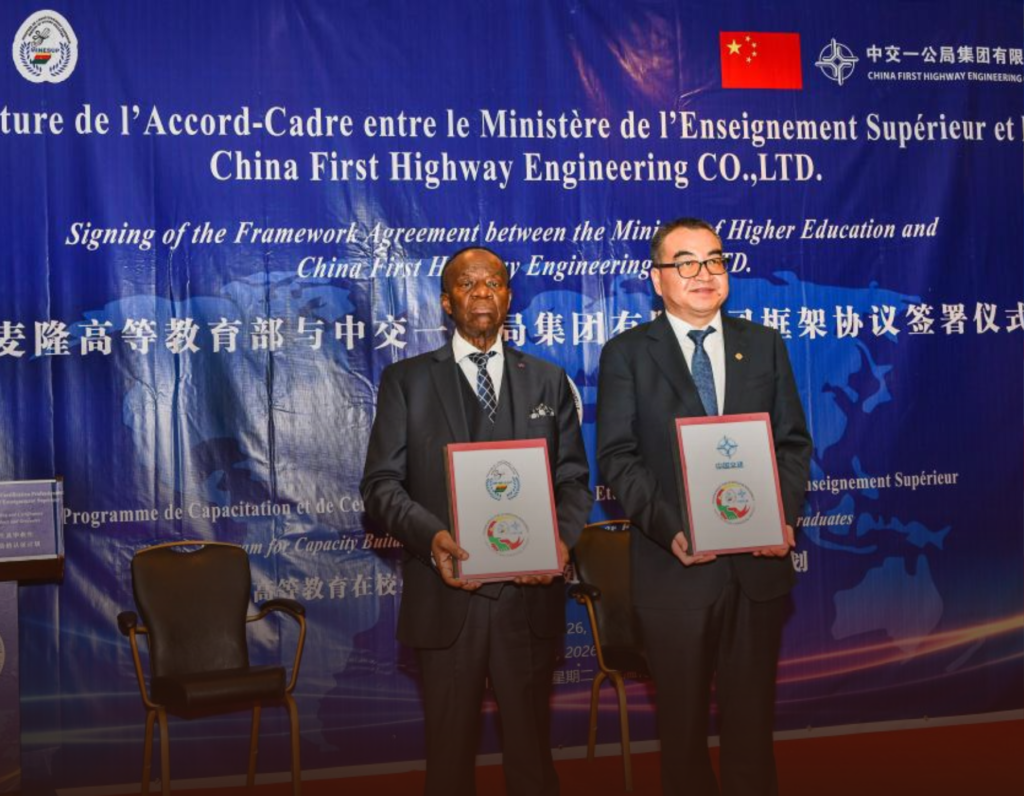
Cameroon’s Ministry of Higher Education has taken a bold step to align academic training with real-world industry needs through a new framework partnership agreement signed on January 13, 2026, with China First Highway Engineering Co., Ltd. (CFHEC). The collaboration aims to enhance professionalism in university education and improve the employability of graduates by linking academic learning directly with practical workplace experience.
Cameroonian Minister of Higher Education Jacques Fame Ndongo emphasised that the agreement will contribute significantly to developing practical skills and strengthening the national workforce, addressing a long-standing challenge where many graduates leave university with diplomas but lack the hands-on experience required by employers. He noted that partnership with CFHEC will provide construction sites across Cameroon as open training platforms for students and recent graduates.
Under the MINESUP-CFHEC Professional Certification Programme, students will combine academic study with industry-aligned professional certification, allowing them to earn recognised credentials alongside university degrees. The programme includes structured training that blends practical immersion on construction sites with mentorship from industry experts and targeted theoretical instruction.
CFHEC’s chief engineer Zhao Zongzhi highlighted that the company’s long history of engagement in Africa has prioritised local talent development and technology transfer, with this partnership envisioned as a foundation for expanding youth employment, higher education advancement and broader cooperation between Cameroon and China.
This collaboration exemplifies a growing trend in China-Africa educational cooperation, where industry-linked training complements academic programmes to produce job-ready graduates. Despite strong academic output, many higher education institutions in the region face challenges in equipping students with the practical skills demanded by modern employers. By partnering with a major infrastructure firm, Cameroon is introducing a model that bridges this gap, combining academic credentials with certified professional training aligned to market requirements.
Cameroon’s initiative dovetails with broader government strategies such as Vision 2035 and the National Development Strategy (NDS30), which prioritise workforce development and alignment of education with national development objectives. Industry-university partnerships like this signal a shift toward dual pathways, where universities and private sector partners jointly develop curricula, internships, and hands-on opportunities that strengthen economic competitiveness.
The agreement reinforces a deepening strategic partnership between Cameroon and China across multiple sectors. At the 2024 Forum on China-Africa Cooperation (FOCAC) summit in Beijing, leaders endorsed elevating the bilateral relationship to a Global Strategic Partnership, designed to expand cooperation in infrastructure, industrialisation, connectivity, and human capital development.
China’s engagement in Cameroon spans large-scale infrastructure projects including the construction of major road networks and ports. For example, China First Highway Engineering Company has been entrusted with significant national projects such as the Edéa-Dizangue road, improving mobility and regional connectivity.
Educational ties are also part of the bilateral agenda: Cameroon and Chinese universities have engaged in academic exchange, including mechanisms to support student mobility and vocational cooperation under wider China-Africa educational frameworks. Programmes such as the Confucius Institute network in Cameroon facilitate language teaching and cultural exchanges, further integrating students into broader educational opportunities with Chinese partners.
By enabling students to earn both academic degrees and professional certifications recognised by industry, this partnership introduces an innovative model for higher education reform in Cameroon. Ideally, this approach will reduce graduate underemployment and bolster the national talent pipeline needed to support infrastructure, engineering and other key sectors.