

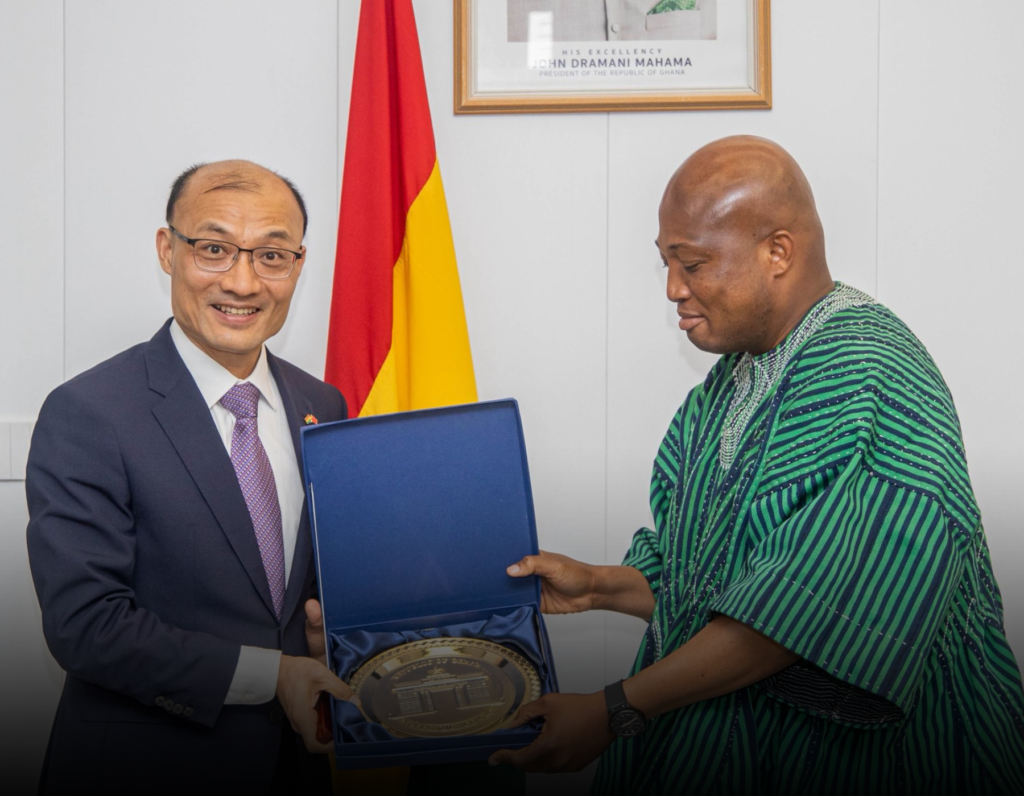
The recent farewell visit by China’s outgoing Ambassador to Ghana, H.E. Tong Defa, sparked reflection and celebration across the diplomatic and development community. Hosted by Ghana’s Minister for Foreign Affairs, Sam Okudzeto Ablakwa, the send-off highlighted an exceptionally productive chapter in Ghana-China relations, one marked by strategic agreements, expanded cooperation across sectors, and concrete benefits for communities nationwide.
In a candid reflection shared on social media, Minister Ablakwa underscored that Ambassador Tong’s tenure delivered a remarkable suite of achievements. “I am profoundly proud of what we achieved together during this relatively short period,” he remarked. At the forefront were two headline-grabbing grant agreements that will shape Ghana’s development trajectory: a US$30 million grant to build a modern market in Aflao and another US$30 million grant to establish a Science and Technology University in Damongo. Both projects align closely with Ghana’s goals to strengthen economic infrastructure and expand access to quality higher education beyond traditional urban centres.
These investments dovetail with Ghana’s broader efforts to decentralise growth and stimulate regional development, a priority echoed in the country’s Coordinated Programme of Economic and Social Development Policies (2022–2025), which stresses the need for inclusive infrastructure and human capital expansion.
Beyond capital projects, Minister Ablakwa highlighted progress in global governance cooperation. Ghana expedited efforts toward membership in the International Organization for Mediation (IOMed) – a China-backed multilateral entity designed to support peaceful dispute resolution. Cabinet approval has been secured, and parliamentary ratification is expected soon, a development that positions Ghana at the forefront of emerging Global South governance platforms.
Trade and economic diplomacy also registered solid gains. Bilateral negotiations resulted in a zero-percent tariff regime with China, a move expected to improve Ghanaian export competitiveness – particularly for cocoa, horticulture, and processed agricultural goods in one of the world’s largest consumer markets. According to recent data from the Ghana Export Promotion Authority, China already ranks among Ghana’s top three export destinations, underscoring expanded market access and bilateral trade momentum.
Education cooperation saw meaningful expansion, with scholarships increasing significantly. Under Chinese government and university scholarship schemes, a growing number of Ghanaian students are pursuing studies in fields critical to national development, such as engineering, medicine, and environmental science. This reflects a broader pattern across Africa, where educational exchange remains a cornerstone of China-Africa people-to-people ties.
On the security and environmental fronts, the two governments advanced collaboration to confront the illegal small-scale mining challenge, widely referred to as “galamsey”. Joint efforts included cooperation on visa controls, information sharing, and community education programmes – including outreach within China to stem environmentally harmful activities by foreign operators. These partnerships illustrate how bilateral cooperation is addressing development challenges with nuanced, action-oriented frameworks.
Minister Ablakwa also acknowledged the roll-out of Constituency Smart School Projects, an initiative that embeds digital learning infrastructure into Ghana’s school network, aligned with the broader Digital Ghana Agenda. This programme exemplifies how technology cooperation is taking root in education and rural development, complementing the hardware investments represented by new markets and campuses.
Ghana-China relations stretch back to 1960, and over the decades, they have grown into what both sides describe as a deep strategic partnership. Beyond education and infrastructure, this partnership spans energy cooperation, health systems strengthening, and trade facilitation under frameworks such as the Forum on China-Africa Cooperation (FOCAC). At the 2024 Beijing Summit, leaders from Ghana and China reaffirmed their commitment to mutual development goals, including support for industrialisation, agricultural transformation, and youth empowerment.
As Ambassador Tong Defa prepares to depart on the next chapter of his diplomatic career, Ghana’s leadership and civil society recognise his role in transitioning Ghana-China ties from broad diplomatic engagement to measurable, citizen-centric impact. From Aflao’s bustling future market and Damongo’s future university campus to enhanced market access and new governance platforms – the legacy of this tenure is likely to be felt for years to come.
Ghana now looks ahead with renewed momentum in its China partnership, anchored in shared prosperity, pragmatic cooperation, and sustained diplomatic trust.