

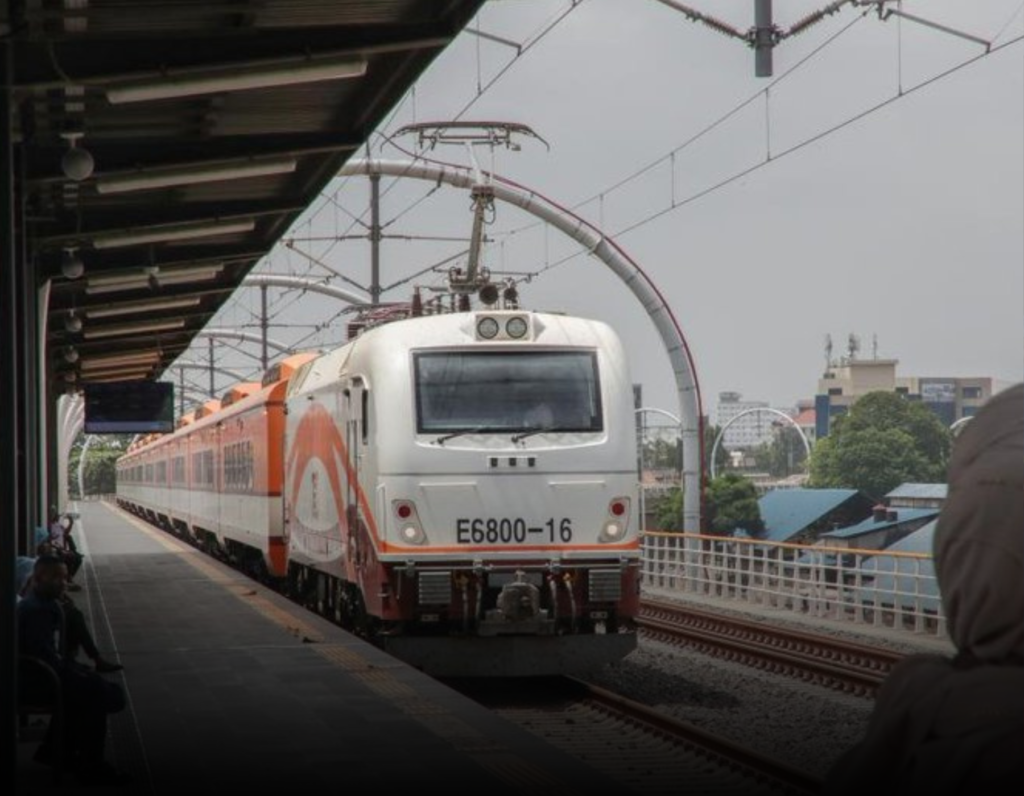
Amina Ally Sauko returned to Tanzania at the end of 2025 after a three-month specialised railway training programme in China, not just with enhanced skills, but as part of a new wave of Tanzanian professionals poised to transform the country’s rail sector. Amina was one of 67 Tanzanian railway staff, including 11 women, selected for an intensive capacity-building initiative hosted by Beijing Jiaotong University and Zhengzhou Railway Vocational and Technical College under a partnership with the China Civil Engineering Construction Corporation (CCECC).
The programme, designed to address Tanzania’s urgent need for skilled railway personnel amid the rapid expansion of its standard-gauge railway (SGR) network, blended classroom instruction with practical orientation on advanced systems, safety management, dispatch efficiency, and operational coordination – areas essential for modern railway operations.
Amina, a transport officer at Tanzania Railways Corporation (TRC), described the experience as “challenging, rewarding and unforgettable,” saying the training enhanced her technical confidence and broadened her strategic perspective on safety, efficiency and coordination. Now back at the Operation Control Centre (OCC) in Dar es Salaam, she is among the first cohort of “seed instructors” tasked with transferring new knowledge to colleagues and shaping a sustainable talent pipeline for Tanzania’s rail industry.
China’s role in developing Tanzania’s railway infrastructure is rooted in a shared history that stretches back decades. The iconic Tanzania-Zambia Railway (TAZARA), funded and constructed with Chinese support in the 1970s, was among the earliest manifestations of this partnership, providing essential connectivity between Dar es Salaam and Zambia’s hinterland.
Today, the cooperation has evolved beyond construction to operational capability and skills transfer. With China backing the expansion of Tanzania’s standard-gauge railway, a key element of the country’s modern transport strategy – training initiatives like the 2025 programme mark a deliberate shift toward building indigenous expertise and long-term sustainability rather than reliance on external technical staff.
This trend mirrors broader China-Africa cooperation in human capital development. Across the continent, Chinese partnerships increasingly emphasise training, vocational education and knowledge exchange alongside infrastructure financing, as seen in similar capacity building efforts in the construction sector under the China-Africa Vocational Education Alliance.
For Tanzania, a country investing heavily in rail connectivity to spur industrial growth and regional integration, the ability to train, retain and deploy skilled railway professionals is mission-critical. The return of Amina and her peers represents a multiplier effect: each “seed instructor” will extend training to colleagues across the TRC, enhancing institutional capacity and closing the skills gap that often hinders large-scale transport projects.
On a deeper level, programmes like this highlight how China’s engagement in Africa is evolving. Where earlier phases of cooperation focused primarily on financing and building hardware, today’s partnerships increasingly integrate technology transfer and human resources development – establishing a foundation for joint advancement rather than one-sided project delivery.