

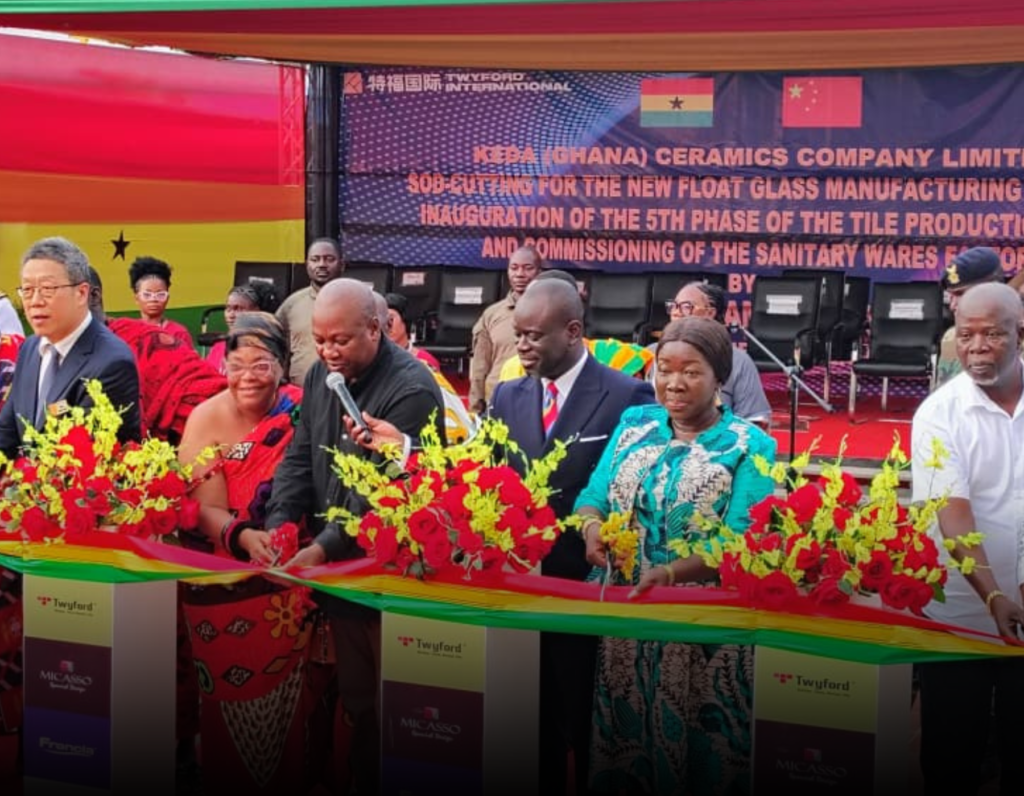
President John Dramani Mahama has cut the sod for a $250 million float glass manufacturing plant in Shama in Ghana’s Western Region, marking a significant step in the country’s push to expand domestic manufacturing and reduce reliance on imports.
The project, expected to become one of Africa’s largest float glass facilities, forms part of a broader industrial expansion that also includes the commissioning of a sanitary ware factory and the inauguration of a new production line for ceramic tiles operated by KEDA (Ghana) Ceramics Company Limited.
Speaking at the sod-cutting ceremony, Mahama described the investment as a transformative moment for Ghana’s manufacturing sector. The factory is designed to produce up to 1,400 tonnes of glass per day when both phases are completed – 600 tonnes daily in the first phase and an additional 800 tonnes in the second.
Ghana currently depends heavily on imported glass products for the construction, automotive and manufacturing industries. In 2024 alone, the country imported more than 65,000 tonnes of glass valued at nearly $25 million.
“With this factory, we are replacing imports with domestic production while creating export opportunities for Ghanaian industry,” Mahama said during the event, emphasising that “production, not speculation, strengthens a currency.”
The new facility is projected to create more than 2,000 direct jobs, including positions during the construction phase and permanent roles once production begins. Thousands of additional indirect jobs are also expected through supply chains and logistics services tied to the plant.

At full capacity, the factory could generate export revenues approaching $100 million annually while contributing over GH₵1 billion in tax revenue, according to government projections.
Officials say the project aligns with Ghana’s ambition to become a regional manufacturing hub under the African Continental Free Trade Area, whose secretariat is hosted in Accra.
The float glass plant highlights the growing industrial partnership between Ghana and China. Chinese-backed investments have played a central role in Ghana’s industrialisation drive over the past decade, particularly in the building materials sector.
Companies such as KEDA Industrial Group – the Chinese parent company of KEDA (Ghana) Ceramics – have established large-scale manufacturing operations in Ghana, producing tiles, sanitary ware and other construction materials for both domestic and export markets. These factories already export products to more than 20 countries, including markets in Europe and America.
Beyond manufacturing, China has become one of Ghana’s largest bilateral partners in infrastructure development. Major projects supported through Chinese financing and engineering include the Bui Dam hydropower project, the Tema Port Expansion and key road networks linking mining and industrial zones.
Trade between the two countries has also expanded steadily, with China remaining Ghana’s largest trading partner in goods and a major source of foreign direct investment across sectors such as construction, mining equipment, energy and manufacturing.
The Shama project also carries symbolic significance for Ghana’s industrial history. The country once operated the Aboso Glass Factory, established in the 1960s during the industrialisation push under Kwame Nkrumah, which produced bottles and glass products for local industries before eventually collapsing due to financial challenges.
Analysts say the new float glass facility could help restore Ghana’s capacity in the sector while strengthening the supply chain for construction, automotive assembly and manufacturing industries across West Africa.
As Ghana accelerates its industrialisation strategy, projects like the Shama glass plant are expected to reinforce the country’s role as a manufacturing gateway in the region – while further consolidating the economic partnership between Ghana and China.