
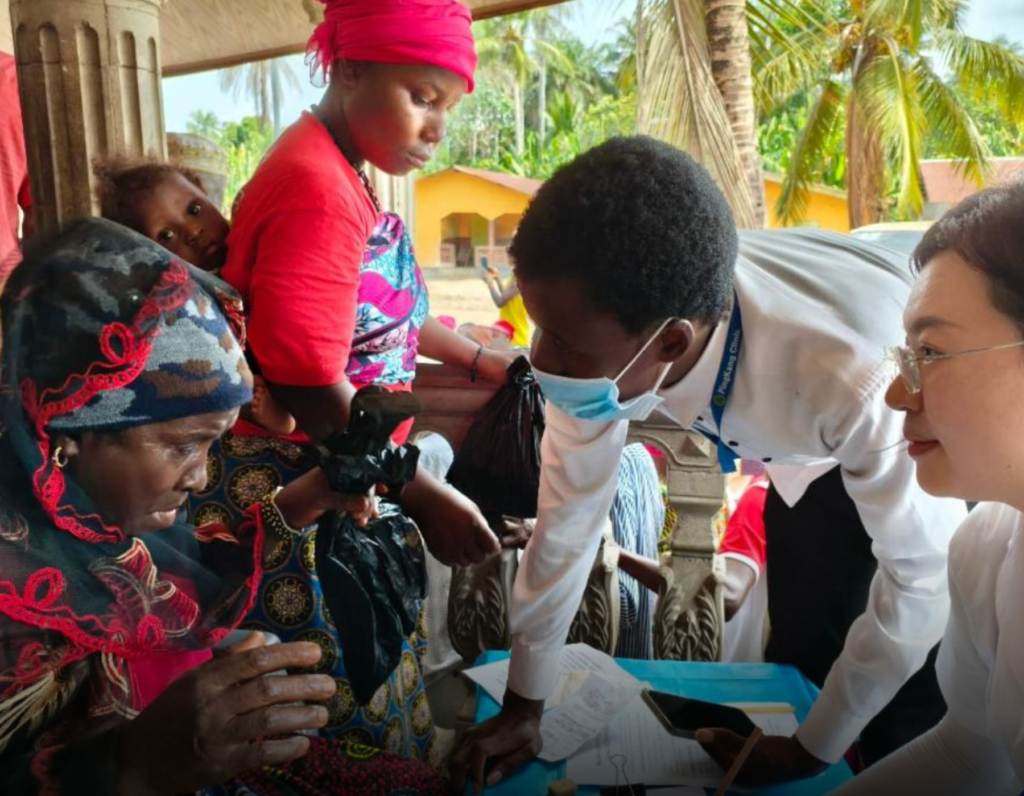
A Chinese medical team stationed in Sierra Leone has intensified community healthcare outreach efforts, providing free consultations, screenings, and public education on chronic diseases as part of broader China-Sierra Leone health cooperation.
The outreach campaign, held in Freetown over the weekend, focused on raising awareness about hypertension, diabetes, cardiovascular diseases, and other non-communicable illnesses that are becoming an increasing public health concern across Africa.
Medical experts from the 25th Chinese medical team offered blood pressure and blood sugar testing, health consultations, medication guidance, and lifestyle advice to local residents during the exercise. The team also distributed educational materials aimed at improving public understanding of prevention and long-term disease management.
According to the Chinese medical team, many chronic illnesses in Sierra Leone often go undiagnosed until complications emerge, partly due to limited awareness and restricted access to routine medical screening services.
“Our goal is not only treatment but prevention through early detection and public awareness,” one member of the medical team said during the outreach event.
Local residents welcomed the initiative, with many describing the free screenings as an important opportunity to access healthcare services that are often difficult or expensive to obtain.
Health officials in Sierra Leone have increasingly raised concerns over the growing burden of non-communicable diseases, which are now emerging alongside infectious diseases as major healthcare challenges across the country. According to the World Health Organization (WHO), non-communicable diseases account for a rising share of deaths in many African countries due to changing lifestyles, urbanization, and limited preventive healthcare systems.
The latest outreach effort forms part of China’s long-standing medical cooperation with Sierra Leone, which dates back to the 1970s. Chinese medical teams have continuously worked in Sierra Leonean hospitals for decades, providing clinical services, surgeries, training, and medical support programs.
In recent years, China and Sierra Leone have strengthened cooperation in healthcare infrastructure, infectious disease control, maternal health, and hospital development. Chinese-supported projects have included hospital renovations, medical equipment donations, malaria prevention programs, and technical training for local healthcare workers.
Healthcare has become one of the most visible pillars of China-Africa cooperation under the Forum on China-Africa Cooperation (FOCAC), where Beijing has repeatedly pledged support for Africa’s public health systems, pharmaceutical development, and medical capacity building.
China currently dispatches medical teams to dozens of African countries, making it one of the continent’s largest providers of bilateral medical assistance. These teams often combine direct patient care with training and knowledge-sharing initiatives aimed at strengthening local healthcare systems.
Analysts say the focus on chronic diseases marks an important evolution in China-Africa health cooperation, which historically concentrated more heavily on infectious diseases and emergency healthcare.
Public health experts warn that Africa’s rising rates of diabetes, hypertension, obesity, and cardiovascular diseases could place growing pressure on already strained healthcare systems if preventive measures and community awareness programs are not expanded.
Beyond healthcare, China and Sierra Leone maintain broader bilateral relations in infrastructure, fisheries, agriculture, education, mining, and economic development. Beijing has supported several major projects in Sierra Leone, including roads, public buildings, energy facilities, and technical training programs.
For many residents who attended the outreach exercise, the initiative’s immediate impact was deeply personal – offering access to medical advice, early diagnosis, and preventive healthcare support that could help save lives long before chronic illnesses become severe.