

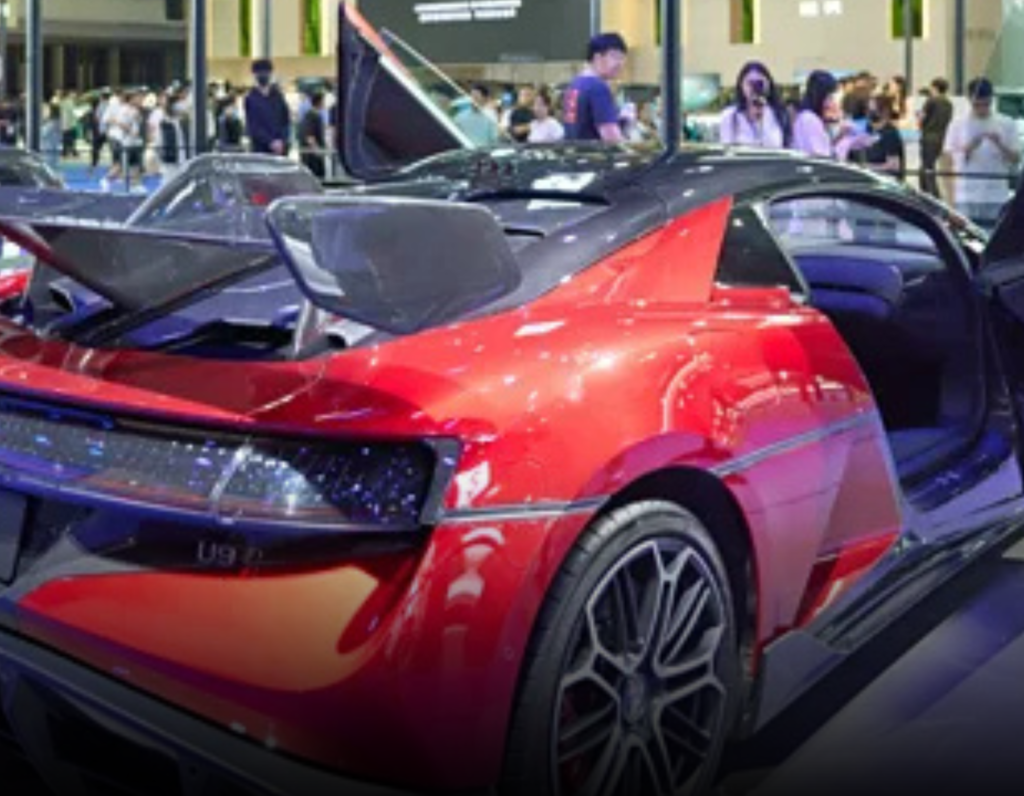
Africa’s electric vehicle industry will grow faster if governments step back and let private business take the wheel, a Chinese auto executive told Xinhua this week, offering Ghana as a test case for how that shift might unfold.
Du Haotian, sales manager at Shanghai Launch Automotive Technology Co., Ltd., made the case on the sidelines of Ghana Investment Trade Week, a three-day event that wrapped up in Accra on July 9. His argument: rather than waiting for governments or big infrastructure programs to jump-start EV adoption, African markets should focus first on building genuine private-sector demand. The rest of the value chain, he said, will follow on its own once that demand exists.
Du’s pitch to Ghanaian businesses was concrete. Banks, mining firms, manufacturers and other private companies, he suggested, could start by swapping their conventional staff transport for electric fleets, cutting fuel costs in the process. From there, he sees room for private operators to build out commercial EV fleets; taxis, delivery trucks, refrigerated trucks, logistics vehicles, describing this as the point where the real momentum begins. As those fleets multiply, he argued, investors will notice and start putting money into charging infrastructure, which in turn makes EV ownership more practical for everyday consumers.
“When investors observe the growing number of EVs in Ghana, they will recognize and seize the opportunity to invest here in more charging stations and related industries,” Du said, adding that the battery sector, chassis steel production and other supporting industries would follow once that cycle takes hold.
He also pointed to an underused resource sitting in plain sight: sunlight. Du described Ghana’s solar potential as vast and largely untapped, and said a growing EV sector would give the country a practical reason to put that capacity to use. Through charging networks powered by solar generation rather than the grid alone. Beyond the market mechanics, he repeated a familiar call to policymakers: put sound, predictable regulatory frameworks in place, since it’s ultimately government policy that determines whether private investment feels safe enough to commit.
Du’s remarks land amid a wider flurry of China-Africa engagement on electric mobility. At the 2025 China-Africa Automotive Development Forum, held in Ghana the previous year, officials and engineers from China, Ghana, Kenya and Nigeria discussed EV manufacturing prospects, with Ghana Automotive Development Center director Kojo Annobil noting the country planned to revise its automotive policy to include tax incentives on EV components not yet produced locally. Chinese firms have also been expanding retail footprints across the continent. EV maker BYD, for instance, has been growing its dealership network in South Africa, while two-wheeler brand Yadea has been adapting scooter designs to local conditions, including raising ground clearance to handle Kenya’s speed bumps.
The UN Economic Commission for Africa has framed the China partnership as central to the continent’s electric-mobility ambitions. Robert Tama Lisinge, the commission’s acting director for technology and infrastructure, has said Africa wants EVs not just imported but manufactured locally, tapping the continent’s raw materials for battery production rather than simply exporting them. He has credited Chinese investment as a leading driver of Africa’s infrastructure development generally, while pushing for even deeper collaboration on capacity-building and technology transfer.
The EV conversation is unfolding against a Ghana-China relationship that has been setting records of its own. Bilateral trade hit a historic $14.1 billion in 2025, up more than 19 percent from the year before, according to Chinese Ambassador to Ghana Cong Song — though Ghanaian trade data show the relationship still leans heavily toward Chinese imports, with Ghana’s exports to China representing a far smaller share of the total. That imbalance is part of why officials on both sides have pointed to China’s zero-tariff policy, which took effect May 1, 2026, and covers products from 53 African countries with diplomatic ties to Beijing, as a potential turning point — cocoa exports to China, for instance, previously carried tariffs of 8 to 22 percent that have now been eliminated.
Chinese investment in Ghana already spans mining, power generation, oil refining, aviation, steel, ceramics and cement, and Ghana has reciprocated with its own outreach: a Ghanaian trade delegation toured industrial and agribusiness facilities in China’s Hubei and Wuhan provinces in May 2026, part of a push to attract Chinese investment into fertilizer production, food processing and export-oriented manufacturing. Cultural and education exchanges have deepened in parallel, with more than 10,000 Ghanaian students currently learning Chinese language and culture, according to Chinese officials, as both countries mark 2026 as the China-Africa Year of People-to-People Exchanges.
Not every aspect of the relationship has been friction-free — the presence of Chinese nationals in Ghana’s illegal small-scale gold mining sector, known locally as ‘galamsey’, has drawn repeated criticism, prompting Ghana to tighten visa rules in 2025 and Chinese officials to publicly reiterate that Beijing expects its citizens abroad to obey local law. Still, officials on both sides describe the broader trajectory as an evolution, from a straightforward trade relationship toward something officials increasingly describe as a fuller industrial partnership, with the EV sector positioned as one of its newest frontiers.
Whether that framing holds will depend on whether Du’s private-sector model actually takes root. For now, the pitch is simple: let Ghanaian businesses put electric vehicles on the road first and let the rest of the industry find its way to them.