

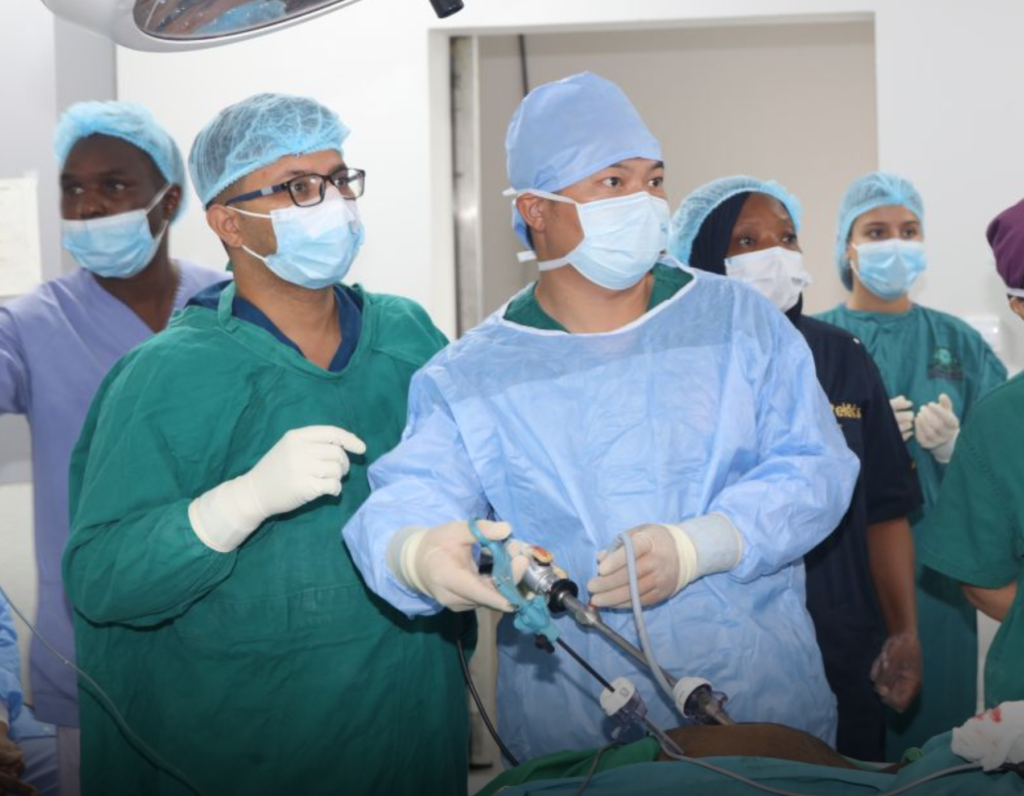
For more than ten years, Khadija Ali Saleh built her days around pain. The 76-year-old Zanzibar resident lived with a severe form of acid reflux that left her doubled over with chest discomfort and heartburn after nearly every meal, relying on medication simply to function. “I suffered for many years,” she said. “After eating, I would feel pain in my chest, and sometimes I could not even rest properly.”
Doctors at Zanzibar’s Lumumba Hospital eventually traced the source of her suffering to a hiatal hernia, a condition where part of the stomach pushes up through the diaphragm, disrupting the body’s natural barrier against acid reflux. The diagnosis came with a complication: the hospital had never performed the minimally invasive surgery typically used to correct it and operating on a 76-year-old patient through open surgery carried far greater risk. With local options exhausted, Lumumba’s doctors turned to the 35th batch of the Chinese medical team stationed in Zanzibar for help.
Bao Zengtao, the team’s leader and a senior general surgery specialist, assessed Saleh’s case and reached a clear verdict: medication could no longer manage the condition and surgery was the only real path forward. Anticipating that Lumumba Hospital wouldn’t have the specialized tools the procedure required, Bao had already arranged to bring an ultrasonic scalpel, surgical clips and composite mesh for hernia repair with him from China: equipment that proved essential once the operation got underway.
Working laparoscopically alongside a team of local doctors gathered in the operating room, Bao carried out a precise dissection and reconstruction of the hiatal region, repaired the hernia and performed a fundoplication. A procedure that wraps part of the stomach around the esophagus to reinforce it against acid reflux, addressing the underlying cause of Saleh’s decade-long illness rather than just its symptoms. According to Haitham Hamudu, a local general surgeon at Lumumba Hospital, it was the first successful laparoscopic hiatal hernia repair combined with fundoplication ever performed in the region.
For Hamudu, the significance went beyond a single successful operation. Throughout the procedure, Bao gave real-time guidance to the Tanzanian surgeons in the room, walking them through key anatomical landmarks, surgical techniques and how to manage risk during the operation. “This is a major step forward for us,” Hamudu said. “It opens the door for treating more patients locally.”
Saleh’s own recovery came quickly. Within days, the symptoms that had shadowed her for years were gone. “I feel like I have been given a new life,” she said. Back home now, she spends her time resting and surrounded by her large family. “I am grateful,” she added simply.
Saleh’s surgery is a single moment inside a much longer story. China first sent a medical team to Zanzibar in 1964. Jiangsu Province, the mainland province responsible for staffing the mission, has now rotated 35 successive teams through the islands over more than six decades. Cumulatively, those teams have treated an estimated 8.3 million patients, performed more than 240,000 surgeries and saved roughly 40,000 critically ill patients, according to Jiangsu health officials, while also donating imaging equipment including MRI, CT and X-ray machines to Zanzibar’s Mnazi Mmoja Hospital. Since 2009, Jiangsu’s teams have also helped Zanzibar build out eight specialized technical centers covering laparoscopic surgery, cleft lip and palate repair, gastrointestinal endoscopy and maternal and infant care.
The partnership’s public health record extends beyond routine clinical care. Between 2016 and 2019, a Jiangsu-led project helped drive Zanzibar’s schistosomiasis infection rate down from 8.92 percent to just 0.64 percent within its demonstration area, a result local health authorities have credited with effectively bringing the parasitic disease under control on the islands. Zhang Zhisheng, China’s consul-general in Zanzibar, has described the medical mission alongside projects like the Tanzania-Zambia Railway, as one of the “golden signboards” of the China-Tanzania relationship, one built on person-to-person trust rather than headline infrastructure alone.
More recently, the mission has leaned harder into exactly the kind of capacity-building on display in Saleh’s case. In May, the current team donated medicines and equipment to Abdulla Mzee Hospital on Pemba Island and in late May it joined Zanzibar’s Ministry of Health for a free outreach clinic at Sinai Polyclinic under China’s “100 Medical Teams in 1,000 Villages” program, treating nearly 200 residents in a single day. Chinese-invested firms have gotten involved too. In March, the East Africa Commercial and Logistics Center partnered with visiting Chinese medical teams from both mainland Tanzania and Zanzibar to run a free two-day clinic in Dar es Salaam that served more than 1,000 patients, with EACLC managing director Cathy Wang describing it as a token of respect for what she called more than half a century of friendship between the two countries. Analysts tracking China-Africa health cooperation have credited these decades of medical assistance with contributing meaningfully to falling mortality rates and stronger public health systems across the countries where Chinese teams have served.
The medical mission sits alongside a China-Tanzania relationship that has grown substantially on multiple fronts. Ties were elevated to a Comprehensive Strategic Cooperative Partnership after talks between President Xi Jinping and President Samia Suluhu Hassan in 2024, and bilateral trade surpassed $10 billion for the first time in 2025, with a zero-tariff policy for Tanzanian exports to China taking effect on May 1, 2026. The two countries also marked the 50th anniversary of the Tanzania-Zambia Railway’s operation this month, alongside a newly launched $1.4 billion project to revitalize the line, and a separate UN-backed, China-supported vocational training program has been equipping young Tanzanians with job skills in the country’s Mtwara region.
Officials on both sides describe the medical partnership as the piece of the relationship built to outlast any single infrastructure project or trade cycle: what health officials in Zanzibar have called, aspirationally, “a medical team that will never leave.” For Khadija Ali Saleh, at least, that continuity arrived exactly when she needed it.