

Half a century after the first freight train rolled down its tracks, the Tanzania-Zambia Railway gathered its three founding partners in Dar es Salaam this week for a gala dinner that was equal parts commemoration and reaffirmation. A night to honor the past while locking in commitments to the line’s next chapter.
Tuesday’s event marked TAZARA’s 50th anniversary of commercial operation, and speakers from all three governments used the occasion to underscore both the railway’s historic weight and the active revitalization already underway to secure its future. Tanzania’s Minister for Transport, Makame Mbarawa, called the railway one of Africa’s greatest development achievements, describing it as the product of extraordinary vision, unwavering solidarity and enduring friendship among nations. Speaking on behalf of Tanzanian President Samia Suluhu Hassan, he reaffirmed the government’s commitment to strengthening regional connectivity and keeping the railway a strategic pillar of economic transformation and shared prosperity.
Zambian Deputy High Commissioner to Tanzania Anthony Bwalya offered a reminder of just how consequential the line has been historically, noting that TAZARA played a critical role in securing Zambia’s economic independence during the liberation era by giving the landlocked country access to international markets through the Indian Ocean port of Dar es Salaam, a lifeline that let Zambia route trade around the hostile, apartheid-era and colonial regimes that once surrounded it.
Chinese Ambassador to Tanzania Chen Mingjian placed the anniversary within the human cost and cooperation behind the original construction, noting that China dispatched more than 56,000 engineering and technical personnel who worked side by side with their Tanzanian and Zambian counterparts, undeterred by danger, hardship or sacrifice, to build the railway together in the 1970s. She added that Chinese technical assistance and training for Zambian and Tanzanian rail personnel has continued without interruption for the full 50 years since, calling TAZARA an everlasting monument to a friendship forged in sacrifice.
TAZARA Managing Director Bruno Ching’andu framed the anniversary as both celebration and renewal, pointing to the railway’s ongoing modernization through a strategic partnership with China Civil Engineering Construction Corporation (CCECC). Spanning 1,860 kilometers from Dar es Salaam to New Kapiri Mposhi in Zambia, the line has for five decades facilitated regional trade, supported livelihoods along its route, and stood as a symbol of enduring trilateral cooperation, he said.
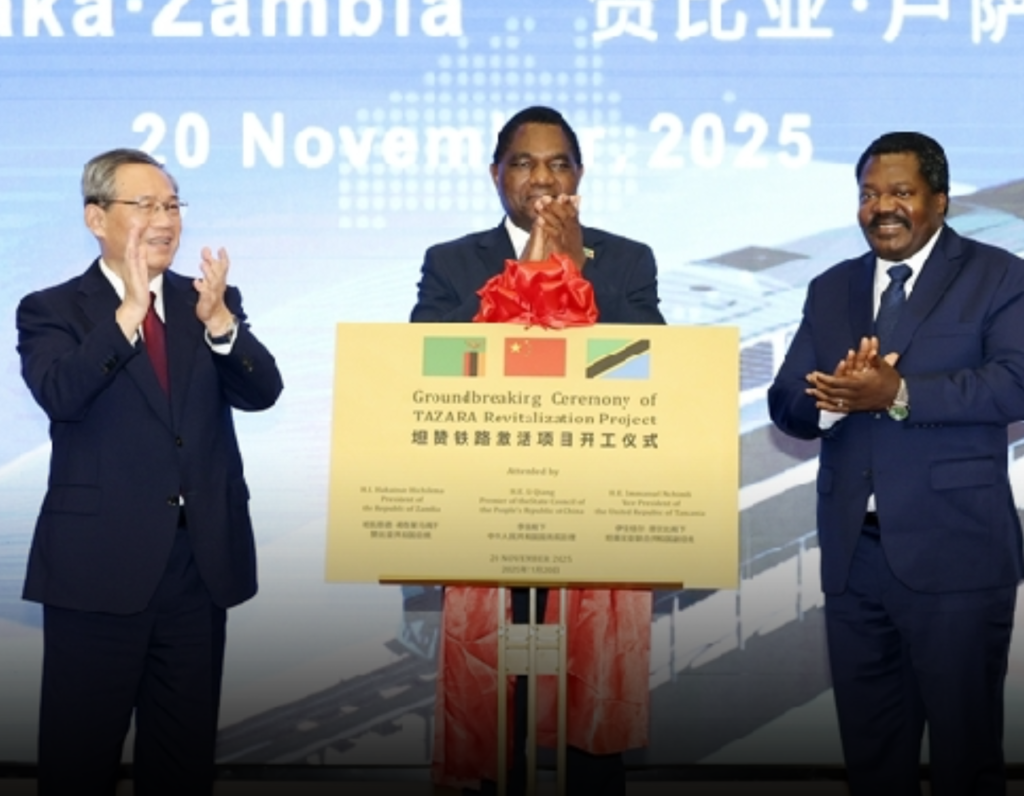
In September 2025, China, Zambia and Tanzania signed a landmark $1.4 billion agreement to revive the railway, with CCECC committing an initial $1.1 billion investment plus a further $238 million in reinvestment, covering full track rehabilitation and the procurement of new locomotives, coaches and wagons. Chinese Premier Li Qiang, Zambian President Hakainde Hichilema and Tanzanian Vice President Emmanuel John Nchimbi formally launched the project at a ground-breaking ceremony in Lusaka on November 20, 2025, unveiling a commemorative plaque at the Mulungushi International Conference Centre. Li called the railway a signature project of China-Africa cooperation and pledged Chinese support for building what the three governments have taken to calling the “TAZARA prosperity belt.”
CCECC, the same company that built the original railway in the 1970s, says work will follow a “revitalize first, develop later” approach, involving replacement of every sleeper along the entire line, laying of 390 kilometers of new rail, repair of bridges with hidden structural defects, and upgrades to power supply and communication systems. Chinese Foreign Ministry spokesperson Mao Ning said the three governments have agreed to advance comprehensive regional development along the corridor once the revitalization is complete, describing the shared goal as forging the railway into a path toward freedom, development, friendship, happiness, green growth and harmony.
Hichilema has pushed for an even more ambitious framing of the project, arguing after meeting CCECC’s parent company in November that TAZARA should be developed as more than a transport corridor, but into an economic corridor capable of unlocking mining, agriculture and other resource-driven opportunities along its length. TAZARA’s anniversary sits at the intersection of two of China’s longest-running African partnerships. China established diplomatic relations with Tanzania in the early 1960s and with Zambia in 1964, the year of Zambian independence. And the railway itself was financed and built by China through the 1970s at a time when western and international lenders had largely declined. TAZARA has long stood as the signature achievement of that era of cooperation.
Both bilateral relationships have deepened well beyond the railway in recent years. China-Tanzania ties were elevated to a Comprehensive Strategic Cooperative Partnership following talks between President Xi Jinping and President Samia Suluhu Hassan in 2024, with bilateral trade surpassing $10 billion for the first time in 2025 and a zero-tariff policy for Tanzanian exports taking effect May 1, 2026. China-Zambia relations, elevated to a comprehensive strategic and cooperative partnership in 2023, having recently expanded into renewable energy, with Chinese firms currently building solar plants across all of Zambia’s constituencies as part of the country’s push to hit 10,000 megawatts of generation capacity by 2030.
For all three governments, the Dar es Salaam gala dinner served as a marker of continuity, a railway born of Cold War-era solidarity, still running and now being rebuilt for a very different economic era, with much the same builder at the helm and much the same rhetoric of shared prosperity guiding the partnership forward.