

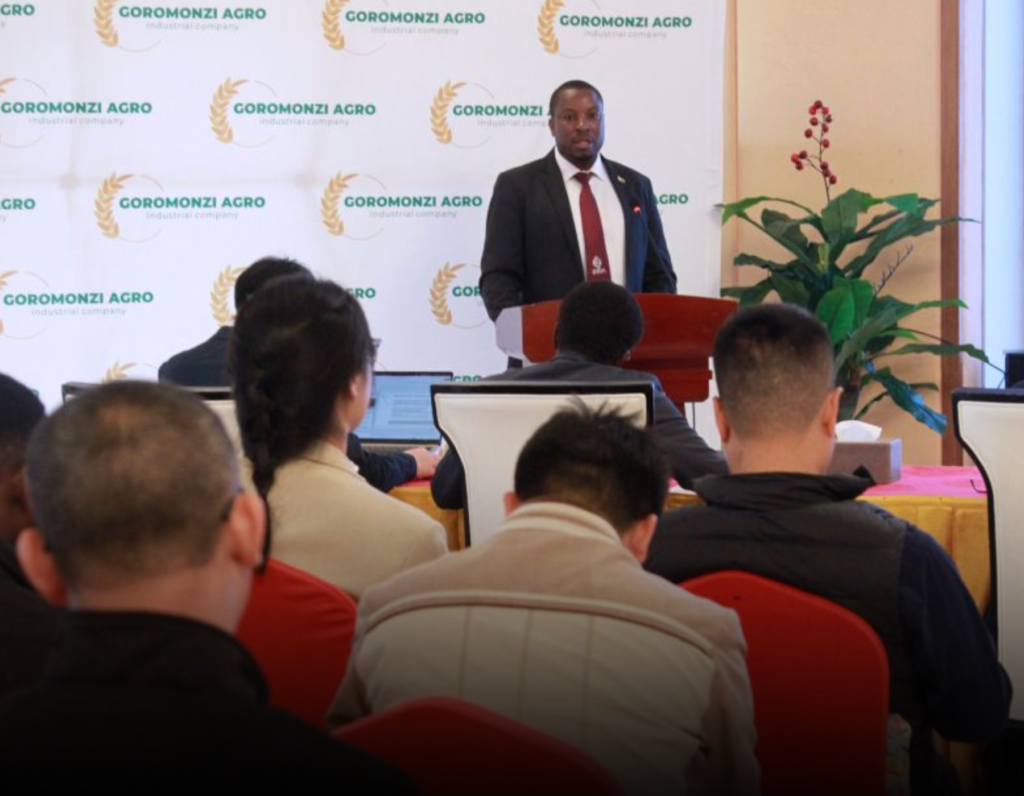
Zimbabwe is making its case to Chinese investors for one of its most ambitious agricultural projects yet. A special economic zone east of Harare that officials hope will turn raw crops into finished, export-ready goods without ever leaving Zimbabwean soil.
At an investment promotion event in Harare on Thursday, the Zimbabwe Investment and Development Agency (ZIDA) pitched the Goromonzi Agro-Industrial Park (GAIP) to roughly 50 Chinese enterprises, framing the 1,025-hectare site in Mashonaland East Province as a high-tech farming and agro-processing hub built to anchor a more competitive, export-oriented agricultural sector. ZIDA investment manager Pardon Nyandoro told attendees the initiative is designed around integrating production, processing and value addition in one location, rather than the pattern that has long defined much of Zimbabwe’s agricultural trade, where raw commodities are shipped out and processed elsewhere.
Nyandoro highlighted the site’s practical advantages: located roughly 40 kilometers from Harare, GAIP sits close to major trade corridors, reliable water supplies and productive farmland and a comprehensive feasibility study for the project has already been completed. According to the Goromonzi Agro-Industrial Company, which is spearheading the development. As a designated special economic zone, the park comes with a suite of investor incentives, including reduced corporate income tax, streamlined import-export approvals and a more liberalized regulatory framework intended to lower the overall cost of doing business, Nyandoro added.
The scope of what investors are being asked to build is substantial. Planned cooperation areas span solar power generation, a packaging and processing center, cold chain facilities, transportation systems, warehousing, general infrastructure, and even hotel and accommodation services. The makings of a fully self-contained agro-industrial cluster rather than a single factory or farm. Earlier project documentation describes a phased development approach for the park, with high-value crop cultivation, including industrial hemp production, envisioned as one component of the broader mix alongside horticulture and high-tech farming.
Thursday’s event was organized by Crowe Zimbabwe, an audit, tax and advisory firm, working alongside the China Zimbabwe Exchange Center (CZEC). CZEC founder Zhao Ke said the park would create a modern agricultural industry cluster capable of accelerating Zimbabwe’s agricultural industrialization, describing the opportunity as one that combines Zimbabwe’s rich natural resources with China’s expertise in agricultural technology, processing and infrastructure development.
The Goromonzi pitch is not happening in isolation. It follows closely on the heels of Zimbabwe’s completed certification process for duty-free exports to China under Beijing’s zero-tariff policy, announced just days earlier. An arrangement that already covers Zimbabwean horticultural products, groundnuts, citrus and other agricultural goods, and one officials hope a functioning agro-processing hub like GAIP could help Zimbabwean exporters actually capitalize at scale. CZEC itself has been active on this front for months, having hosted a dedicated Zero Tariff Policy Conference in April to walk local farmers, processors and small businesses through the compliance requirements needed to access the Chinese market.
Zimbabwean officials have increasingly framed agro-processing capacity as the missing piece connecting the country’s raw agricultural output to the tariff advantages now on offer. Economists tracking the relationship have made a similar point about China-Zimbabwe cooperation more broadly, noting that the partnership has shifted over roughly two decades from straightforward trade toward deeper industrialization supporting; solar plants, processing facilities and now agro-industrial parks representing the latest layer of that shift, rather than one-off infrastructure loans.
The Goromonzi pitch adds a new dimension to an already substantial China-Zimbabwe economic relationship. Chinese Ambassador to Zimbabwe Zhou Ding has said Chinese investment currently supports roughly a million jobs across the Zimbabwean economy, with China standing as the country’s largest single source of foreign direct investment. Existing flagship projects include Dinson Iron and Steel’s operations and a wave of lithium processing investment, alongside cement, power generation and broader industrial manufacturing. Much of it concentrated on capturing more value from Zimbabwe’s raw resources before they leave the country.
That pattern extends into the energy sector as well: Chinese firms are currently building 2-megawatt solar plants across all of Zimbabwe’s 156 constituencies as part of a national push toward 10,000 megawatts of generation capacity by 2030, a buildout that dovetails directly with GAIP’s own plans for on-site solar power. Diplomatic ties between the two countries remain among China’s steadiest on the continent, underpinned by decades of cooperation that Zimbabwean officials frequently describe as evolving from simple trade and lending toward a fuller industrial partnership.
Whether Thursday’s pitch to 50 Chinese enterprises converts into actual capital committed to Goromonzi’s fields and factories remains to be seen. But for ZIDA and its partners, the message was clear: Zimbabwe has the land, the crops and now tariff access. What it needs next is the processing capacity to turn all three into finished goods on the way to market.