
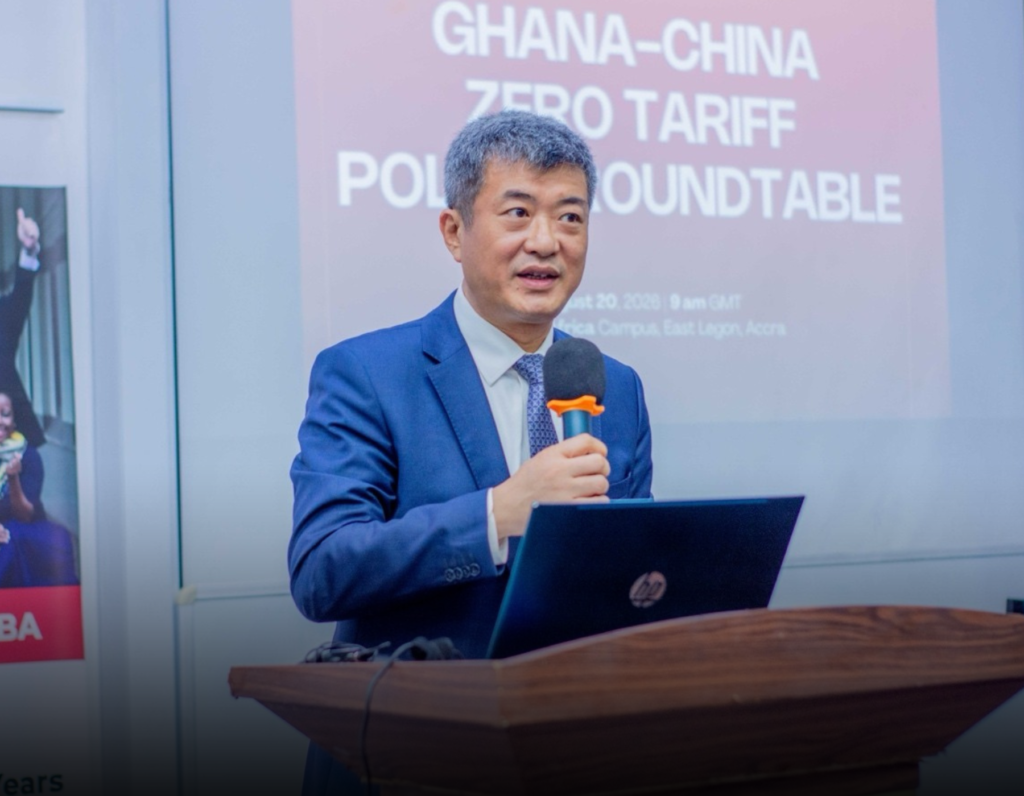
China’s Ambassador to Ghana, H.E. Cong Song, has outlined three areas he believes could help translate China’s zero-tariff policy into greater trade and industrial opportunities for Ghana: Access, Alignment and Advocacy.
Speaking at the Ghana–China Zero Tariff Policy Roundtable in Accra, convened by the China Europe International Business School (CEIBS Africa) and the Africa–China Centre for Policy & Advisory (ACCPA), Ambassador Cong said the policy creates new opportunities for Ghanaian products to enter the Chinese market, but practical barriers must be addressed for those opportunities to deliver tangible results.
China began implementing zero-tariff treatment on all products from 53 African countries with diplomatic relations with China on May 1, 2026.
Access: Lowering the cost of entering China
Explaining the first “A”, Access, Ambassador Cong said zero-tariff treatment lowers the cost of African products entering China and could improve their competitiveness.
He cited cocoa as an example, noting that Ghanaian cocoa previously faced tariffs ranging from 8 to 22 percent. He identified cocoa products, cashews, shea butter, textiles and handicrafts among products that could benefit from greater opportunities in the Chinese market.
The Ambassador also pointed to recent trade figures, stating that Ghana’s exports to China reached US$2.67 billion in 2025, representing a 33.9 percent year-on-year increase. According to figures he cited from China’s General Administration of Customs, China’s imports from Ghana reached US$290 million in June 2026, up 166 percent from the previous month.
Alignment: Connecting trade with industrialisation
The second pillar, Alignment, focused on linking expanded trade with Ghana’s productive and industrial capacity.
Ambassador Cong argued that zero-tariff treatment could help attract investment, technology, equipment and managerial expertise while encouraging more African products to be processed locally before export.
This, he said, could increase value addition, support farmers and small businesses, strengthen industrial chains and contribute to more balanced and sustainable China–Africa trade.
Advocacy: Expanding trade openness
On Advocacy, Ambassador Cong situated the zero-tariff initiative within China’s broader approach to economic opening and South–South cooperation.
He described the policy as part of China’s efforts to implement commitments under the Forum on China–Africa Cooperation (FOCAC) and support a more inclusive global trading environment amid increasing protectionism and uncertainty in international trade.
From policy to practical results
Beyond the three “As”, the Ambassador acknowledged that translating preferential market access into actual trade would require further work.
He called for greater attention to three practical areas.
First, Ghana should identify products with the strongest export potential. He highlighted processed cocoa products—including chocolate, cocoa powder and cocoa butter—as well as cashew kernels, shea butter, pineapples, mangoes and coconuts. He called for assessment of their production volumes, processing levels, export readiness and international competitiveness.
Second, he called for examination of institutional bottlenecks, including cross-sector coordination, Rules of Origin certification and export customs clearance processes.
Third, Ambassador Cong stressed the need to better align Ghana’s supply capacity with Chinese market requirements, particularly in areas such as quality standards, inspection and quarantine, cold-chain logistics, processing capacity and large-scale production.
He emphasised that while zero-tariff treatment opens the door to the Chinese market, Ghanaian products must still satisfy the conditions necessary to enter and compete successfully.
The Ambassador therefore encouraged policymakers, businesses and researchers to identify implementation bottlenecks and develop practical solutions capable of turning the zero-tariff policy into industrial growth and tangible benefits for Ghana.