
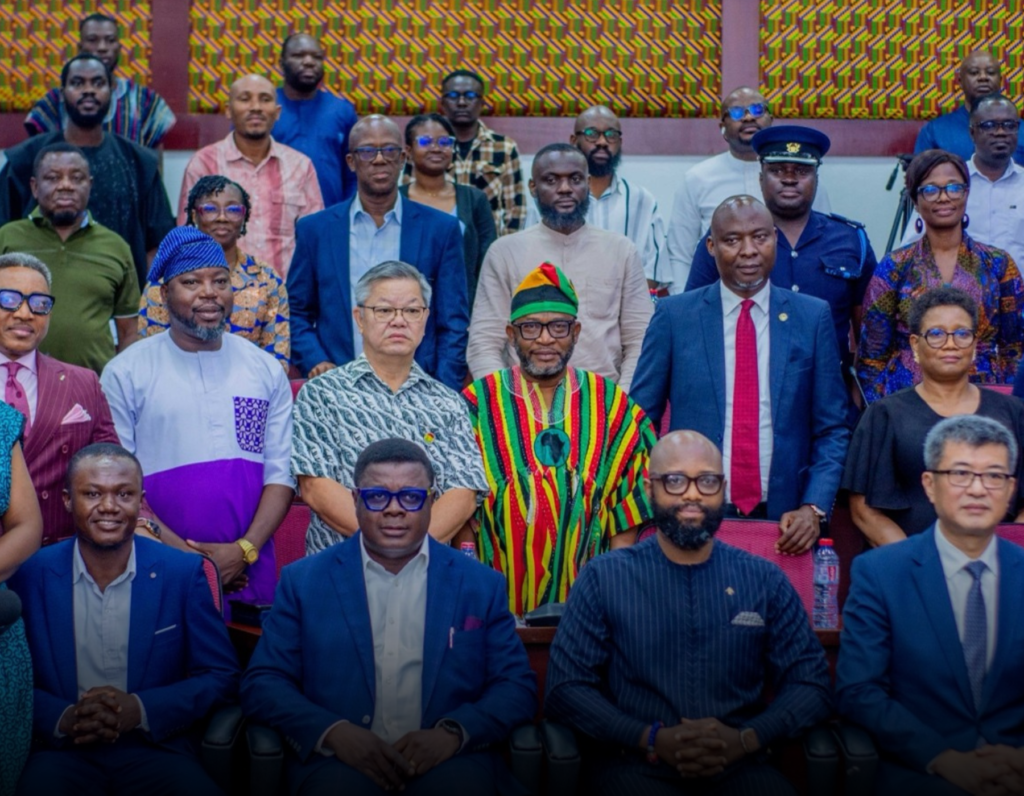
The Africa-China Centre for Policy & Advisory (ACCPA) and China Europe International Business School (CEIBS Africa) have convened a high-level policy roundtable in Accra to examine how Ghana can translate China’s zero-tariff policy into increased exports, stronger competitiveness and deeper commercial engagement with the Chinese market.
The Ghana–China Zero Tariff Policy Roundtable brought together senior representatives from government, regulatory institutions, the private sector, financial institutions, academia, exporters and the Chinese business community for a practical discussion on the opportunities and challenges associated with the policy.
Speaking at the Roundtable, Paul Frimpong, Executive Director of ACCPA, underscored the need to move the conversation beyond preferential market access towards the practical conditions that will determine whether Ghanaian businesses can successfully compete in the Chinese market.
Prof. Gordon Adomdza, Director of CEIBS Africa, also highlighted the importance of bringing policymakers and businesses together to interrogate the practical constraints confronting Ghanaian exporters and identify solutions capable of translating trade opportunities into commercial outcomes.
Delivering a keynote address, Chinese Ambassador to Ghana H.E. Cong Song framed the zero-tariff opportunity around three areas—Access, Alignment and Advocacy. He noted that while the policy lowers the cost of African products entering China, further work is required to identify priority Ghanaian products, address institutional bottlenecks and align domestic production and standards with Chinese market requirements.
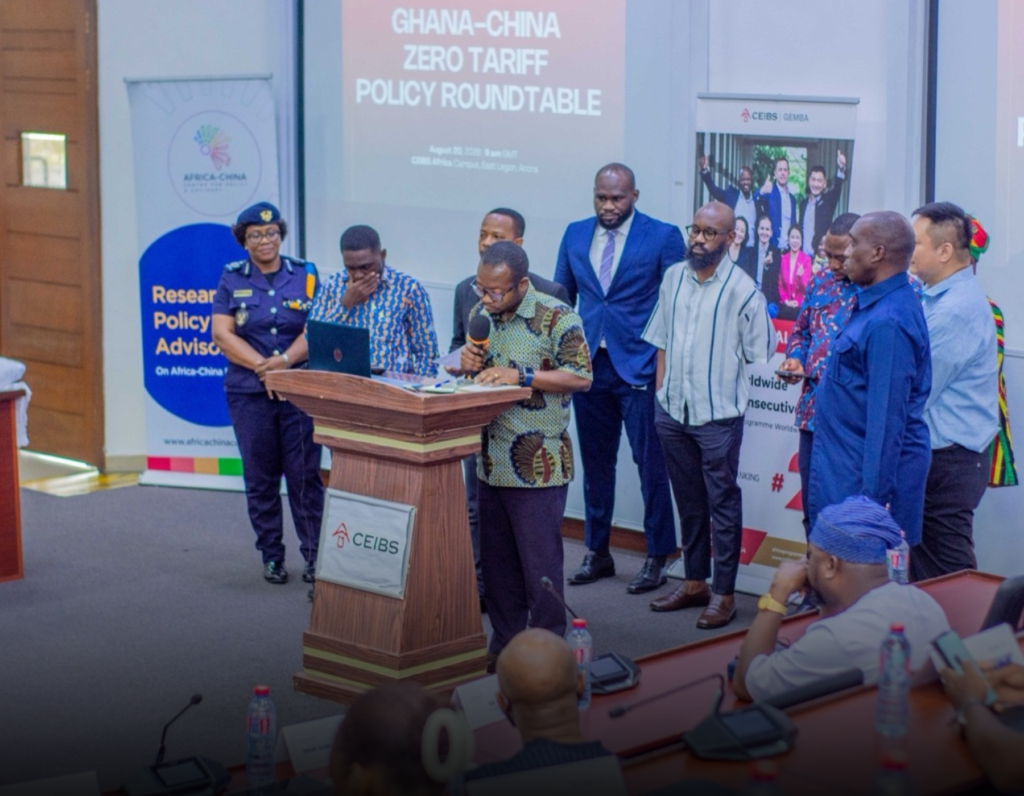
Rather than adopting a conventional panel format, the Roundtable featured an interactive Zero Tariff Policy Lab, where participants were divided into groups and presented with practical case scenarios reflecting challenges Ghanaian businesses could encounter in seeking to take advantage of the policy.
The cases focused on export readiness and production scale; standards, certification and regulatory market access; Chinese buyer linkages and market intelligence; trade finance and logistics; and value addition and industrialisation.
Participants subsequently presented their solutions for scrutiny and discussion by the wider Roundtable.
Among the issues emerging from the discussions were the need for more targeted export financing, stronger coordination among trade and regulatory institutions, improved access to information on standards and certification, greater production capacity, warehousing and aggregation systems, stronger buyer linkages, and increased domestic processing. Participants also explored contract farming, fintech-enabled financing, equipment leasing, Chinese–Ghanaian joint ventures and a proposal for a dedicated Ghana–China Zero-Tariff Fund to support export financing.
The discussions further emphasised that tariff preferences alone would not guarantee export success. Ghanaian businesses would still need to satisfy applicable market requirements, produce at sufficient scale and quality, secure reliable financing, and develop commercially viable routes into the Chinese market.
The Roundtable forms part of efforts by ACCPA and CEIBS Africa to facilitate practical policy and business dialogue around Ghana–China economic cooperation and generate actionable recommendations for strengthening Ghana’s capacity to benefit from emerging trade opportunities.