

By Isatou Keita, The Gambia
At 4am, while most of The Gambia is still asleep, Adama Bah is already preparing for class.
Hours before her 8:30am lecture at the University of The Gambia’s Faraba Banta campus, she leaves home for Sukuta Traffic Lights, hoping to secure a seat on one of the buses transporting students to campus.
For Adama, waking before dawn is not a matter of discipline or punctuality. It is a necessity.
Arrive late at the pickup point, and the buses may already be full. That can mean waiting for another bus, squeezing into an overcrowded vehicle, or, in some cases, missing classes altogether.
The journey from Sukuta to Faraba is roughly 30 kilometres. Yet for many students, distance is not the greatest obstacle. Uncertainty is.
Will the bus arrive? Will there be enough seats? Will they make it to class on time?
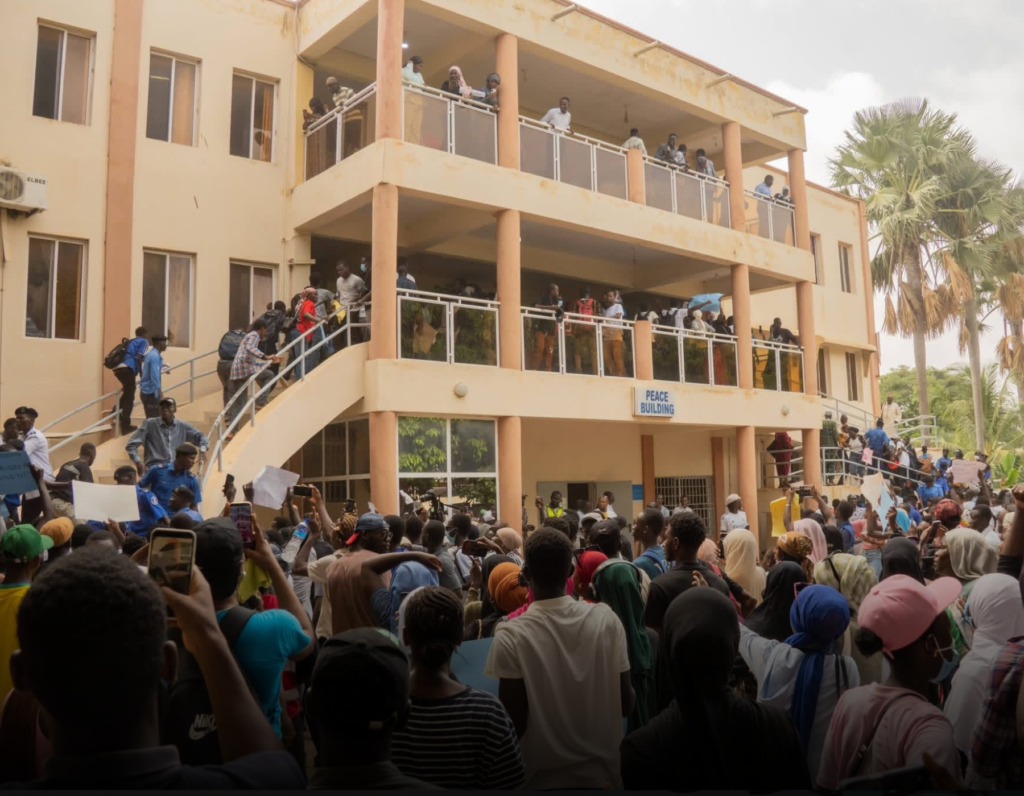
Those questions have become part of daily life for many students and were among the concerns that sparked a protest on October 26, when hundreds of University of The Gambia students gathered at the university’s former Kanifing campus to demand improvements in transportation, access to food, drinking water, internet connectivity, and other essential services.
For many students, university begins long before the first lecture.
Students often gather at designated pickup points before sunrise, forming queues and hoping buses will arrive as scheduled. Missing one bus can mean a lengthy delay. On some occasions, students say buses fail to show up altogether, forcing them to return home and miss lectures or assessments.
What should be a routine commute can quickly become a daily calculation of risk and timing. How early is early enough? How long will the wait be? Will there be room on the bus?
Even when transportation arrives, the journey is not always comfortable. Students have reported travelling in overcrowded conditions, packed tightly together for much of the trip.
The situation raises a simple but important question: how much effort should a student expend getting to a classroom before learning can even begin?
The challenges at Faraba do not end once students arrive on campus.
Students have also raised concerns about access to food, drinking water, and reliable internet connectivity. These are not conveniences. They are fundamental elements of a learning environment.
Without access to affordable meals, students may spend money they cannot afford or spend long hours in lectures without eating. Without reliable internet, research, assignments, and academic communication become more difficult. Without safe drinking water, another basic need remains unmet.
At the October protest, Students’ Union Vice President Adama Sanyang described students being packed into buses and expressed concern about students fainting during journeys.
“We have been through a lot,” she said.
The protest was not an isolated event.
In March 2024, students also demonstrated over transport shortages and access to clean water at the Faraba campus. More than a year later, many of the same concerns persist, prompting questions about whether earlier interventions went far enough to address the underlying challenges.
The Faraba campus was built to expand access to higher education and create space for the university’s growing population. Yet students argue that access to education is about more than buildings and lecture halls. It also depends on the systems that make learning possible every day.
For Adama, those challenges are not policy discussions or administrative concerns. They shape her daily routine, determining when she wakes up, how she travels, and whether she arrives in class ready to learn.
Following the protest, the government announced several measures, including the restoration of catering services, the installation of additional water dispensers, improvements to internet services, and the deployment of the full fleet of university buses.
Higher Education Minister Professor Pierre Gomez has also visited the campus to assess the situation and monitor progress.
These measures have offered hope that conditions may improve. But students say the real test lies not in announcements, but in outcomes.
For Adama, success is straightforward. It means buses arriving on time, enough seats for students, reliable services on campus, and the ability to leave home at a reasonable hour without fear of missing class.
Students’ Union President Ismaila Fadera has also questioned why stronger engagement occurred only after the protest was announced, noting that students had sought dialogue before taking to the streets.
“Students deserve transparency,” he said.
His remarks point to a broader issue of accountability. Students want clear information about what is being done, when improvements will happen, and how those improvements will be sustained.
The challenges facing students at Faraba reflect a wider conversation taking place across the world.
From crowded commuter trains serving universities in major African cities to housing shortages affecting students in Europe and North America, access to higher education is increasingly understood as more than admission to a university. The ability to reach classrooms safely, access learning resources, and study in a supportive environment has become an important part of educational success.
Universities around the globe continue to invest in infrastructure and expand enrolment. Yet student experiences often show that the value of those investments depends on the quality and reliability of the services that support everyday learning. A university campus may be built for thousands of students, but its success is ultimately measured by how effectively students can use it.
At Faraba, that reality is playing out every day.
The debate surrounding transportation, water, internet access, and food services is not simply about convenience. It is about ensuring that students can participate fully in their education without barriers that consume their time, energy, and resources.
As The Gambia prepares for its presidential election on December 5, education remains central to the country’s future. The experiences of students at UTG have brought renewed attention to the practical conditions that shape higher education and the responsibility of institutions to respond to the needs of those they serve.
For students at Faraba, quality education is measured not only by what happens inside the lecture room but also by the conditions that make learning possible.
For Adama Bah, that conversation begins long before sunrise.
At 4am, she joins a queue at Sukuta Traffic Lights alongside hundreds of other students pursuing the same goal: an education.
The question now is whether the journey to that education can become less of a daily struggle and more of what it was always meant to be: a pathway to opportunity.