

By Isatou Keita
Across Africa, journalists are navigating an increasingly difficult environment.
Many work without secure contracts, earn low or irregular incomes, face threats to their safety, and operate under growing political and economic pressures. Now, the rapid rise of artificial intelligence (AI) is introducing new opportunities but also fresh concerns about misinformation, job security, and the future of quality journalism.
Against this backdrop, African journalism leaders have adopted a continental action plan aimed at promoting the responsible use of AI, improving working conditions, and strengthening media freedom across the continent.
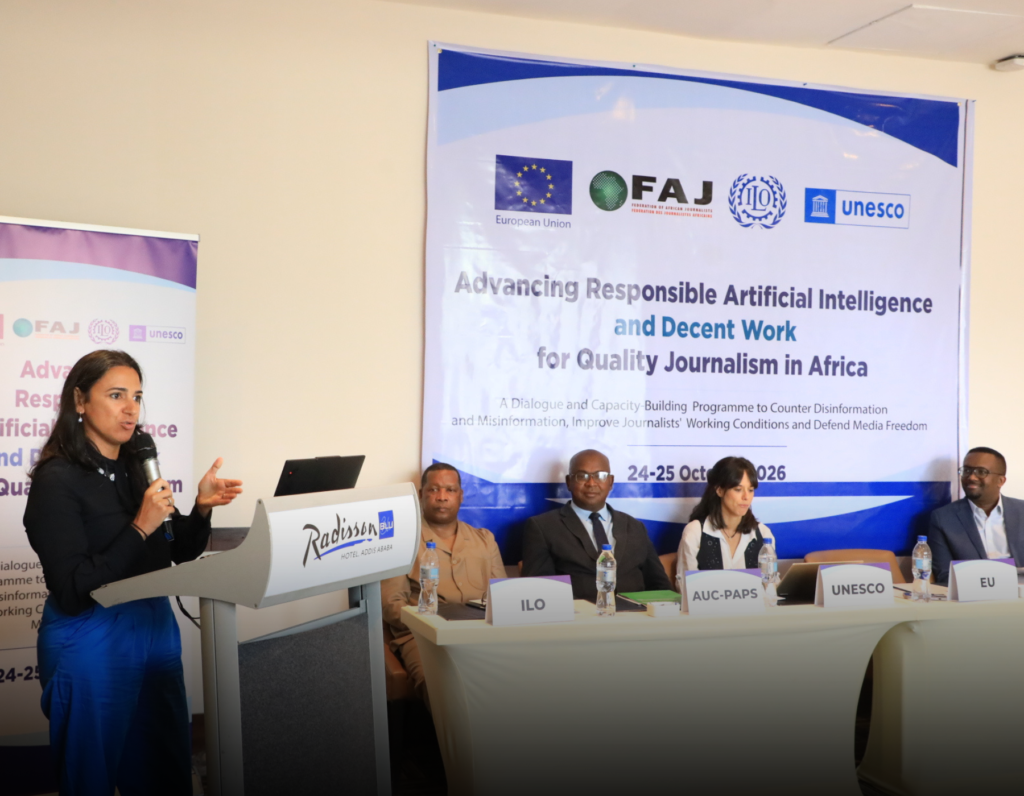
The plan was endorsed at the conclusion of a two-day dialogue and capacity-building programme convened by the Federation of African Journalists (FAJ) in Addis Ababa, Ethiopia, from October 24-25, 2026.
Held under the theme “Advancing Responsible Artificial Intelligence and Decent Work for Quality Journalism in Africa,” the programme brought together journalist leaders, alongside representatives of the African Union Commission (AUC), UNESCO, the International Labour Organization (ILO), and the European Union (EU).
Their discussions focused on a growing concern within the media sector: how to harness the benefits of AI without undermining journalism’s core principles of accuracy, accountability, and public trust.
Participants recognised that AI is already reshaping newsrooms around the world. Tools powered by AI are increasingly being used for research, translation, audience engagement, and content verification. In resource-constrained media environments, these technologies could help journalists work more efficiently and reach wider audiences.
However, participants also warned that the same technologies can be used to create fabricated content, impersonate trusted news sources, and accelerate the spread of misinformation and disinformation. They stressed that without adequate safeguards, AI could deepen existing challenges confronting the media industry.
The conversation extended beyond technology to the realities many journalists face in their daily work.
Participants reflected on persistent concerns over low pay, delayed salaries, insecure employment, the absence of contracts, inadequate social protection, and pressures that can undermine editorial independence. They also explored how increasing automation and cost-cutting measures could reduce employment opportunities in already strained newsrooms.
For many participants, the future of responsible AI cannot be separated from the broader struggle for decent work.
“Artificial intelligence must not deepen the precarious conditions in which journalists across the continent continue to work,” said FAJ President Omar Faruk Osman.
“When journalists lack decent working conditions, quality journalism is weakened and consequently, disinformation and misinformation gain ground. This is why we believe the responsible use of AI, decent work and media freedom are closely interconnected.”
He added that journalists need not only digital skills but also fair working conditions, editorial independence, and the ability to apply human judgement in an increasingly technology-driven media environment.
Throughout the programme, participants emphasised that AI should serve as a tool to support journalism rather than replace journalists.
Beyond labour concerns, safety and media freedom featured prominently in the discussions.
Participants expressed concern about continuing attacks on journalists across Africa, including physical violence, legal harassment, digital surveillance, and online abuse. Particular attention was given to the growing levels of online harassment targeting women journalists, a challenge increasingly recognised as a threat to both press freedom and gender equality in the media sector.
The discussions were informed by FAJ’s recent continental survey on journalists’ working conditions, safety, labour rights, and media freedom. The survey, supported by the ILO, the EU, and UNESCO through the Multi-Donor Programme on Freedom of Expression and Safety of Journalists, gathered responses from 1,586 journalists across 45 African countries, making it the first journalist-led survey of its scale on the continent.
Participants said the findings provide an important evidence base for engaging governments, media owners, development partners, and other stakeholders on reforms needed to strengthen the profession.
While the challenges discussed in Addis Ababa are particularly pressing in Africa, participants noted that they mirror debates taking place across the world. From concerns about AI-generated misinformation in election periods to growing uncertainty about the future of newsroom jobs, media organisations globally are grappling with how technological change is reshaping journalism.
The difference for many African journalists is that these changes are unfolding alongside existing challenges related to safety, labour rights, and media sustainability.
The newly adopted action plan seeks to address these interconnected issues by advancing responsible AI governance, protecting journalists’ rights, promoting decent work, and defending media freedom.
FAJ said it will work with its member organisations, the African Union, regional bodies, organised labour, UN agencies, human rights organisations, and other partners to advance the plan and advocate for meaningful reforms.
For African journalists, the message emerging from Addis Ababa was clear: the future of journalism will not be determined by technology alone. It will also depend on whether journalists have the freedom, security, and support needed to serve the public interest in an increasingly complex information landscape.
[/ihc-hide-content]