

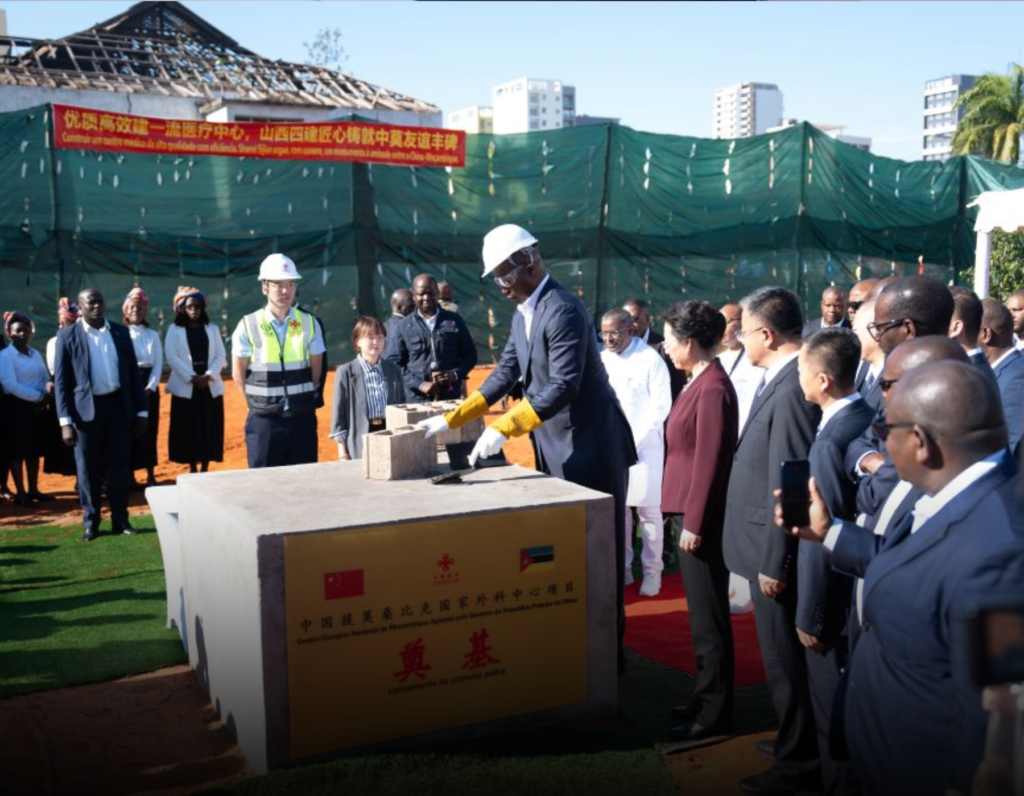
Mozambique’s capital marked the start of one of its most ambitious healthcare projects in years on Monday, as officials broke ground on a China-aided National Surgical Center designed to keep more Mozambicans from having to leave the country for complex medical care.
The complex will rise within the grounds of Maputo Central Hospital. Comprising a surgical center building and two utility buildings spread across more than 20,000 square meters of floor space. Once complete, the eight-story facility, with an additional basement level, will house emergency and trauma services, a medical imaging department, a pharmacy, laboratories, 14 operating rooms, a 19-bed intensive care unit and 456 inpatient beds. Giving Mozambique a level of surgical capacity officials say the country has long needed.
President Daniel Chapo, addressing the ceremony, called the groundbreaking the start of a new stage in Mozambique’s capacity to save lives and treat complex diseases. One that would let more Mozambicans access specialized medical care without having to travel abroad for it. Describing Mozambique and China as “brotherly countries,” Chapo said. The two nations have built a solid partnership over decades, grounded in mutual respect, political trust and a shared commitment to finding development solutions that benefit both peoples. “This friendship is once again being translated into an investment that will have a direct impact on the lives of thousands of Mozambican families,” he said. Adding that he expects the project to stand as another significant symbol of the long-running cooperation between the two countries, particularly in public health.
Chinese Ambassador to Mozambique Zheng Xuan said Beijing has always prioritized people’s health. Placing real importance on supporting the development of Mozambique’s healthcare sector. Pointing to China’s continuous work dispatching medical teams, providing training and supplying equipment and medicines to the country as evidence of that commitment.
The surgical center adds a major new chapter to a health partnership that already runs deep. China has dispatched 26 medical teams to Mozambique since 1976. A near-uninterrupted, five-decade run of clinical cooperation that officials on both sides describe as one of the most people-centered aspects of the broader bilateral relationship. That legacy sits alongside newer forms of collaboration, including agricultural technical assistance. Chinese rice and agro-processing experts have spent recent months at Maputo Province’s Umbeluzi Agricultural Station. Training local technicians in cultivation techniques as part of a broader push to strengthen Mozambican food security.
Monday’s groundbreaking arrives during a milestone year for the relationship more broadly: 2026 marks the tenth anniversary of China and Mozambique’s comprehensive strategic cooperative partnership. And the two countries have used the occasion to point to a string of tangible infrastructure gains. Chief among them is the Maputo-Katembe Bridge, built by China Road and Bridge Corporation and now recognized as Africa’s longest suspension bridge by main span. A crossing that has cut travel time across Maputo Bay from four or five hours by ferry down to five or ten minutes by car. Which locals have taken to calling the “bridge of dreams.” President Chapo has cited the bridge, alongside the Maputo Ring Road, Maputo International Airport and a jetty bridge on Inhaca Island. These are concrete evidence of what Chinese-backed infrastructure cooperation has delivered for ordinary Mozambicans.
Water infrastructure has followed a similar pattern: a project built by China Henan International Cooperation Group in Maputo’s suburbs now benefits nearly 72,000 residents. Adding roughly 30,000 cubic meters of daily water supply capacity, according to Mozambique’s Minister of Public Works, Housing and Water Resources, Fernando Rafael. Beyond the capital, a graphite processing plant built by Jinan Yuxiao Group in northern Niassa Province has tapped into Mozambique’s substantial mineral reserves. Graphite alone accounted for roughly 60 percent of China’s imports from Mozambique in recent years. Alongside other minerals, fisheries products and agricultural goods.
Beyond infrastructure and health, Mozambique’s natural gas reserves have increasingly become a focal point of the relationship. Chinese financing and technical support help make large-scale energy projects viable at a moment when global energy markets remain unsettled. Cooperation that serves China’s own interest in diversifying energy supply while giving Mozambique a path to developing reserves it could not finance alone. China ranks among Mozambique’s top trading partners, alongside South Africa and India. Trade flowing substantially through the ports of Maputo, Beira and Nacala. Diplomatic ties between the two countries date to June 1975, shortly after Mozambique’s independence. Mozambique became the first African nation to sign a Global Strategic Partnership Cooperation agreement with Beijing. A distinction officials on both sides continue to cite as evidence of the relationship’s depth.
More than 20 agreements were signed during a recent high-level exchange between the two governments this year. Spanning infrastructure, healthcare, trade and digital development. Analysts tracking the relationship say that cooperation is increasingly aimed at linking Chinese investment directly to local production and everyday economic activity.
The surgical center’s groundbreaking also lands within China’s designated 2026 Year of People-to-People Exchanges with Africa. A framing Chinese officials have used across the continent this year to emphasize cultural and social cooperation alongside trade and infrastructure. For Maputo Central Hospital, though, the immediate significance is more concrete. A facility that, once complete, is meant to give Mozambican doctors the operating rooms, imaging equipment and bed capacity to treat conditions that currently send patients abroad. Converting decades of medical-team rotations and equipment donations into a permanent, expanded piece of the country’s own healthcare infrastructure.