

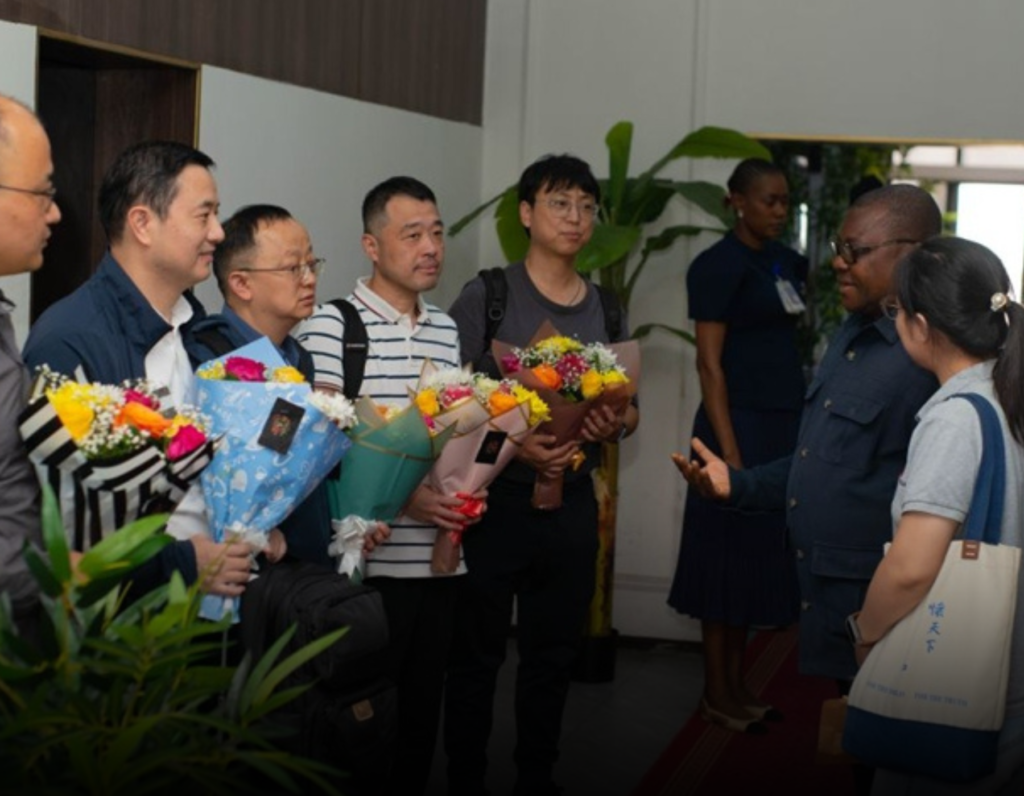
China’s third medical expert team for the Ebola response touched down in Kinshasa on Saturday. Arriving at a grim milestone: the World Health Organization confirmed the same day that the Democratic Republic of the Congo’s current outbreak has become the largest ever recorded in the country. Surpassing even the devastating 2018-2020 epidemic that once ranked among history’s deadliest.
Luku Maleyo Marius, a representative of the DRC’s health ministry, welcomed the team at the airport. Telling them plainly that the Ebola situation across the country remained severe. And that response efforts continued to face considerable pressure. He said the arrival of the Chinese experts would provide strong support for epidemic surveillance, patient treatment and laboratory testing. And added that the DRC stands ready to further strengthen cooperation with China to jointly enhance its epidemic response capacity.
Yang Xiaochen, head of the third expert team, said the group would build directly on the work of the two teams that preceded it. Continuing to provide technical assistance shaped by practical response needs on the ground. While deepening exchanges and cooperation with both DRC health authorities and international partners already engaged in the response. The team’s mission, he said, is to contribute Chinese expertise toward bringing the outbreak to an early end.
China’s medical involvement in the current outbreak began shortly after the World Health Organization declared it a public health emergency of international concern on May 17. The first Chinese anti-epidemic medical expert team arrived in Kinshasa on June 2 for what was initially framed as a three-month mission. Followed by a second team on July 3. According to China’s National Health Commission, the newly arrived team is tasked with conducting in-depth technical guidance at the grassroots level. Improving local epidemic response procedures, strengthening the joint prevention and control mechanism. Aimed at expanding on the results the first two rotations have already achieved.
Jiang Rongmeng, vice president of Beijing Ditan Hospital and a member of the first expert team, told Chinese media in June that early detection and timely intervention remain the key factors in reducing Ebola’s mortality rate. Regardless of which viral strain is driving a given outbreak, underscoring why the response’s surveillance and rapid-testing components. The Chinese teams have specifically supported, carry such outsized importance. China’s National Health Commission has framed the broader mission in explicitly diplomatic terms as well. Describing support for Africa’s Ebola response as a clear example of building what officials call an all-weather China-Africa community with a shared future. Tying the effort to the ten partnership actions agreed at the 2024 FOCAC summit in Beijing.
The scale of what the third team is walking into has grown considerably since the earlier rotations arrived. As of the most recent figures released by DRC public health authorities, confirmed Ebola cases in the country had climbed to 3,532. With 1,556 confirmed deaths, a toll that has now made this outbreak the country’s worst on record. Ahead of the 2018-2020 epidemic in eastern DRC that killed more than 2,280 people and previously ranked as the second-deadliest Ebola outbreak in history. After the 2014-2016 West African epidemic. The current outbreak is caused by Bundibugyo virus, an Ebola species with no licensed vaccine and a historical fatality rate estimated between 25 and 50 percent. First identified in Ituri Province in May before spreading into North Kivu and beyond.
China’s financial contribution to the response has kept pace with the deployments. Beijing has now committed $4.5 million in direct emergency funding to Africa’s Ebola response. A sum Africa CDC Director General Jean Kaseya publicly commended in a July meeting with Chinese officials in Addis Ababa. Calling the support “a powerful expression of solidarity” at what he described as a critical moment for the continent.
China’s health diplomacy in the DRC continues to unfold alongside a bilateral relationship still defined substantially by mining. Chinese firms including CMOC Group, Zijin Mining and Huayou Cobalt dominate large segments of the DRC’s mining sector. A country that alone accounts for roughly 70 percent of global cobalt production. And Beijing remains the DRC’s largest bilateral creditor. That resource-driven relationship has periodically drawn scrutiny from auditors and civil society groups. Most notably around the renegotiated Sicomines infrastructure-for-minerals arrangement. Though Chinese officials have consistently pointed to projects like a newly inaugurated water treatment plant in Kamina and the current medical mission. As evidence the relationship delivers tangible public goods beyond commercial extraction.
Congolese cobalt exports have also gained duty-free access to the Chinese market under Beijing’s zero-tariff policy for African goods. Which took effect in May 2026. Adding a trade dimension to a relationship increasingly stretched across health, infrastructure and resource cooperation simultaneously.
For health workers now confronting the largest Ebola outbreak in DRC’s history. Though, the immediate priority is narrower than any of that broader context. Getting a third rotation of Chinese specialists into surveillance posts, laboratories and treatment centers fast enough to help bend a case curve that, as of Saturday, was still climbing in the wrong direction.