

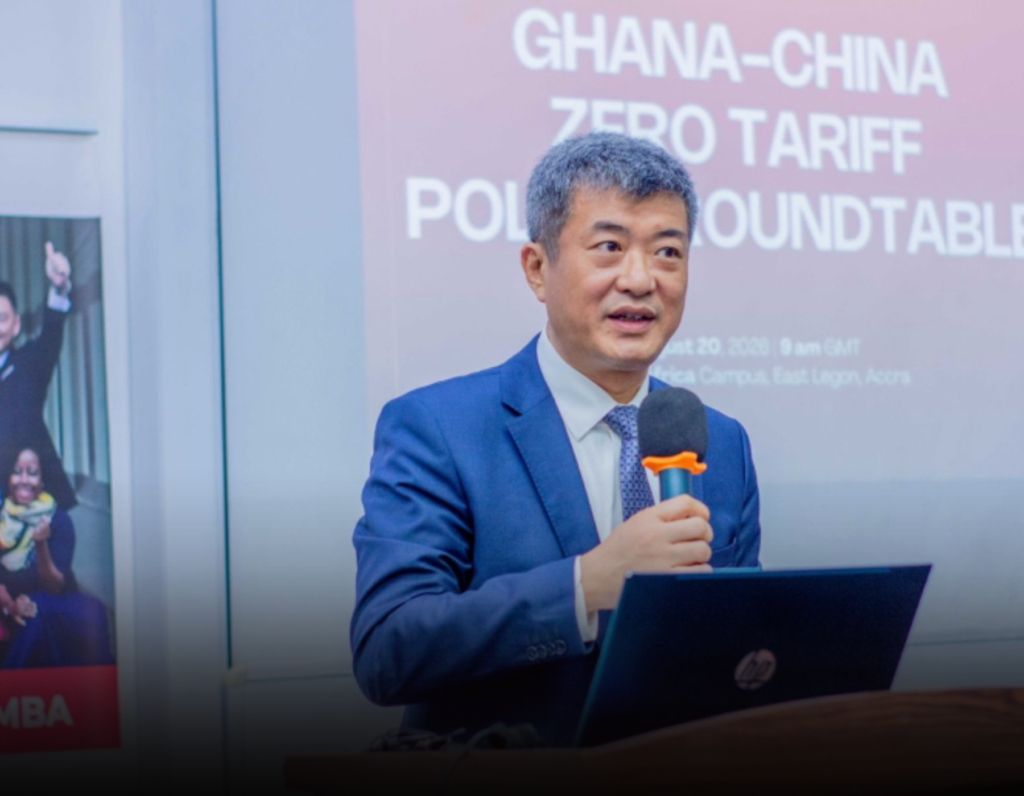
Chinese Ambassador Cong Song says Beijing is ready to support Ghana’s economic transformation through artificial intelligence, green technology, industrial upgrading and mining expertise. But with no specific financing package or projects announced, the real test will be whether the offer translates into technology transfer, local production and jobs.
Ghana’s US$10 billion economic transformation programme is opening another potential front in its economic partnership with China, with Beijing signalling readiness to support the country’s ambitions in artificial intelligence, green technology, industrial upgrading and mineral processing.
Chinese Ambassador to Ghana, Cong Song, says China is prepared to share its development experience, transfer appropriate technologies and work with Ghana to strengthen local technical capacity and its innovation ecosystem.
The offer comes as Ghana prepares to implement its New Economy Programme, a four-year initiative announced in the 2027 Budget to increase domestic production, expand value addition and create employment.
Speaking at a press briefing in Accra on Monday, November 16, the Ambassador said the two countries could align China’s 15th Five-Year Plan with Ghana’s 24-Hour+ Economy and Reset Ghana Agenda to identify areas of shared interest.
The briefing focused on the outcomes of the Fifth Plenary Session of the 20th Central Committee of the Communist Party of China, held in Beijing from October 26 to 29.
Cong identified artificial intelligence, green technology, industrial upgrading, green agriculture and sustainable mining as areas with considerable potential for cooperation.
“There is considerable potential for cooperation between China and Ghana in areas such as talent training, smart healthcare and many other areas,” he said.
A $10bn programme looking for productive partnerships
Ghana’s New Economy Programme is expected to run from 2027 to 2030, with the government projecting total investment of US$10 billion over the period.
The 2027 Budget earmarks GH¢30 billion for the programme, equivalent to 1.5 per cent of GDP. Its eight pillars cover commercial agriculture, energy infrastructure, critical minerals value addition, tourism and creative arts, textiles and garments, pharmaceuticals and biomanufacturing, technology, and macroeconomic stability and affordable finance.
The programme is designed to shift the economy towards higher domestic production, processing and productivity, with the private sector expected to play a central role.
For Ghana, the attraction of China’s offer lies in the possibility of connecting this ambition to the experience of a country that has developed substantial industrial and technological capabilities.
Cong cited China’s artificial intelligence industry, which he said was valued at more than 1.2 trillion yuan in 2025, with over 6,600 AI enterprises. He also pointed to China’s electric vehicle industry, which produced approximately 16.6 million vehicles and sold nearly 16.5 million in the same year.
The figures were presented as evidence of the importance of sustained investment in research, innovation, technology and domestic production.
But the relevance to Ghana will depend less on the scale of China’s technological achievements than on whether Ghanaian institutions, businesses and workers can acquire the skills and productive capacity to participate in those industries.
Beyond importing electric vehicles
One of the clearest areas where the Ambassador outlined a more practical form of cooperation was electric mobility.
Cong urged Chinese electric vehicle manufacturers operating in Ghana to move beyond importing and selling vehicles by investing in maintenance facilities, technical training and local capacity development.
He also encouraged Chinese companies to partner Ghanaian educational institutions to establish training programmes and research and development facilities.
The Ambassador cited ongoing discussions between Chinese enterprises and educational institutions, including the Kumasi Technical Institute, on possible collaboration in electric vehicle training and skills development.
Such cooperation could help address a critical gap in Ghana’s emerging electric mobility market: the availability of trained technicians and local facilities capable of maintaining and repairing electric vehicles.
It could also provide a pathway for technical institutions to develop specialised programmes that prepare young Ghanaians for new areas of industrial employment.
However, the reference to ongoing discussions does not yet amount to a confirmed training centre, investment commitment or implementation agreement. The institutions and companies involved, the scale of the proposed collaboration and its timeline remain important details to establish.
Mining: the bigger question of value addition
The Ambassador’s comments on mining may carry particular significance for Ghana’s industrial ambitions.
Cong said China wanted its cooperation with Ghana and other African countries to move beyond the extraction and export of raw materials towards local processing, industrial development and value addition.
He said Chinese companies were being encouraged to introduce environmentally friendly technologies, establish local processing facilities and train Ghanaian workers.
He also emphasised that Africa’s mineral resources belonged to Africans and that partnerships should be guided by mutual benefit, sustainable investment and respect for national development priorities.
The position aligns with one of the central objectives of Ghana’s New Economy Programme: to capture more value from the country’s natural resources before they leave its shores.
The government has identified critical minerals value addition as one of the programme’s eight pillars, with an estimated US$1.5 billion expected to be directed towards the sector. Its stated targets include expanding local gold refining and increasing the domestic processing of manganese and bauxite.
For Ghana, the challenge is not simply attracting companies to extract minerals. It is securing investment in processing plants, technology, skills and supporting industries that can create a broader domestic industrial base.
China’s offer could be relevant to that ambition. But the development impact will depend on the terms of investment, the extent of local participation, environmental safeguards and the share of value retained within Ghana.
Can Ghana turn technology cooperation into local capacity?
Ghana has already launched its National Artificial Intelligence Strategy and is advancing the One Million Coders Programme. Cong identified these initiatives as potential entry points for cooperation in talent development, technology transfer and innovation.
The possibilities extend beyond developing software skills. Cooperation in AI could support applications in agriculture, healthcare, manufacturing and public services, while partnerships in green technology could help strengthen Ghana’s response to energy and environmental challenges.
Yet technology transfer is not automatic. It requires structured partnerships, research collaboration, technical training, institutional capacity and opportunities for local businesses to apply and adapt the technologies.
Ghana will therefore need to define the specific capabilities it wants to acquire, the institutions responsible for implementation and the measurable outcomes expected from each partnership.
The missing details: investment, timelines and accountability
China’s expression of readiness to support the New Economy Programme is an important diplomatic and economic signal. It comes at a time when Ghana is seeking partners capable of supporting its industrialisation and technological transformation.
However, the announcement should not be mistaken for a Chinese financing commitment to the US$10 billion programme.
No specific Chinese funding allocation, approved project list, investment value or implementation timetable was announced in the reports of the briefing. The Ambassador spoke of potential cooperation, technology transfer, capacity building and the alignment of development priorities.
That leaves important questions for both governments and prospective investors.
Which projects under the New Economy Programme could attract Chinese participation? Will Chinese companies establish processing and manufacturing facilities in Ghana, or will cooperation remain concentrated on equipment supply and technical assistance? What mechanisms will ensure that technology transfer produces Ghanaian expertise, local jobs and stronger domestic businesses?
The answers will determine whether the offer becomes a meaningful contribution to Ghana’s economic transformation or remains a broad statement of diplomatic goodwill.
For Ghana, the priority should be to translate the areas identified by the Ambassador into specific, bankable partnerships with clear local-content expectations, training commitments, implementation timelines and measurable outcomes.
China has signalled that it is willing to be part of Ghana’s next phase of economic transformation. The next step is to establish exactly what that partnership will deliver—and how much of the resulting industrial and technological capacity will remain in Ghana.
[/ihc-hide-content]