

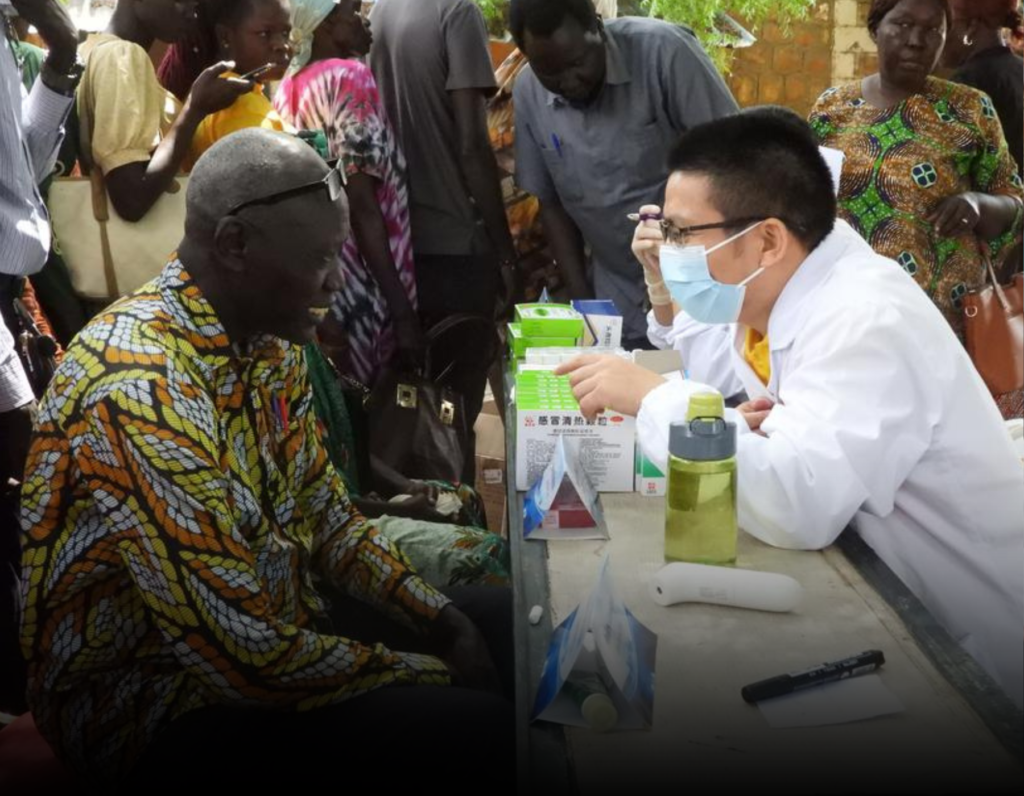
Health cooperation between China and South Sudan continues to expand as Chinese doctors provide specialised training to local medical students and young practitioners, helping strengthen the country’s capacity to diagnose and treat infectious and joint-related diseases.
Members of the 13th batch of the Chinese medical team in South Sudan recently delivered a day-long training session for medical students at Upper Nile University in Juba. The program focused on the diagnosis and treatment of joint diseases such as osteoarthritis as well as infectious and inflammatory conditions commonly seen in clinical practice.
The training was led by Chinese specialists in orthopedics and ear, nose and throat medicine, who shared clinical knowledge and practical treatment approaches with local students and interns. Among the participants was a young intern doctor who said the training offered valuable exposure to diseases such as osteoarthritis and tonsillitis, adding that it helped fill critical knowledge gaps for early-career medical professionals.
South Sudan’s healthcare system faces severe challenges, including shortages of trained specialists and limited access to advanced medical training. Initiatives like these are designed to strengthen local capacity while improving healthcare outcomes.
Chinese medical teams stationed in the country are largely based at Juba Teaching Hospital, the country’s largest referral facility with more than 500 beds and an affiliation with the University of Juba. The hospital provides secondary and specialised care for much of the nation’s population.
Beyond clinical services, the Chinese teams routinely train South Sudanese health workers and students. Previous outreach programs have included free medical consultations for university communities and local residents in Juba, with officials praising the teams for bringing specialist expertise to underserved populations.
China has maintained a continuous medical assistance program in South Sudan since 2012, sending rotating teams of doctors who work in hospitals, conduct outreach clinics, and provide training for local professionals. These teams also deliver medical supplies and support health facilities in remote areas.
Medical outreach activities have included free treatment campaigns and community consultations outside the capital, where Chinese physicians have treated hundreds of patients and provided medicines to health centers facing shortages.
Such initiatives form part of China’s broader medical diplomacy across Africa, where training and technology transfer are increasingly emphasised alongside clinical services.
Healthcare collaboration reflects a wider partnership between China and South Sudan that spans infrastructure development, energy cooperation, and technical training.
China has been involved in upgrading medical facilities in the country, including support for modernisation projects at Juba Teaching Hospital and the installation of an oxygen plant to strengthen intensive care and infectious disease treatment capacity.
Beyond the health sector, China remains a key economic partner for South Sudan. Chinese companies have long been active in the country’s oil industry – South Sudan’s main economic sector – while Chinese firms have also contributed to road construction, public infrastructure, and telecommunications development.
Education and skills exchange programs have also expanded, with South Sudanese students receiving scholarships to study in China in fields such as medicine, engineering, and public administration. These exchanges complement medical training programs delivered locally by visiting Chinese experts.
For South Sudan’s young medical professionals, the training sessions provide more than academic instruction – they offer exposure to international medical practices and specialised treatment methods that are often unavailable in the country.
Health officials say continued cooperation in medical education and hospital capacity building will be crucial for improving health outcomes in the young nation, which still faces high burdens of infectious diseases and limited medical infrastructure.
As China and South Sudan deepen cooperation in healthcare, initiatives like these training sessions highlight how knowledge transfer and professional development are becoming central pillars of the bilateral relationship.