

For a growing number of Egyptian students, learning Mandarin is no longer just about cultural curiosity – it is becoming a direct pathway to employment, professional growth, and participation in one of the fastest-expanding economic partnerships in the region.
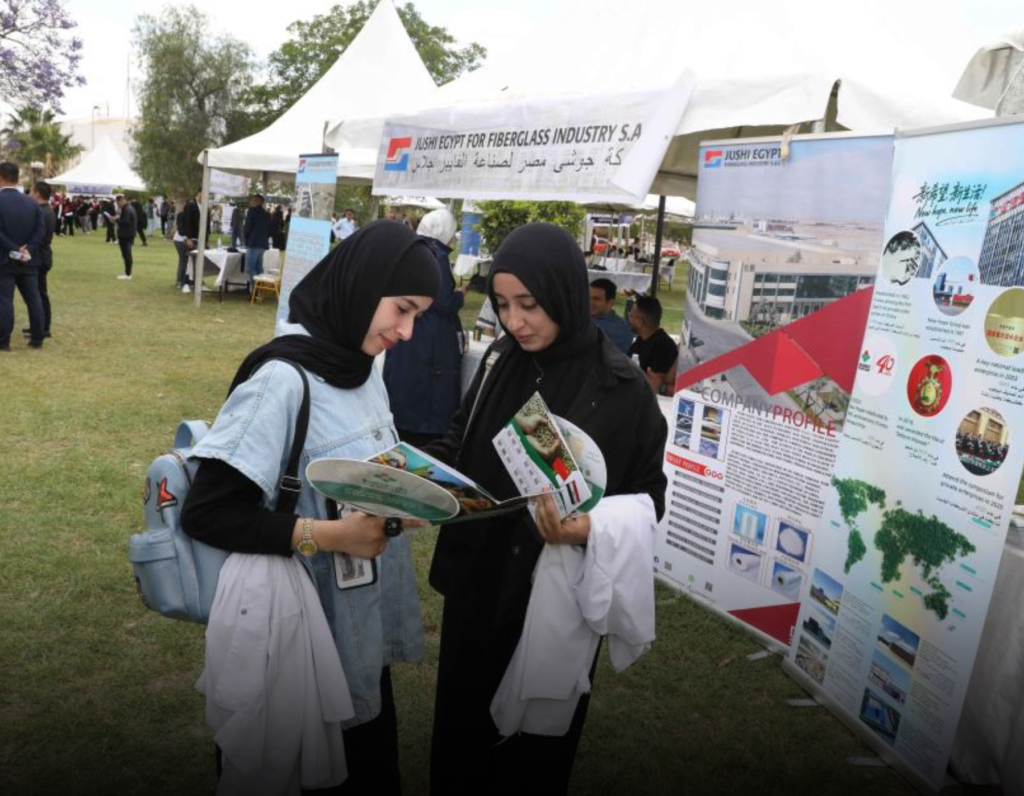
At Suez Canal University in Egypt’s Ismailia province, Chinese firms recently gathered for a campus recruitment fair that highlighted the increasing demand for Chinese-speaking graduates across sectors ranging from construction and energy to telecommunications and manufacturing.
The event reflected a larger shift in Egypt-China relations, where language education is increasingly tied to economic opportunity and workforce development.
According to Hassan Ragab, Egyptian director of the Confucius Institute at Suez Canal University, more than 2,500 Chinese companies are currently operating in Egypt, creating strong demand for graduates with Mandarin skills.
This year’s recruitment fair featured over 30 companies offering more than 200 job opportunities in fields such as administration, translation, engineering, logistics, and human resources.
For students, the message was clear: language is becoming a professional asset.
Mariam Saeed, a 2024 graduate, began her career through an internship with China State Construction Engineering Corporation before joining Anton Oilfield Services Group, where she now works full-time. Reflecting on her experience, she said working with Chinese firms exposed her to a different professional culture and broadened her outlook. She added that she believes “China represents the future.”
Interest in learning Chinese has grown steadily across Egypt over the past decade, fueled by expanding economic cooperation, scholarship opportunities, and rising Chinese investment.
Institutions such as the Confucius Institute at Cairo University and Suez Canal University have become important platforms for language and cultural exchange. Egypt was also among the first countries in North Africa to establish Confucius Institutes, reflecting the depth of educational cooperation between Cairo and Beijing.
Recruiters say Chinese-speaking graduates now possess a competitive edge in the job market, particularly within companies operating in the China-Egypt TEDA Suez Economic and Trade Cooperation Zone, one of the flagship industrial projects under bilateral cooperation.
The zone hosts a growing number of Chinese enterprises involved in manufacturing, textiles, renewable energy, and industrial production – sectors driving Egypt’s industrialization agenda.
China and Egypt share one of the Arab world’s most significant strategic partnerships. Diplomatic ties between the two countries date back to 1956, and relations have expanded substantially under the Belt and Road Initiative.
Today, cooperation spans infrastructure, technology, education, transport, renewable energy, and even space science.
Chinese companies have contributed to major Egyptian projects, including the Central Business District in Egypt’s New Administrative Capital, high-speed rail initiatives, and industrial development zones around the Suez Canal.
As economic engagement deepens, language proficiency is increasingly becoming a bridge between investment and local participation.
Observers say the growing intersection between language education and employment reflects a broader trend across Africa, where Mandarin skills are becoming more valuable in labor markets shaped by expanding China-Africa trade relations.
For many Egyptian students, studying Chinese now represents more than academic achievement – it is an investment in future employability within a globalized economy.
University officials also view the trend as evidence that education systems must evolve alongside economic realities, aligning training programs with emerging labor market demands.
Beyond employment, the recruitment fairs and language programs are strengthening people-to-people connections between Egypt and China.
Students are not only learning a language, but also navigating cultural exchange, business practices, and international collaboration. In many ways, campuses are becoming microcosms of the broader Egypt-China partnership itself.
As Chinese firms continue expanding their footprint in Egypt, demand for bilingual professionals is expected to rise even further.
For Egypt’s youth, that reality is transforming Mandarin from a niche academic subject into a gateway to global opportunity.