

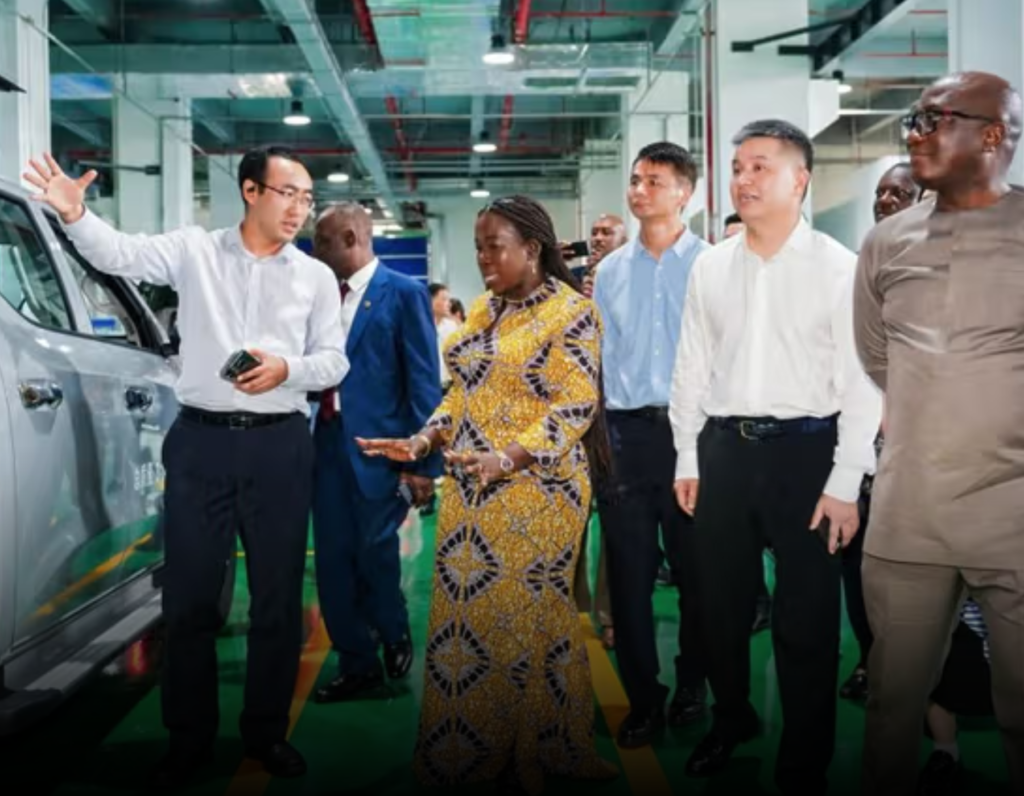
Ghana has taken a decisive step toward building a homegrown electric vehicle (EV) industry after signing two major China-backed agreements designed to accelerate local EV assembly and contribute to broader industrialisation goals. The deals – formalised in early 2026, signal a new era of cooperation between Accra and Beijing that blends technology transfer, investment facilitation, and strategic economic transformation.
The twin agreements focus on establishing EV assembly hubs in Ghana and bringing Chinese electric vehicle expertise, manufacturing know-how, and supply-chain partnerships to West Africa. They involve collaboration with Chinese EV manufacturers and institutional partners keen to support Ghana’s ambitions to become a regional centre for clean mobility. These breakthroughs come as global EV markets expand rapidly, and Africa strives to capture a portion of this high-growth sector.
According to government sources, the first agreement tasks a Chinese automotive and energy consortium, comprising established EV brands and component suppliers, with constructing an EV assembly plant in the Greater Accra Region, complete with battery integration and powertrain assembly lines. The second pact focuses on developing Ghana’s EV servicing and parts ecosystem, including training programmes for technicians, engineers and EV maintenance professionals across the country’s automotive sector.
This push positions Ghana as one of the first African countries to pursue integrated EV assembly – from kits imported from China to finished vehicles assembled locally, with plans to scale production to neighbouring markets. It aligns with Ghana’s Industrial Transformation Agenda and broader economic development blueprint, which sees automotive assembly and green technologies as key pillars of sustainable growth.
The EV agreements deepen an already robust China-Ghana economic relationship that spans infrastructure, education, health, ICT, and trade. In recent years, China has supported significant infrastructure investments, including road networks and market facilities, as well as educational initiatives such as scholarships and technical training partnerships. China’s involvement in Ghana’s transportation sector is not entirely new, Chinese firms have participated in bus fleet upgrades and taxi modernisation partnerships in Accra – but this marks a strategic shift toward electrified mobility and green industrial linkages.
According to recent data from the Ghana Export Promotion Authority, China has been among Ghana’s top trading partners, absorbing key exports and supplying manufactured goods, machinery and consumer technology. The new EV pacts leverage that trade relationship, adding value-added production and technology cooperation to the bilateral economic mix.
A cornerstone of the second agreement is a comprehensive skills development framework co-designed by Ghana’s Ministry of Trade and Industry and Chinese technical partners. This involves selecting cohorts of Ghanaian engineers and technicians to undertake specialised training in China, as well as establishing Luban-style vocational workshops within Ghana that focus on EV assembly, battery safety, power electronics, and service-bay protocols. The workshops draw inspiration from China’s extensive vocational education networks used to support industrial transformation in multiple African countries.
In parallel, the agreements incorporate public-private cooperation on research and development (R&D). Ghanaian universities and technical institutes are expected to participate in joint R&D projects with their Chinese counterparts, including battery recycling technologies, locally adapted EV designs for African terrain, and software optimisation for fleet management – potentially positioning Ghana as a centre for EV innovation in Sub-Saharan Africa.
Economists and policymakers see the EV push as a catalyst for both job creation and environmental benefits. By assembling vehicles locally, Ghana can conserve foreign exchange that would otherwise be spent on fully imported units, while creating new jobs in assembly, logistics, maintenance, and sales. Additionally, local EV adoption is poised to help reduce greenhouse gas emissions from the transport sector, which remains one of the largest contributors to urban air pollution and carbon emissions in West African cities.
The initiative also slots into broader continental ambitions to expand renewable energy use and electric mobility. For example, the African Union’s Agenda 2063 encourages member states to harness innovation and technology to drive sustainable industrialisation, and several African capitals are already experimenting with EV buses and ride-hailing fleets. Ghana’s EV assembly strategy may amplify these trends, positioning the country as a regional manufacturing hub that attracts additional investment from China and beyond.
While the agreements are promising, experts note that supporting infrastructure will be critical to success. This includes expanding EV charging networks, implementing battery safety standards, and ensuring reliable power supplies – areas where Ghana has already begun exploring partnerships with Chinese energy firms and renewable developers. Investments in solar-powered charging stations, for instance, have been piloted with Chinese clean energy partners, laying a foundation for more extensive system build-out.
The signing of two China-backed EV agreements places Ghana at the forefront of Africa’s emerging electric mobility landscape. By combining technology transfer with local skills development and industrial capacity building, the partnerships chart a pathway toward sustainable industrialisation that aligns with national development goals and continental aspirations for green growth.