
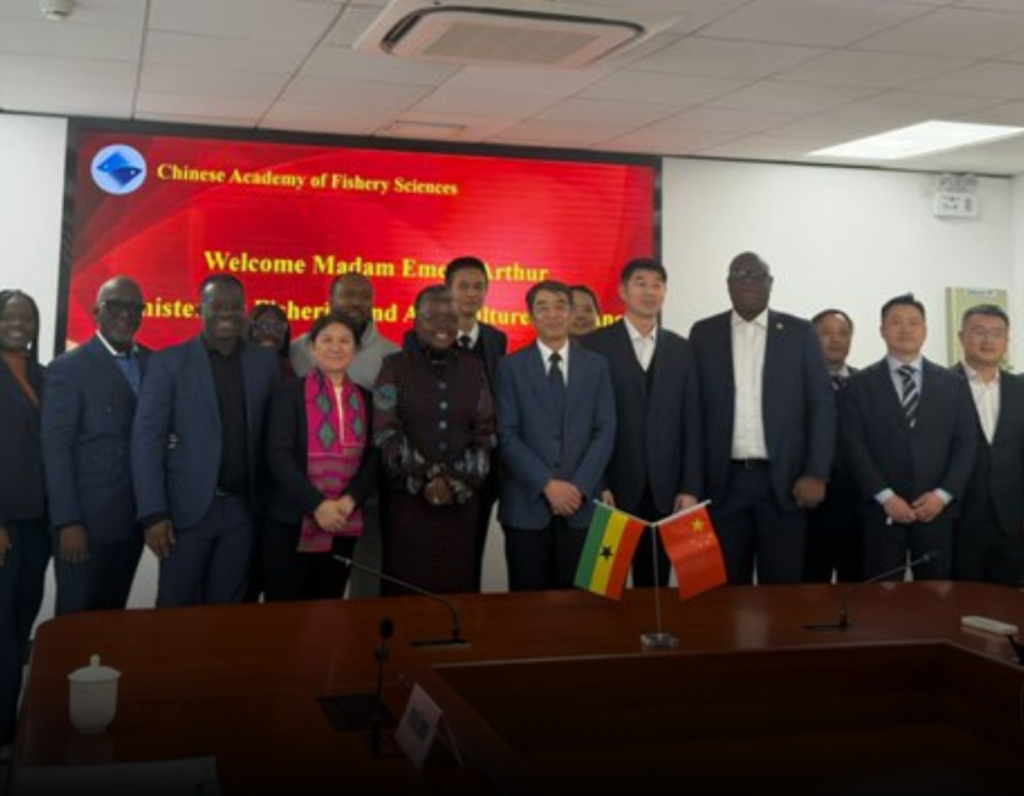
For more than six decades, Ghana-China relations have evolved from political solidarity into a multidimensional development partnership. This week in Beijing, that long-standing relationship entered a new strategic phase as Ghana’s Ministry of Fisheries and Aquaculture Development (MoFAD) held high-level talks with the Chinese Academy of Fishery Sciences (CAFS), positioning fisheries and aquaculture as a core engine of Ghana’s economic transformation.
Led by Fisheries Minister Emelia Arthur, the Ghanaian delegation outlined an ambitious plan to align fisheries reform with the government’s flagship 24-Hour Economy (24H+) agenda, which seeks to unlock productivity, jobs, and exports across key sectors. Fisheries, long constrained by declining stocks and infrastructure gaps, is now being reframed as a growth frontier within Ghana’s Economy.
At the center of the discussions was research-led cooperation. Ghana and China explored joint programmes spanning aquaculture and mariculture expansion, improved capture fisheries management, stock assessments, and stronger responses to illegal, unreported and unregulated (IUU) fishing. Climate resilience, fish disease control, and biosecurity – issues increasingly highlighted by the UN Food and Agriculture Organization (FAO) as critical to Africa’s food systems, also featured prominently in the talks.
According to officials, MoFAD will now steer the next phase of engagement, including the negotiation of a Framework Memorandum of Understanding, the launch of joint research initiatives, and technical missions by CAFS experts to Ghana. A structured pipeline for training and scholarships is also being designed, reinforcing China’s role in capacity building; a model Beijing has consistently promoted under the Forum on China-Africa Cooperation (FOCAC)
The talks also addressed practical bottlenecks in Ghana’s fisheries value chain. Both sides examined opportunities to modernise fish processing facilities, expand cold-chain logistics, and improve access to quality feed systems. These investments are seen as essential to boosting exports and stabilising incomes for fishers, fish farmers, processors, and coastal communities.
This push sits within a broader 66-year Ghana-China strategic partnership that already spans infrastructure, energy, education, health, and industrial development. Chinese-built projects such as the Bui Dam, road networks, and industrial parks have reshaped Ghana’s economic landscape, while cooperation in education – including scholarships and technical training, has produced a growing cadre of Ghanaian professionals with China-linked expertise
Trade ties have also deepened steadily. China remains one of Ghana’s largest trading partners, importing cocoa, minerals, and agricultural products while exporting machinery, electronics, and industrial inputs, flows that underpin Accra’s industrialization drive.
Analysts note that fisheries cooperation represents a strategic pivot: moving beyond hard infrastructure toward knowledge transfer, sustainability, and value addition. Similar China-backed fisheries and aquaculture initiatives in countries such as Egypt and Mozambique have demonstrated how research collaboration can lift productivity while addressing overfishing concerns, according to reports by the World Bank and African Development Bank.
A joint Ghana-China working group is expected to be established by February 2026, with pilot projects targeted for mid-year. For Accra, the message is clear: international partnerships must translate into tangible livelihoods and food security at home. For Beijing, the engagement reinforces China’s evolving Africa strategy, one that increasingly emphasises science, sustainability, and long-term economic resilience.