
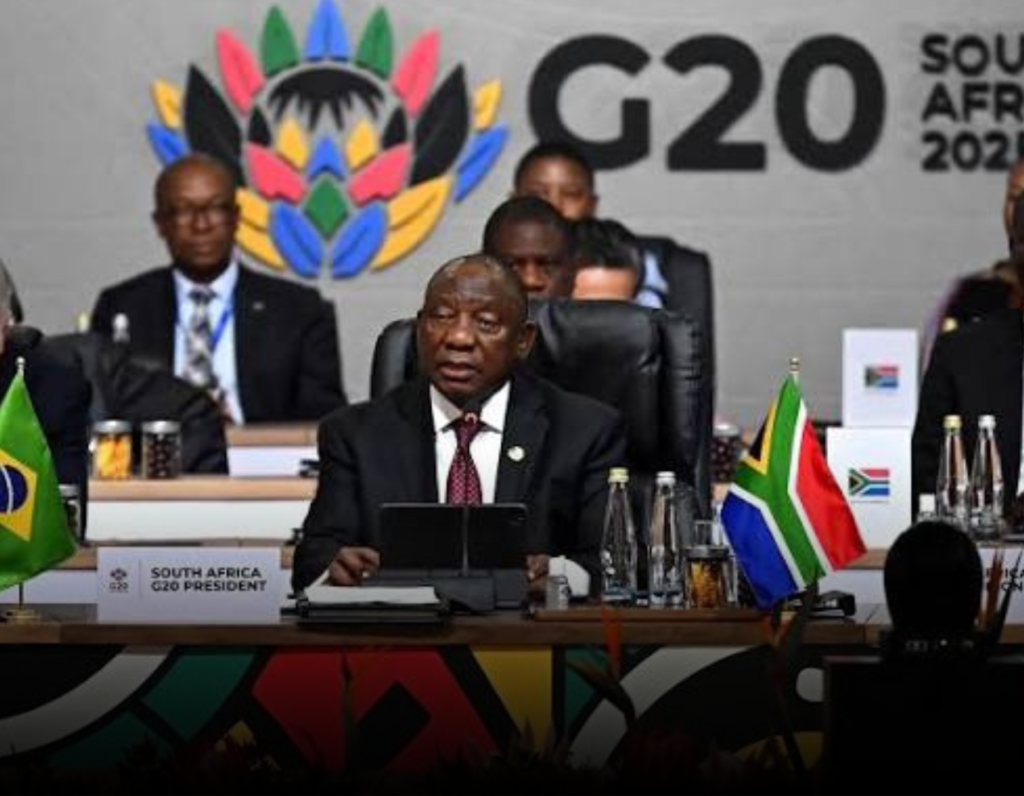
Africa’s formal elevation into the sphere of global governance, most visibly through the African Union’s seat at the Group of Twenty (G20), marks more than a symbolic victory. It reflects a fundamental shift in the architecture of international power where an increasingly multipolar world can no longer afford to sideline the continent’s demographic weight, economic potential, or diplomatic voice.
This evolution was at the centre of discussions at the recent ACCPA–ISPS webinar on Post-G20 Reflections and Africa’s Emerging Global Role, where analysts and policymakers explored what the continent’s G20 role really signifies for the future of global governance. As Professor Christopher Isike puts it, “Africa’s presence in the G20 signals the recognition that global changes cannot be solved without Africa.”
Africa’s inclusion, particularly with the African Union securing a permanent seat, acknowledges this reality. It sends a clear message: global challenges such as climate change, debt restructuring, and sustainable development cannot be solved without Africa’s involvement. The continent’s vast reserves of critical minerals like cobalt, copper and lithium – essential for the global green energy transition, further underlines its strategic importance.
Experts argue that this shift is not simply about representation at high-profile summits. It reflects a broader multipolar transformation of the international system in which power is dispersed more widely among nations of the Global South, including China, India and Brazil – and increasingly, Africa itself. The rise of these actors has reduced the relative dominance of traditional Western powers, such as the G7, challenging old assumptions about who sets the agenda and defines the rules.
Africa’s changing global role is also reflected in its bilateral relationships, which have expanded in scope and strategic depth in recent years, often intertwined with broader multilateral aspirations.
One prominent example is South Africa’s strategic partnership with Vietnam, formalised and deepened around shared interests in trade, investment, and inclusive economic growth. South African leaders have highlighted Vietnam’s potential as a gateway into ASEAN markets, while South Africa offers access to the African Continental Free Trade Area (AfCFTA) – a bloc of over 1.4 billion people.
China remains a major partner for the continent, investing heavily in infrastructure, industrial capacity and development cooperation. Research highlights how Africa-China relations are helping reshape development trajectories within the Global South, potentially realigning global norms and economic patterns.
Meanwhile, broader South Africa-EU cooperation continues to emphasise sustainable development, trade, and democratic governance, illustrating how Africa navigates and balances diverse partnerships to advance its interests in a multipolar world.
Africa’s G20 role is reshaping not only how the continent engages with the world but also how the world engages with Africa. Its growing actorness, characterised by agency, demographic momentum, and strategic assets, is reshaping debates in international institutions from trade and finance to climate and security.
For policymakers and observers, the central challenge remains: how to convert representation into real leverage. This requires continued investment in continental unity, stronger institutions, and a strategic vision that aligns Africa’s bilateral, regional, and global engagements in pursuit of shared interests.
In a world that can no longer ignore Africa, the future of global governance may very well depend on how effectively the continent harnesses its space at the table, not just as a participant, but as a shaper of the rules that govern the global order.