

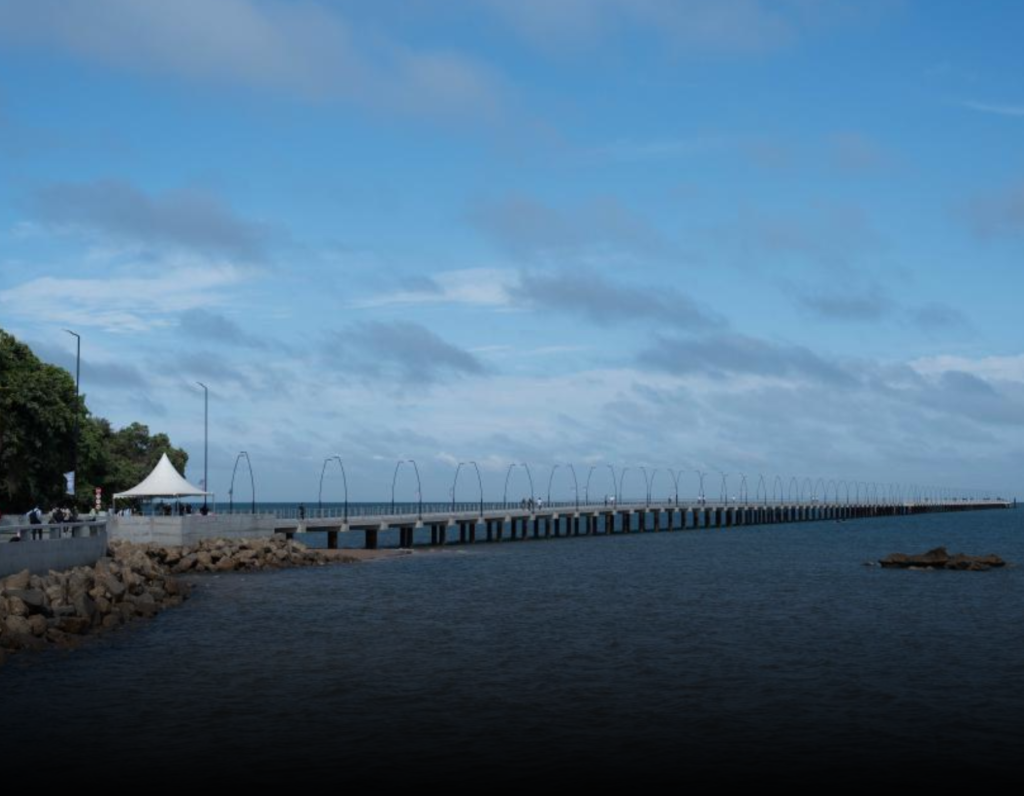
A newly completed jetty bridge built by China Road and Bridge Corporation is expected to transform tourism and economic activity on Inhaca Island in Mozambique, marking another milestone in the expanding infrastructure partnership between Maputo and China.
Mozambican President Daniel Francisco Chapo presided over the inauguration ceremony in early March, unveiling the jetty located in Maputo Bay, about 30 kilometers from the capital Maputo. The structure, stretching roughly 1.3 kilometers into the bay, allows passenger vessels to dock safely despite fluctuating tides and shallow coastal waters.
Speaking during the opening ceremony, President Chapo said the project would enhance mobility and unlock new opportunities for local economic growth, particularly through tourism and related services. Construction also created employment for hundreds of Mozambicans, with many local workers participating in the project at peak stages.
Local tourism operators believe the new infrastructure will immediately improve the island’s attractiveness as a destination. Bruno Chanicomo, a tour guide on the island, noted that easier access could lead to a steady increase in visitors and business opportunities for the community.
The project also incorporated environmental safeguards, reflecting the ecological sensitivity of nearby waters within the Maputo National Park. Developers implemented monitoring programs for air and seawater quality during construction and transported waste back to the mainland for proper disposal.
Analysts say infrastructure such as the Inhaca jetty plays a strategic role in unlocking Mozambique’s coastal tourism potential. The country boasts hundreds of kilometers of Indian Ocean coastline and numerous island destinations, but access challenges have historically limited visitor numbers.
The jetty bridge adds to a growing list of Chinese-supported infrastructure projects across Mozambique. Among the most prominent is the Maputo-Katembe Bridge, the longest suspension bridge in Africa, which connects Maputo to the southern district of Katembe and forms part of a major transport corridor toward the South African border. Construction began in 2014 and the bridge opened in 2018, largely financed by loans from the Export-Import Bank of China and built by the same Chinese contractor.
Officials say the bridge and its accompanying road network have already stimulated tourism and business activity in surrounding districts by improving access to resorts and coastal areas. Local authorities previously reported a sharp increase in visitor numbers and tourism revenue after the infrastructure opened.
Infrastructure development has become a cornerstone of the bilateral relationship between China and Mozambique. Beyond bridges and transport links, Chinese companies and financial institutions have participated in projects spanning energy, port development, agriculture and urban planning.
Mozambique is also part of broader China-Africa cooperation frameworks such as the Forum on China-Africa Cooperation, which has supported funding, trade initiatives and capacity-building programs across the continent. These initiatives have increasingly focused on infrastructure that supports economic diversification, tourism growth and regional connectivity.
For Mozambique, improved transport networks are viewed as essential for unlocking its tourism economy – from island destinations like Inhaca to cross-border coastal routes linking southern Africa.
As travelers begin to arrive via the new jetty, local businesses and tourism operators hope the project will signal the start of a new chapter for Inhaca Island – one in which improved access brings greater investment, visitor numbers and opportunities for the island’s residents.