

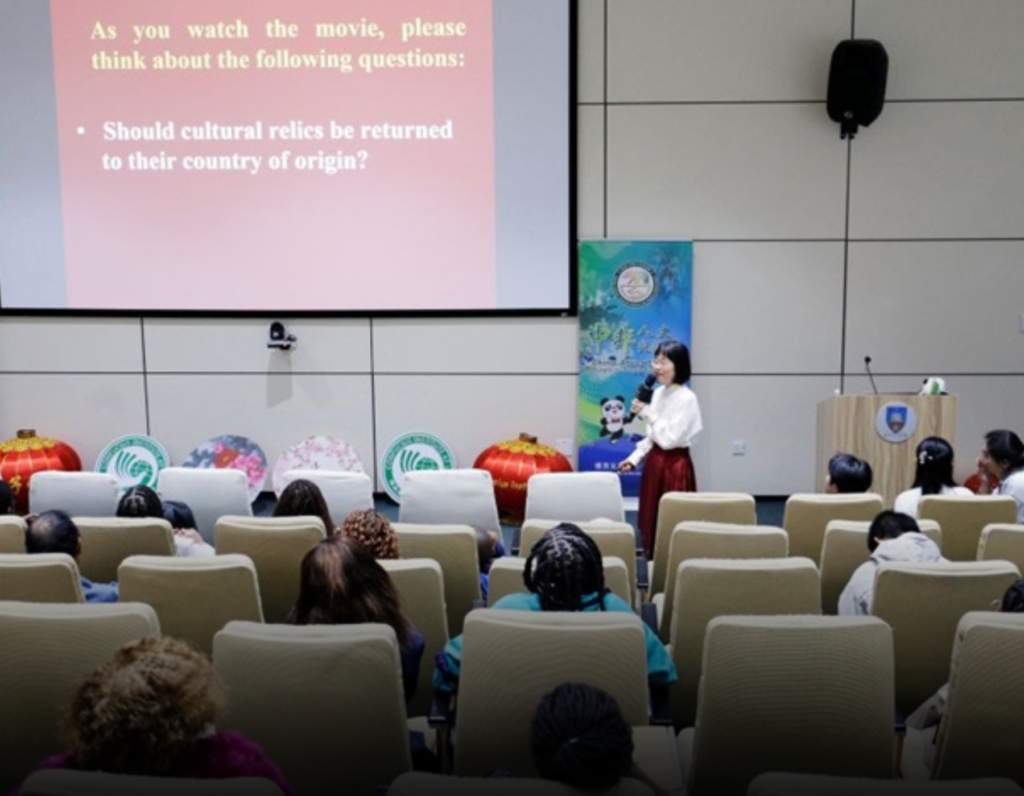
A caper film about a wandering treasure hunter and a set of stolen bronze zodiac heads doubled as a language lesson in Gaborone over the weekend. The Confucius Institute at the University of Botswana used the action movie “CZ12: Chinese Zodiac.” Give local students a hands-on introduction to Chinese history and culture.
The Chinese Film Day event, held Saturday under the theme “Discover China Through Film.” This drew Chinese-language students of all ages, children and adults alike. Designed to sharpen their listening and reading skills in Mandarin, build confidence in spoken Chinese and deepen their broader understanding of Chinese culture. Before the screening, an instructor walked participants through the origins and meaning of China’s 12 zodiac animals. One of the country’s most widely recognized cultural traditions, guiding the group through the correct Mandarin pronunciation of each animal’s name.
The film itself gave students plenty to react to. Centered on the fictional pursuit of looted bronze zodiac relics and the broader theme of returning cultural artifacts to their country of origin. The movie kept participants laughing through its action sequences while introducing a real-world issue. The repatriation of looted cultural heritage that resonates well beyond China’s own borders. A question-and-answer discussion followed the screening. Particular attention paid to the film’s cultural-relics theme and what it means for countries seeking to reclaim lost heritage.
Saturday’s screening is the latest in a long-running program of cultural events run by the Confucius Institute at the University of Botswana (CIUB). It was established in 2008 through a partnership between the University of Botswana and Shanghai Normal University. Growing out of Botswana’s 2006 internationalization policy aimed at building strategic ties with major Asian universities. It was the first Confucius Institute in the country. Later joined by a second at the Botswana International University of Science and Technology in Palapye in 2023.
CIUB has built a packed calendar of similar events over the years, blending language instruction with cultural immersion. From a “Chinese Gongfu” event earlier this year that introduced students to martial arts vocabulary and basic movements. The annual “Chinese Bridge” Proficiency Competition, where students compete in both language skill and cultural performance. At last year’s competition, Chinese Ambassador to Botswana Fan Yong told participants that the Chinese language represents the crystallization of the country’s civilization. Learning it opens a window onto China’s past, present and future. Researchers who have studied CIUB’s role in Botswana describe it as the most active tool of Chinese cultural engagement in the country. Credited with improving perceptions of China among the students it reaches. Even as its footprint remains concentrated mainly on university-connected participants rather than the broader public.
Saturday’s film screening sits within a China-Botswana relationship that has been picking up pace across multiple fronts. The two countries marked the 50th anniversary of diplomatic relations in January 2025. Presidents Xi Jinping and Duma Boko exchanged congratulatory messages to mark the occasion. Ties were elevated to a strategic partnership during the 2024 FOCAC summit in Beijing. Bilateral trade has grown dramatically over the decades since diplomatic relations began in 1975. From less than $500,000 in the early 1980s to more than $1 billion in 2024, a jump of more than 1,500-fold. According to figures from China’s Ministry of Foreign Affairs. That 2024 trade volume represented a 42.1 percent year-on-year increase, driven particularly by a sharp rise in China’s imports from Botswana.
Botswana became the 46th African country to sign a memorandum of understanding on the Belt and Road Initiative in 2021. And cooperation has since expanded into agriculture, healthcare, education and digital infrastructure. A protocol allowing Botswana beef exports to China was signed last year. Part of a broader push by both governments to diversify Botswana’s economy beyond its traditional reliance on diamond exports. China’s zero-tariff policy for African goods, in effect since May 1, 2026. Now covers Botswana’s exports as well, adding fresh trade incentive to a relationship both governments describe in notably warm terms. Grounded, as Ambassador Fan has put it, in mutual respect, equal treatment and decades of what officials on both sides call sincere, traditional friendship.
Saturday’s gathering in Gaborone represented cultural diplomacy at its smallest and most direct scale. A room full of students laughing at an action film, sounding out zodiac animal names in Mandarin. And getting a glimpse, however brief, of the country increasingly shaping Botswana’s economic future. For CIUB and the Chinese Embassy in Gaborone, that kind of steady, low-key programming has become as much a fixture of the bilateral relationship. As the trade figures and ministerial visits that make the bigger headlines.