


Stakeholders from government, financial institutions, regulatory agencies, the private sector and academia have proposed the establishment of a dedicated Ghana–China Zero-Tariff Fund to address financing constraints that could limit the ability of Ghanaian businesses to take advantage of China’s zero-tariff policy.
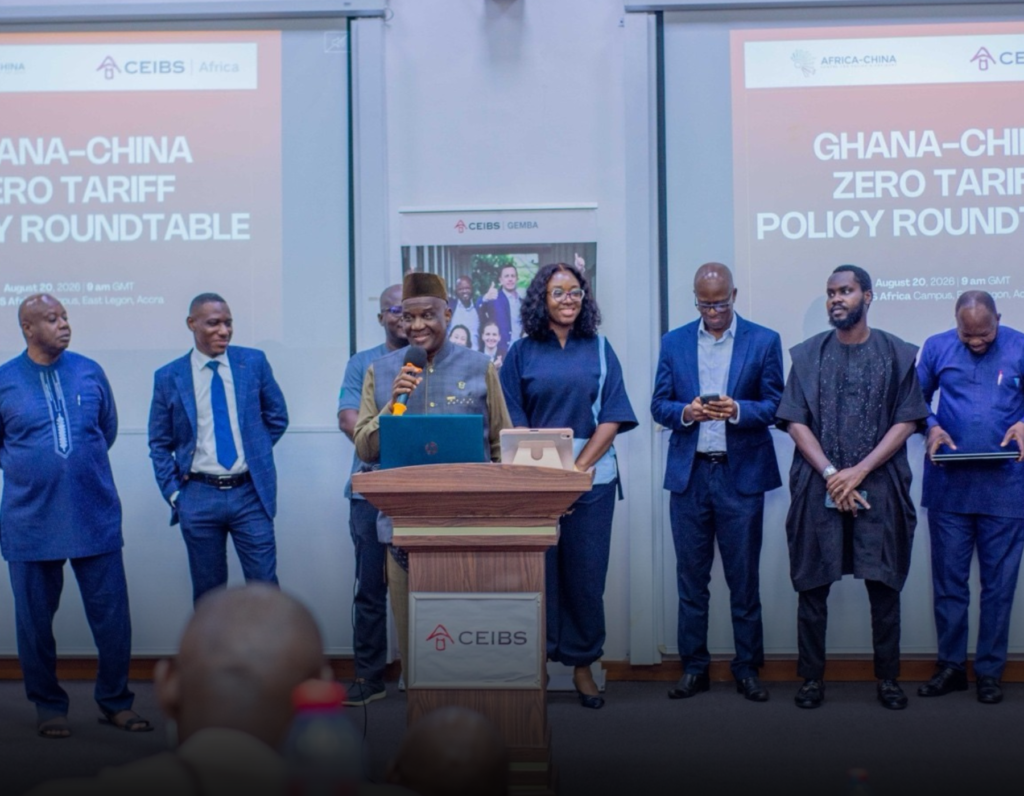
The proposal emerged at the Ghana–China Zero Tariff Policy Roundtable in Accra, convened by the China Europe International Business School (CEIBS Africa) and the Africa–China Centre for Policy & Advisory (ACCPA). The high-level Roundtable brought together Ghanaian and Chinese stakeholders to examine practical barriers to translating expanded market access into increased exports.
During the Roundtable’s interactive Zero Tariff Policy Lab, participants identified access to finance as a critical constraint, particularly for SMEs seeking to increase production, aggregate supply, invest in processing and respond to potential orders from the Chinese market.
Participants consequently proposed a dedicated financing mechanism to support businesses seeking to export under the zero-tariff framework. The discussions also called on financial institutions to look beyond conventional lending and develop products specifically suited to the emerging Ghana–China trade opportunity.
Financing the entire export chain
The discussions suggested that the financing challenge extends beyond providing loans to individual exporters.
Using the cashew value chain as an example, participants noted that firms seeking to increase exports would require financing to aggregate produce from farmers and expand production. Contract farming finance was proposed as one mechanism through which businesses could support outgrowers and secure more reliable supplies.
Participants also highlighted warehouse financing, fintech-enabled financing and equipment leasing as possible instruments for addressing constraints at different stages of the value chain. The role of development finance institutions also featured prominently, with participants questioning how institutions such as Ghana EXIM Bank and Development Bank Ghana could be more effectively deployed to support export-oriented businesses.
Finance linked to production and value addition
A major theme emerging from the discussion was that export finance cannot be separated from Ghana’s productive capacity.
Participants observed that businesses may struggle to take advantage of increased Chinese demand if they cannot secure sufficient quantities of products, finance farmers and aggregators, or invest in processing capacity.
In the cashew case, participants proposed a phased approach that could combine immediate exports with longer-term investment in domestic processing. They also highlighted the potential for Ghanaian–Chinese joint ventures, including partnerships capable of bringing financing, equipment and technology into local production and processing.
The financing discussion therefore pointed to a broader policy challenge: removing tariffs creates market access, but Ghanaian businesses still require the financial capacity to produce, process and deliver competitively.
This suggests that the proposed Ghana–China Zero-Tariff Fund, if taken forward, would need to be considered as part of a wider export-financing ecosystem rather than simply another lending facility.
The Roundtable discussions also highlighted standards and certification, production scale, regulatory requirements, logistics and market linkages as other constraints that must be addressed alongside financing if Ghana is to translate zero-tariff access into sustained export growth.
Ultimately, the proposal emerging from the Roundtable was clear: preferential market access can open the door, but Ghanaian exporters need the financing and productive capacity to walk through it.