

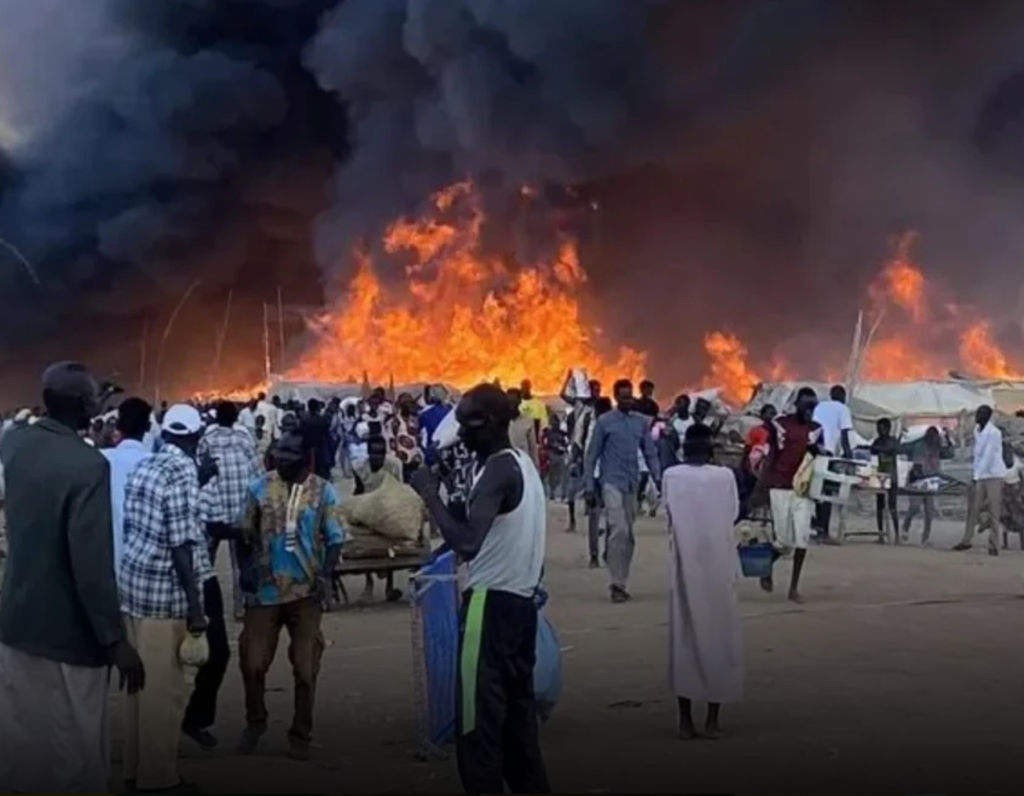
A deadly drone strike on a busy market in the disputed Abyei region between Sudan and South Sudan has killed at least 153 people, according to a local official, intensifying concerns about civilian protection and the growing regional consequences of Sudan’s prolonged civil war.
The attack struck Amiet Market on Monday, October 19, hitting a nearby fuel depot and triggering a fire that was still burning on Tuesday, according to the Associated Press. The market is located north of Abyei town, in an oil-rich territory whose political status remains unresolved between Sudan and South Sudan.
Yohanna Akol Ngor, caretaker information minister for the Abyei administration, blamed Sudan’s military for the attack and warned that the death toll could rise as emergency teams continued to assess the destruction.
South Sudan’s Ministry of Foreign Affairs and International Cooperation also accused Sudan’s armed forces of carrying out the strike. It said drones hit several locations within the market, causing civilian casualties and extensive property damage.
The ministry said it had summoned Sudan’s ambassador to protest the attack and urged Khartoum to refrain from actions that endanger civilian lives and property.
Sudan’s military had not issued an immediate public response to the allegations at the time of the latest reporting. However, a senior Sudanese military officer told the Associated Press that the army had carried out a drone strike targeting fuel tankers arriving from South Sudan that were allegedly bound for the paramilitary Rapid Support Forces (RSF).
The officer maintained that those killed were RSF members and people involved in fuel smuggling, rather than civilians. The Associated Press said it could not independently verify the military’s account of the targets or the identities of those killed.
The competing accounts underscore the difficulty of independently establishing responsibility and the circumstances of attacks in a conflict where both sides have repeatedly accused each other of targeting civilians.
Humanitarian emergency deepens
The United Nations has condemned drone attacks near Amiet Market and Todach, reporting that dozens of civilians, including women and children, had been killed and many others injured.
UN spokesperson Stéphane Dujarric said many people remained missing and the death toll could increase as the United Nations Interim Security Force for Abyei (UNISFA) continued verifying casualties.
UNISFA deployed medical personnel, firefighting capabilities and quick-reaction forces to assist with emergency treatment, evacuate casualties and prevent the fire from spreading.
Medical charity Médecins Sans Frontières (MSF), also known as Doctors Without Borders, said more than 20 wounded people had been brought to Ameth Bek Hospital, where its teams were working alongside South Sudanese health personnel. Some patients were critically injured and others suffered severe burns.
MSF called on all parties to stop attacks on civilians and civilian infrastructure, warning that continued violence could undermine access to healthcare and other essential services.
The attack comes amid a wider escalation of drone warfare across Sudan. Al Jazeera, citing medical personnel and rights groups in a report published on October 19, said more than 160 people had reportedly been killed in attacks across the country in recent days.
Other reported incidents included a strike near a transport hub in West Kordofan, where residents and medical workers reported dozens of deaths, and an attack on a gathering of displaced people in Blue Nile state.
UNICEF has also reported the deaths of at least 12 children in separate recent attacks in Khartoum and West Kordofan, highlighting the dangers facing children and families even in residential neighbourhoods and displacement shelters.
Together, these incidents point to the expanding threat posed by unmanned aircraft in Sudan’s conflict, with attacks affecting markets, homes, displacement sites and other locations essential to civilian survival.
Why Abyei matters beyond Sudan
The attack has implications beyond the immediate battlefield because of Abyei’s contested political status and its position along the Sudan–South Sudan border.
Abyei is claimed by both countries and has remained disputed since South Sudan gained independence in 2011. A 2005 peace agreement envisaged a referendum on the region’s future, but disagreements over voter eligibility prevented the process from taking place.
The region is also economically significant because of its oil resources and its role as a trading area serving the Ngok Dinka and Misseriya communities.
The Amiet Market attack therefore raises concerns about the safety of civilians who depend on cross-border commerce, local markets and transport routes for their livelihoods.
It also exposes the risks associated with the conflict spreading into sensitive border areas, where security incidents can strain relations between neighbouring countries and complicate efforts to maintain peace.
South Sudan’s decision to summon Sudan’s ambassador demonstrates the diplomatic consequences of the incident. Although the two countries have a shared interest in regional stability, the unresolved status of Abyei and the wider Sudanese war create an increasingly difficult security environment.
The alleged use of the area as a supply route for fuel destined for the RSF adds another layer of complexity. The claim, reported by international media through unnamed sources, has not been independently established in all its details.
Nevertheless, the incident illustrates how commercial infrastructure and cross-border supply networks can become entangled in a conflict involving competing armed forces.
Sudan’s war and the growing regional burden
Sudan’s conflict began in April 2023 when fighting erupted between the Sudanese Armed Forces, led by General Abdel Fattah al-Burhan, and the RSF, commanded by Mohamed Hamdan Dagalo, widely known as Hemedti.
The conflict has devastated communities, disrupted essential services and forced millions of people from their homes. It has also placed pressure on neighbouring countries receiving refugees and attempting to manage the wider humanitarian consequences.
The recent wave of drone attacks has heightened concerns that civilians are increasingly exposed to strikes even when they are not directly involved in hostilities.
The destruction of a market is particularly significant because such locations support food distribution, transport, small businesses and other activities on which communities depend. When markets and fuel facilities are damaged, the consequences can extend beyond immediate casualties to disrupt livelihoods and access to essential goods.
The Abyei attack also presents a challenge for humanitarian agencies working to reach injured people and establish the scale of the destruction while fires, security concerns and missing-person reports complicate emergency operations.
Calls for accountability and civilian protection
The immediate priority remains the treatment of survivors, the identification of missing people and an independent assessment of the circumstances surrounding the strike.
The conflicting accounts of the intended target and those killed make credible casualty verification and investigation particularly important.
International humanitarian law requires parties to an armed conflict to distinguish between civilians and combatants and to direct attacks only at lawful military objectives. Parties must also take feasible precautions to minimise civilian harm and refrain from attacks expected to cause excessive civilian losses in relation to the anticipated concrete and direct military advantage.
The presence of a suspected military supply network does not, by itself, remove the obligation to protect civilians in a populated area.
For Sudan and South Sudan, the incident reinforces the need for urgent diplomatic engagement to prevent further violence in Abyei and protect communities living along their shared border.
For the international community, it raises renewed questions about the effectiveness of efforts to contain Sudan’s war, protect civilians and prevent the conflict from destabilising neighbouring territories.
As emergency personnel continue their work in Abyei, the final death toll and the full circumstances of the attack remain subject to verification. What is already clear is that the strike has inflicted a devastating human cost on a community whose security has long been shaped by unresolved political and territorial tensions.
[/ihc-hide-content]