

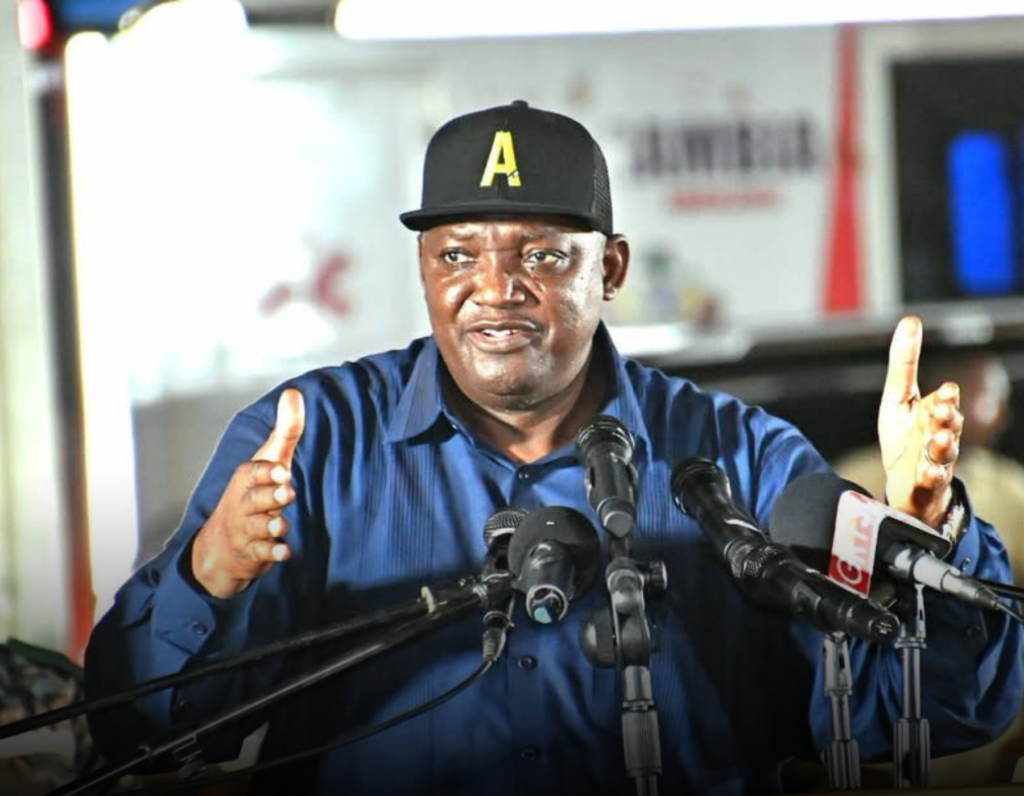
“If he repeats this, he will never do it again. We will do something to him that he will never forget till he dies.”
Those words from Gambian President Adama Barrow have raised questions about the boundaries of political dissent and the protection of democratic freedoms in a country still navigating its post-authoritarian transition.
Barrow made the remarks at a meeting in Banjul marking the conclusion of his nationwide tour, where he sharply criticised Modou Lamin B. Bah, the National Assembly Member for Banjul North, over his involvement in a candlelight protest following prolonged electricity outages in the Greater Banjul Area.
The protest, which drew residents frustrated by recurring power cuts, was widely viewed as a peaceful demonstration aimed at drawing attention to concerns over service delivery.
Addressing the gathering, Barrow described the protest at the gates of State House as a “treasonable offence”, arguing that the lawmaker had mobilised children and young people to participate in the demonstration.
The President further remarked that had such a protest occurred during the administration of former President Yahya Jammeh, protesters could have faced deadly consequences.
The comments attracted criticism from opposition parties, rights advocates and governance observers, who questioned the characterisation of a peaceful protest as an act of treason. Media and civil society monitors argued that statements from a sitting president carry significant weight and could be interpreted as discouraging legitimate democratic expression.
For his part, Bah rejected the President’s assertions, insisting that the demonstration was peaceful, lawful and protected by constitutional guarantees on freedom of assembly and expression.
“We held candles, not weapons,” the lawmaker responded, framing the protest as an attempt to amplify citizens’ frustrations over electricity shortages rather than a challenge to state authority.
The exchange resonated far beyond Banjul.
If the earlier debates surrounding the nationwide tour focused on questions of ethnicity and political identity, the confrontation with the Banjul North lawmaker brought another issue into focus: how public authorities respond to criticism and protest in a democratic society.
That question carries particular significance in The Gambia, where the post-2017 reform agenda has placed considerable emphasis on strengthening democratic institutions, protecting civil liberties and ensuring that citizens can challenge those in authority without fear of reprisal.
The recommendations of the Truth, Reconciliation and Reparations Commission (TRRC), subsequently endorsed in the government’s White Paper, were built around the principle that democratic governance requires not only elections but also respect for fundamental freedoms and dissenting voices.
Viewed in that context, the debate generated by the President’s remarks became about more than a protest over electricity. It became a reflection of a much larger national conversation: whether the democratic culture The Gambia has spent nearly a decade trying to build is strong enough to withstand the pressures of an increasingly competitive election season.