

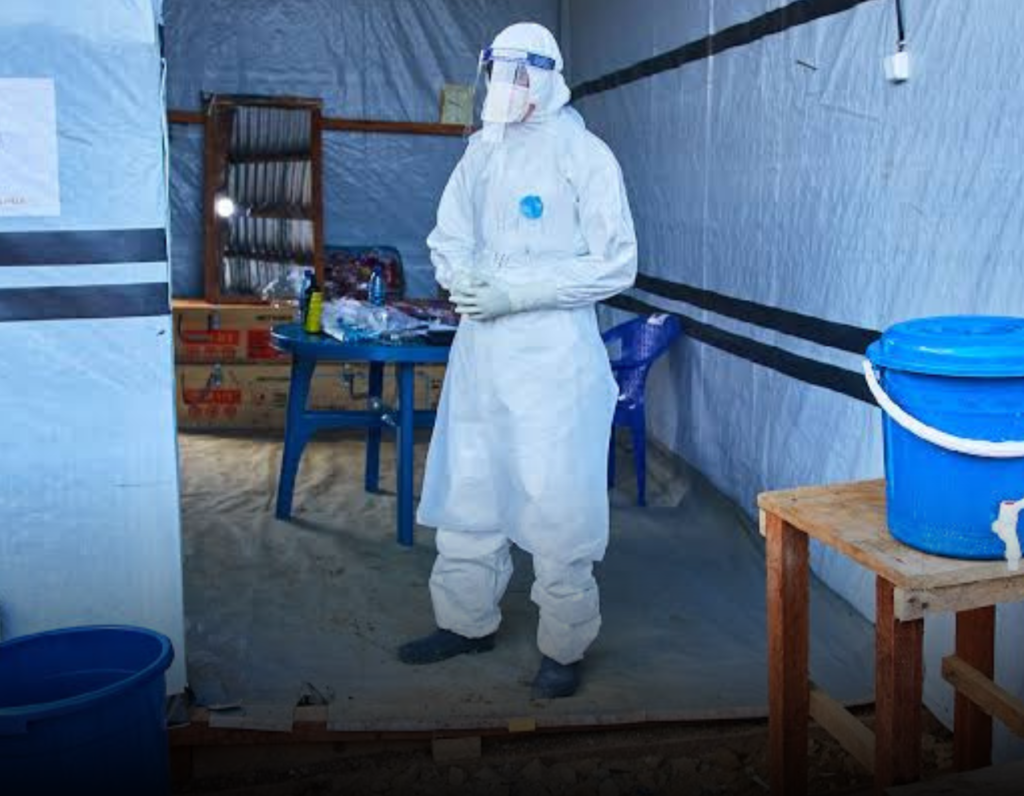
As the deadliest Ebola outbreak to hit central Africa in years continues to strain health systems in the Democratic Republic of the Congo and Uganda, China has stepped up its financial commitment to the response. A move the continent’s top public health body publicly welcomed this week.
Africa Centers for Disease Control and Prevention (Africa CDC) Director General Jean Kaseya met Friday with Jiang Feng, head of the Chinese Mission to the African Union, at the agency’s Addis Ababa headquarters. During the meeting, the two officials signed a handover certificate formalizing a further emergency contribution of $2.5 million from the Chinese government to Africa’s Ebola response, bringing Beijing’s total direct financial support for the outbreak to $4.5 million, Kaseya said in a statement posted on X.
“Today, Africa received a powerful expression of solidarity,” Kaseya wrote, adding that the funding would help “strengthen frontline operations, protect health workers and communities and accelerate efforts to bring the outbreak under control.” He extended his gratitude on behalf of Africa CDC to the Chinese government and people for standing with the continent “at this critical moment.”
Jiang, for his part, described the two sides as good friends and reliable partners, saying Beijing has closely tracked the outbreak since it began and placed real importance on supporting Africa’s response. China’s first $2 million tranche of emergency funding arrived in late June; the additional $2.5 million signed over Friday effectively more than doubled that initial commitment within a matter of weeks.
China’s support hasn’t been limited to financing. Earlier this month, a second Chinese anti-epidemic medical expert team arrived in Kinshasa, the DRC’s capital, to work alongside national authorities on Ebola prevention and control. The team is expected to provide technical support and conduct exchanges across several core areas of outbreak response; epidemiological investigation, laboratory testing, case management, infection prevention and control. Training of local personnel, contributing Chinese expertise to a health system already stretched by conflict, displacement and limited infrastructure in the country’s east.
The outbreak driving this response is a serious one. Confirmed cases are caused by Bundibugyo virus, a species of Ebola with no licensed vaccine and a historical fatality rate estimated between 25 and 50 percent. First identified in DRC’s Ituri Province in May, the World Health Organization declared it a public health emergency of international concern within days, as cases spread into North Kivu and beyond. By mid-July, the DRC had confirmed more than 2,100 cases and over 800 deaths. According to the European Centre for Disease Prevention and Control, making it the deadliest of the DRC’s 17 recorded Ebola outbreaks to date. Uganda’s outbreak, by contrast, has largely been contained to imported cases in Kampala, with the country’s health ministry discharging its last hospitalized patient in mid-July and beginning the 42-day countdown toward officially declaring the outbreak over.
China’s Ebola contribution lands within a China-DRC relationship built substantially, though not exclusively, around mining. The DRC produces the majority of the world’s cobalt and holds significant reserves of copper, lithium and coltan. Chinese firms including CMOC Group, Zijin Mining and Huayou Cobalt already dominate large parts of the country’s mining sector. Beijing remains the DRC’s largest bilateral creditor, a position that has drawn both investment and scrutiny, particularly around historical transparency gaps in Chinese-linked mining deals. A March 2026 mining cooperation agreement between the two governments introduced expanded compliance and monitoring mechanisms alongside commitments to expand local mineral processing capacity, while Congolese cobalt exports gained duty-free access to the Chinese market under Beijing’s zero-tariff policy for African goods, which took effect in May 2026.
That resource-driven relationship has periodically drawn criticism from civil society groups and some Western analysts over the balance of benefits between extraction and local development. China’s health diplomacy in the DRC including the Ebola response, medical team deployments and broader public health cooperation across the continent through Africa CDC has often been framed by Chinese officials as evidence the relationship extends well beyond resource extraction into genuine partnership on issues directly affecting African communities. Chinese medical missions elsewhere on the continent, including decades-long teams stationed in Rwanda, Tanzania and Zanzibar follow a broadly similar model of embedded, longer-term cooperation rather than one-off emergency response alone.
For health workers currently battling the outbreak on the ground in Ituri and North Kivu, the immediate significance of Friday’s signing is more practical than geopolitical: additional funding, additional expertise and one more international partner formally committed to helping bring a still-active, still-lethal outbreak under control.