

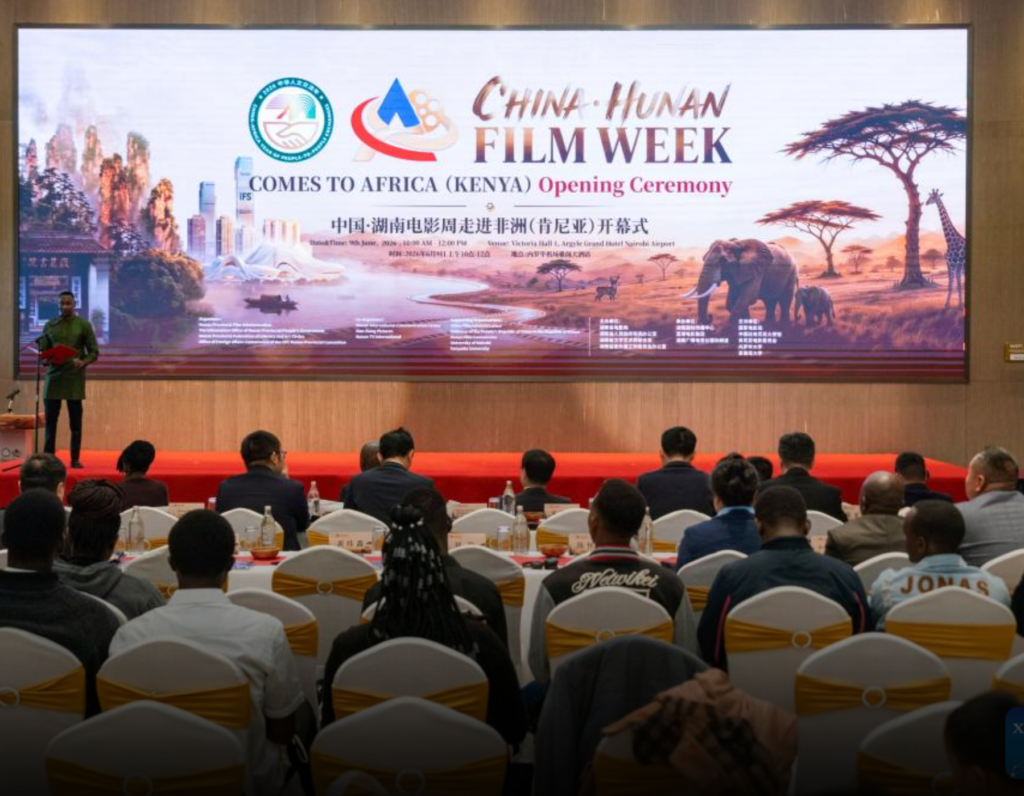
China and Kenya are expanding their growing cultural partnership through film and television cooperation, opening new opportunities for creative exchange, skills development, and joint storytelling between the two countries.
The renewed momentum was highlighted during activities linked to Hunan Film Week Africa (Kenya), where a delegation from China’s Hunan Province visited the University of Nairobi to engage government officials, academics, and industry professionals on future collaboration in the creative economy. The initiative formed part of broader efforts to strengthen people-to-people ties through culture and media.
The engagement placed particular emphasis on cooperation in film production, television development, digital content, and emerging media platforms.
Speaking during the exchanges, Luo Zhengmao, deputy director of the Information Office of the People’s Government of Hunan Province, said the performing arts – particularly film and television – are becoming a major pillar of China-Kenya cooperation.
He noted that both sides are exploring how streaming services, social media platforms, and short-form video content can create fresh opportunities for co-productions, copyright collaboration, and innovative content distribution, particularly for young African and Chinese creators.
Kenyan stakeholders welcomed the initiative as an investment in the future of the country’s fast-growing creative sector.
Jack Odhiambo, Dean of the Faculty of Arts and Social Sciences at the University of Nairobi, said existing cooperation with Hunan Province has already contributed to mentoring and professional development for emerging television and film producers.
He pointed to the successful launch of the first season of “Sing for Africa” in late 2025 – a musical talent platform designed to identify and promote young African artists while encouraging deeper cultural engagement between China and Africa.
At the official opening of China–Hunan Film Week in Nairobi, government officials and cultural leaders described the event as more than a showcase of cinema.
“This Film Week represents much more than a series of screenings. It represents an opportunity for dialogue, learning, and collaboration,” said Noah Otiende, Director of Kenya’s Department of Film Services. He added that such initiatives create opportunities for filmmakers, students, and creative professionals to exchange ideas and build lasting partnerships.
The week featured film screenings, artistic performances, and exhibitions spanning music, photography, painting, and calligraphy – offering Kenyan audiences a window into Chinese culture while encouraging cross-cultural creativity. Eight Chinese films, including productions from Hunan Province, were presented during the program.
Industry leaders also emphasized the economic potential of cultural cooperation.
Timothy Owase, CEO of the Kenya Film Commission, described film as a bridge capable of connecting industries and audiences across borders.
“This week is not just about screening brilliant cinematic works from Hunan. It is about building bridges. It is about creating opportunities for Kenyan and Chinese filmmakers to collaborate, share technical expertise, and co-create stories that resonate globally,” he said.
The growing collaboration in media and entertainment reflects broader China–Kenya relations that extend far beyond culture.
Over recent years, the two countries have strengthened cooperation in trade, infrastructure, tourism, education, digital innovation, and industrial development. China remains one of Kenya’s largest trading partners and has supported major projects including transport infrastructure, energy development, and urban connectivity.
Cultural engagement has become an increasingly important pillar of this relationship. The China–Kenya Culture and Tourism Season, launched in 2025, expanded collaboration across media, heritage, tourism, education, and performing arts while promoting stronger people-to-people connections.
As both countries invest more deliberately in creative industries, film and television are emerging not only as cultural tools – but as economic drivers capable of creating jobs, nurturing talent, and bringing African and Chinese stories to wider global audiences.
For China and Kenya, the next phase of cooperation may not only be built through roads and trade – but also through cameras, scripts, and stories.