

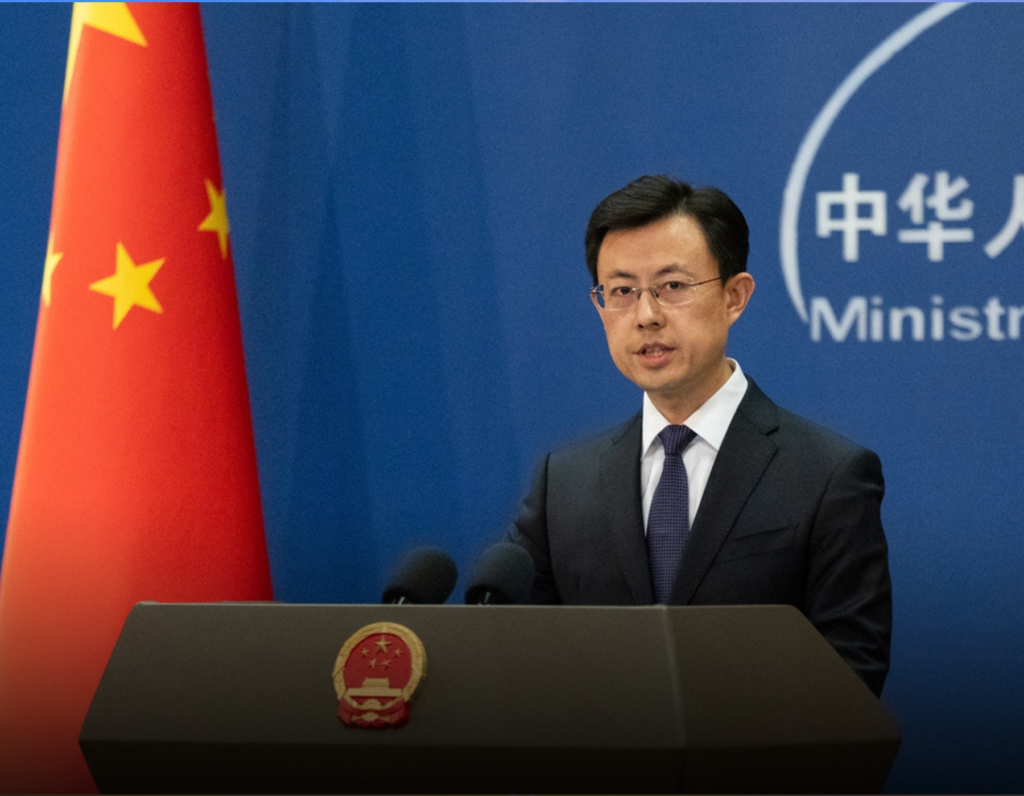
China has reaffirmed its commitment to deepening cooperation with Africa, with Chinese Foreign Ministry spokesperson Guo Jiakun expressing hope that all African countries will become active participants in China-Africa cooperation and benefit from China’s expanding development opportunities.
Speaking during a regular press briefing in Beijing, Guo said China-Africa cooperation has continued to gain momentum under frameworks such as the Forum on China-Africa Cooperation (FOCAC) and the Belt and Road Initiative (BRI), contributing to industrialization, agricultural modernization, infrastructure development, and broader economic transformation across the continent.
China hopes all African countries will join the big family of China-Africa cooperation, Guo said, while emphasizing Beijing’s intention to pursue “common modernization” alongside African nations.
The remarks come shortly after China officially implemented a zero-tariff policy for imports from 53 African countries that maintain diplomatic relations with Beijing. The measure, which took effect on May 1, is widely seen as one of China’s most significant trade openings toward Africa in recent years.
Under the arrangement, qualifying African exports can now enter the Chinese market duty-free, potentially boosting trade in agricultural products, manufactured goods, textiles, minerals, and processed commodities. Several African governments – including Botswana, Ghana, Kenya, Namibia, and Tanzania – have already described the policy as a major opportunity to expand exports and diversify local economies.
Chinese officials say the policy reflects Beijing’s broader strategy of strengthening South-South cooperation at a time of rising global protectionism and economic uncertainty. According to China’s foreign ministry, the initiative is intended not only to expand trade, but also to support long-term development and economic resilience across Africa.
The announcement also underscores the growing strategic importance of Africa in China’s foreign policy. In January, Chinese Foreign Minister Wang Yi visited four African countries as part of the long-standing diplomatic tradition in which China’s foreign minister makes Africa the destination of the first overseas trip each year – a practice now continuing for more than three decades.
This year additionally marks the 70th anniversary of the start of diplomatic relations between China and African countries, while 2026 has been designated as the China-Africa Year of People-to-People Exchanges. Chinese officials say the initiative aims to deepen cultural, educational, and social ties alongside economic cooperation.
China currently maintains diplomatic relations with 53 African countries, with Eswatini remaining the only African nation that recognizes Taiwan instead of Beijing.
Analysts say China’s renewed emphasis on Africa reflects both economic and geopolitical priorities. Africa has become a key partner for Beijing in trade, infrastructure development, energy cooperation, digital technology, mining, agriculture, and logistics under the Belt and Road Initiative. At the same time, African countries are increasingly seeking more balanced partnerships focused on industrialization, value addition, skills transfer, and local job creation.
Trade between China and Africa has expanded rapidly over the past two decades, making China Africa’s largest bilateral trading partner. Major cooperation projects now stretch across railways, ports, industrial parks, renewable energy, telecommunications, and public health systems in multiple African countries.
Observers note that the latest zero-tariff policy could further accelerate that shift by encouraging African exporters to move beyond raw commodity exports toward processed and value-added products aimed at the Chinese consumer market.
The Forum on China-Africa Cooperation, established in 2000, remains the primary platform guiding Beijing’s engagement with African states. Through FOCAC, China has financed infrastructure projects, expanded agricultural cooperation, provided technical assistance, supported industrial parks, and strengthened educational and healthcare partnerships throughout the continent.
While opportunities continue to grow, experts also point out that African governments are increasingly seeking stronger local participation, technology transfer, and more sustainable financing structures within China-backed projects. Recent policy discussions across the continent have focused on ensuring that future cooperation generates broader long-term benefits for African economies rather than reinforcing dependency on raw material exports.
Still, Beijing’s latest message signals that China intends to keep Africa at the center of its global development strategy – positioning the relationship not simply as trade cooperation, but as part of a broader vision for shared modernization across the Global South.