

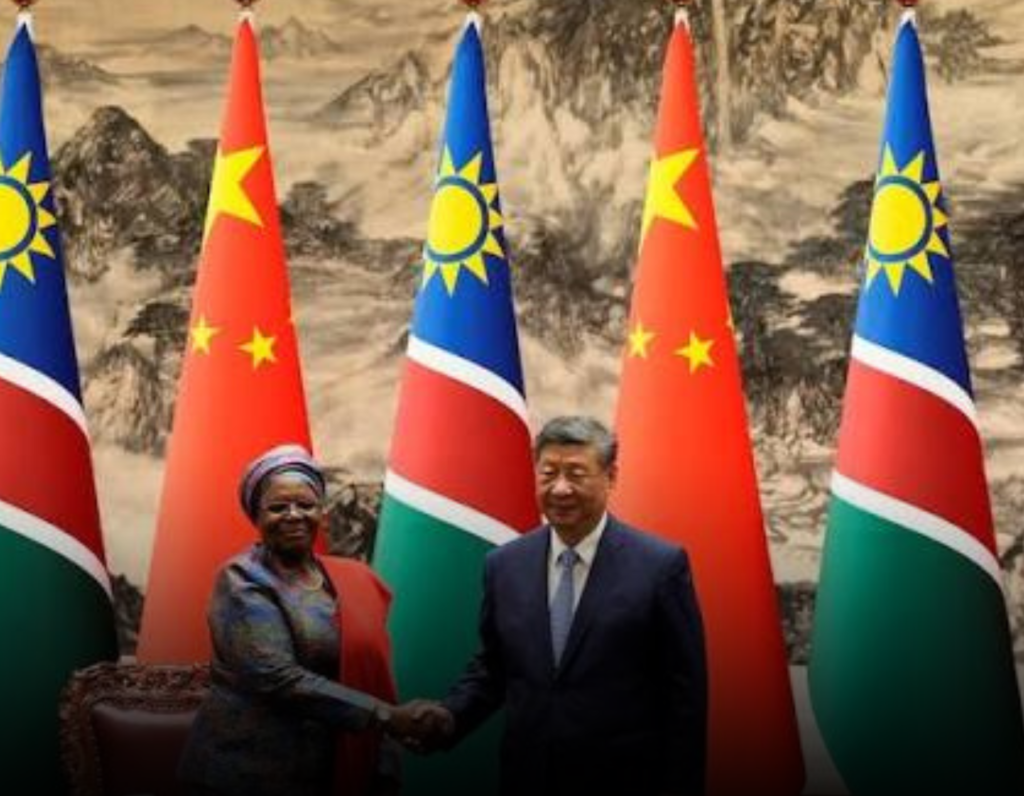
Namibia and China just upgraded their relationship on paper. The harder question, according to one of Namibia’s leading economists, is whether that upgrade actually changes what gets built on the ground.
Speaking to Xinhua, Namibian economist Indileni Nanghonga argued that the real test of the newly elevated China-Namibia partnership lies in whether it shifts the country’s economic model beyond raw commodity exports. “The real opportunity is not simply to export more commodities, but to use Chinese investment to expand manufacturing, mineral beneficiation and other value-added industries,” she said. She pointed to agriculture, renewable energy and skills development as areas where deeper cooperation could lift productivity, generate jobs and help diversify an economy still heavily weighted toward mining and mineral exports.
The upgrade Nanghonga was responding to came out of Namibian President Netumbo Nandi-Ndaitwah’s state visit to China from July 5 to 11, during which she and President Xi Jinping jointly announced the elevation of bilateral relations to a “China-Namibia community with a shared future for the new era.” Xi told Nandi-Ndaitwah during their talks in Beijing that the two countries share a profound traditional friendship and have consistently treated each other as equals since establishing diplomatic ties, according to Xinhua’s account of the meeting. The two governments agreed to deepen cooperation across industry, mining, energy, agriculture, infrastructure, science and technology. Signed a joint statement in which China voiced support for Namibia’s industrialization drive and reaffirmed backing for the country’s sovereignty and development path.
Nanghonga singled out one area of cooperation she believes has been underappreciated: space technology. Earlier this year, China handed over the first phase of a satellite ground data receiving and processing system in Windhoek. This gives Namibia the ability to draw on satellite data for agriculture, disaster response, environmental monitoring and infrastructure planning. “Space technology should be viewed as an economic productivity tool rather than merely a scientific ambition,” she said. Arguing that satellite applications, remote sensing and geospatial data could support precision farming, crop monitoring, irrigation planning and drought preparedness in a country regularly battered by dry spells.
She extended that logic to Namibia’s renewable energy and green hydrogen ambitions specifically, suggesting the same satellite and geospatial tools could help identify optimal sites for solar and wind projects, monitor water resources, and plan the transmission and export infrastructure those industries will eventually need. Namibia has positioned itself as an aspiring green hydrogen hub in recent years, banking on its wind and solar resources to attract international investment. An ambition Nanghonga suggested Chinese technology could help de-risk and accelerate.
Nanghonga was careful to frame investment and infrastructure as necessary but not sufficient on their own. She cited ongoing agricultural cooperation conducted under the South-South cooperation framework as a model for how technical training and knowledge-sharing can be built directly into investment deals, rather than treated as an afterthought. She called for Namibia to strengthen policies supporting industrial development and to ensure foreign investment translates into genuinely sustainable diversification. Alongside closer coordination between universities, research institutions and industry to build the technical expertise higher-value industries will require.
“Infrastructure and investment can stimulate growth, but sustainable development depends on Namibians having the skills to operate, maintain and improve new technologies,” she said. A caution that echoes a broader debate playing out elsewhere on the continent, where economists and manufacturers alike have argued that African countries should study China’s industrial rise rather than attempt to copy it wholesale, adapting the underlying lessons on planning, coordination and skills transfer to their own circumstances.
The “shared future” designation places Namibia among a smaller group of African countries to hold that particular tier of partnership with Beijing, building on a Comprehensive Strategic Cooperative Partnership. Namibia’s state visit followed the 2024 Forum on China-Africa Cooperation summit in Beijing, and China has remained Namibia’s largest overall trading partner, with bilateral trade reaching roughly N$40.64 billion (about $2.2 billion) in 2025 and continuing at strong momentum into 2026. Though officials on both sides acknowledge that trade structure still leans heavily on Namibian mineral exports against imports of Chinese machinery and industrial goods, precisely the imbalance Nanghonga’s beneficiation argument is aimed at correcting.
The visit also touched on infrastructure, housing, healthcare, water security and education, areas where Chinese-backed projects have already taken root in Namibia. China’s zero-tariff policy for African exports, which took effect in May 2026 and covers all 53 African nations with diplomatic ties to Beijing, applies to Namibian goods as well, adding a trade incentive layer to the diplomatic upgrade. Both countries have also committed to advancing cooperation through the Belt and Road Initiative. Per the joint statement issued after the Beijing talks, to support global governance reform and South-South cooperation more broadly.
For Nanghonga, the diplomatic language matters less than what follows it. A satellite data center, an elevated partnership status and a renewed commitment to industrial cooperation are only as valuable, in her framing, as the mineral processing plants, trained technicians and diversified export lines. The difference, as she put it, between exporting more commodities and building the industries that turn them into something worth more.