

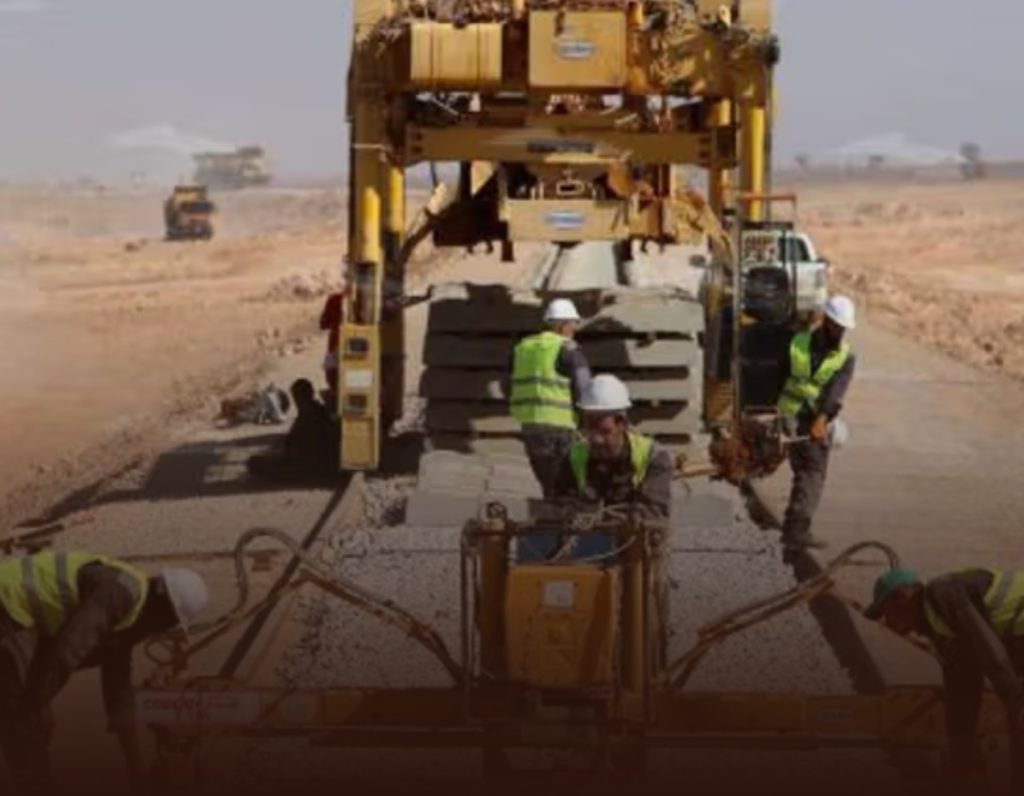
A historic engineering achievement has been recorded in North Africa as a Chinese construction firm completed the track installation for Algeria’s Western Mining Railway, the continent’s first heavy-haul line through desert terrain. The milestone underscores deepening China-Algeria cooperation in transport infrastructure and sets a new benchmark for trans-Saharan connectivity.
Stretching 575 kilometres across the expanse of the Sahara Desert, the Western Mining Railway was constructed through a joint effort by China Railway Construction Corporation (CRCC) and Algerian state-owned enterprises. After more than 24 months of construction under extreme heat and shifting sands, workers completed the mainline track installation three months ahead of schedule, laying and welding more than 580 km of rail and producing 1.1 million concrete sleepers adapted to local standards.
CRCC’s engineers introduced Algeria’s first CPG500 track-laying machine and its first automated rail-welding line, innovations that boosted efficiency and quality control in some of the most demanding conditions on the continent. The railway is designed to support freight trains with 32.5-tonne axle loads and passenger services capable of reaching 160 km/h, positioning it as a modern backbone for inland transport.
The new railway is a flagship Belt and Road Initiative (BRI) infrastructure project, intended to link key mining zones, industrial hubs, and port facilities in southwestern Algeria. The line will significantly enhance transport logistics for iron ore and other natural resources, including the vast Gâra Djebilet iron ore belt, one of the world’s largest deposits, by providing a reliable link from inland production centres to export gateways on the Mediterranean coast.
Algerian officials say the railway will not only improve freight efficiency and reduce logistics costs but also stimulate regional economic development, strengthen industrial clusters and generate employment. The project has already created thousands of local jobs, combining employment generation with skills training and capacity building for Algerian technicians and operators.
The Western Mining Railway is part of a broader pattern of China’s infrastructure partnership with Algeria under the BRI framework. Previous milestones include Chinese involvement in urban transport, energy infrastructure, and industrial upgrades that have reinforced Algeria’s economic diversification priorities. Additionally, Chinese construction firms have completed complex structures such as the PK330 Bridge, Africa’s longest heavy-haul railway bridge, demonstrating technological transfer and collaborative engineering capability in harsh desert environments.
China’s infrastructure footprint across Africa also includes major railway projects such as the Tanzania-Zambia Railway Authority (TAZARA) line, originally built with Chinese support and now undergoing rehabilitation to modern standards, and the Ethiopia-Djibouti Railway, which has enhanced trade corridors in East Africa. These projects have fostered economic integration, improved regional connectivity, and helped diversify transport options beyond road networks.
Completing the full track installation of Africa’s first heavy-haul desert railway highlights how collaborative infrastructure projects can transform regional development prospects. By combining Chinese engineering capacity with local labour and technical expertise, the Western Mining Railway initiative illustrates the tangible benefits of international cooperation, from job creation and capacity building to enhanced logistics and export competitiveness.
As the Western Mining Railway moves toward full operationalisation, it is expected to accelerate trade flows, support industrial expansion and serve as a model for future rail lines across the continent. For Algeria and its partners, this achievement is not only a logistical breakthrough but a strategic asset that will reinforce economic linkages and support long-term prosperity.